Over the time that I worked as a police officer and then as a gunwriter, I have informally tried to determine where, when and by whom fighting pistolcraft began. In the course of that search, I have come up with a great deal of disconnected information on the subject, but it was only in fairly recent times that any linear progression of data could be derived. In other words, until a particular point in history, I can't tell you of any instance where any student of the fighting handgun was ever obviously influenced by a predecessor or teacher. You could argue that the techniques involved became history when someone began to write them down—which is pretty much the definition of history. I think it might be closer to precision to say history began when somebody thought it was important enough to write it down.
Look at it this way. Although the first practical repeating handguns saw limited use as early as 1836, they were pretty much a novelty until the Civil War era. The armies involved in that conflict were faced with fighting over vast amounts of ground and therefore used a great deal of cavalry. Cavalry formations had much greater mobility and often did their fighting at very close range. Equipped with powerful single shot carbines and sabers, the cavalry soldier was ominous, but give him a powerful six-shot revolver and he was formidable. Give him a pair—or several pair—and he was near unbeatable. Literally, the use-with-one-hand revolver was a significant arm as the war raged on, a “force multiplier” in today's jargon. There are many accounts of soldiers in blue or gray (or both) equipped with multiple Colts or their clones. The horse carried most of the weight. But nowhere do I find any description of any kind of formalized training in using those guns. It was probably informal (here, Jake, do it this way!) or nobody thought it was important enough to be ... ah, history.
In the period of western expansion or Frontier era, there was surely a lot of handgunning going on, but outside the military, little recorded training. This is not to say that pure marksmanship training wasn't being conducted. As a matter of fact, there are several books written by obviously knowledgeable people that include discussions of very good bullseye shooting techniques. It was in the waning years of the Frontier era that we saw the beginning of international handgun competition. This is not defensive or combat handgun training. I have seen some early cavalry manuals that depict methods of handling a revolver by mounted soldiers. Certainly, this is a part of the combat shooting picture, but it is not the complete story. As much as the revolver is associated with the American West, it was also used in many other locales around the world, so it is entirely possible to find training references in other languages.
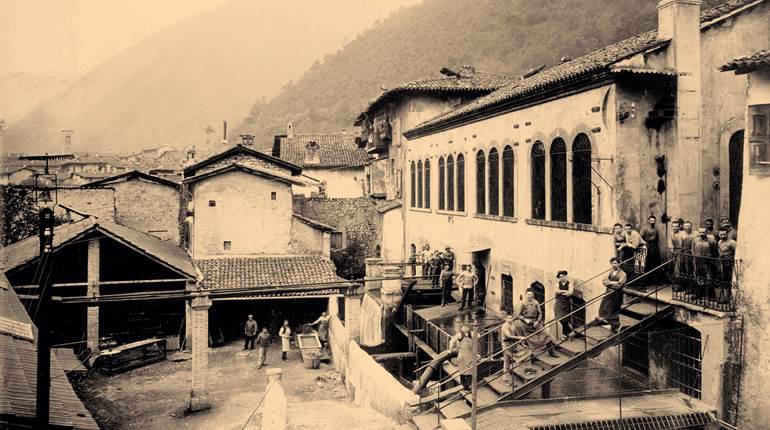
However, history does record an event that developed into organizational handgun training of the highest order. In the 1850s, a unique police department came into being. It was the Shanghai Municipal Police, formed to police the International Settlement of that city. The government of China literally conceded governmental control of major portions of the city to foreign governments who had business interests there. In this curious situation, government was the Shanghai Municipal Council and this multi-national body saw the need for an effective police department to keep order in a crowded Asian port city. With the British influence in control, this agency evolved into a group of men who were able to keep the peace—with difficulty. The SMP existed for almost a hundred years, as the nation of China went through a series of violent upheavals. This lasted until WWII.
Personnel of the SMP came from young Britishers in their kingdom's colonial service, big Sikhs from India and locally recruited Chinese. In the early 1900s, a former Royal Marine named William Fairbairn joined the force and worked his way up through the ranks. His specialty was close combat, both armed and unarmed. Moreover, Fairbairn was a writer who carefully recorded the evolving art of close quarters shooting as he both developed it on the training ranges and practiced it in the course of leading police operations.
When you look carefully at his techniques and compare them to what is taught today, the similarities are clear. Fairbairn may not have been the first guy to teach combat shooting, but he is almost certainly the first to make it history.
Most Popular