Gun: Pocket Model 1849
Manufacturer: Colt Patent Firearms Manufacturing Co. (London, United Kingdom)
Caliber: .31
Manufactured: 1855
Condition: NRA Excellent (Antique Gun Standards)
Value: $4,950 (As cased, with accessories)
The 1849 Pocket Model was one of Colt’s most successful revolvers, being produced in greater numbers than any other of the company’s percussion-cap guns. Introduced during the first years of the California Gold Rush, it had the added distinction of having put Colt solidly in the black, as this diminutive, .31-caliber, five-shooter became a valued companion of argonauts heading west.
Manufactured between 1850 and 1873 (and later chambered for six rounds), some 325,000 Colt Pockets were eventually made. Basically an improved version of Colt’s earlier Model 1848 Pocket Revolver, also known as the “Baby Dragoon,” the ’49 was updated with the addition of an integral under-barrel loading lever, a roller on the base of the hammer for smoother cocking and a rounded trigger guard that reduced snagging on clothing when being brought into action. To enhance its marketability, the gun’s cylinder was roll-engraved with a dramatic stagecoach hold-up scene.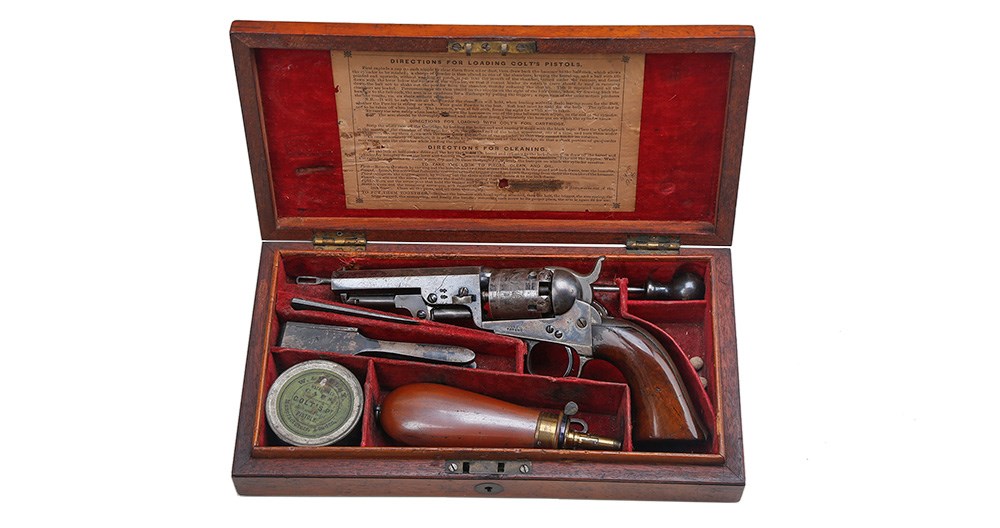
Over its lifetime, the Model 1849 was available with a considerable variety of options. Barrel lengths were 3, 4, 5 or 6 inches, with 4 inches being the most common. The usual finish was a blued barrel, cylinder, trigger and screws and a case-hardened frame, hammer and loading lever. A silver-plated, brass trigger guard and backstrap and varnished walnut grips completed the package. Like other Colt products, the ’49 Pockets could be ordered with special features such as exotic finishes, intricate engraving and exotic wood or ivory stocks. Single or multiple gun cases with full accessories were not uncommon.
Initially produced at Colt’s Hartford, Conn., factory, ’49 Pocket serial numbers began around 12,000, toward the end of the Baby Dragoon’s lifespan. Both were made side-by-side and shared numbers for a few months in 1850, after which the Baby Dragoon was discontinued.
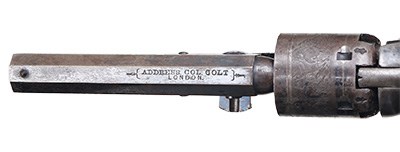 Ambitious and entrepreneurial, Samuel Colt was ever-interested in expanding demand for his products overseas. In 1851, he presented an impressive display of the company’s line at the Great Exhibition in London. Many of his British and Continental rivals at the fair, though extolled for their quality and inventiveness, lacked two main advantages in which Colt’s guns excelled—interchangeability of parts and efficient production methods.
Encouraged by his generally positive reception at the show, and always anxious to gain elusive government contracts, Colt, in 1853, opened a factory in London’s Pimlico district. Here, he would produce Colt Model 1851 Navy revolvers, Model 1849 Pockets and a small number of 3rd Model Dragoon .44s assembled mostly from Hartford parts. Recognizing the English upper-class familiarity with elegantly constructed firearms, Colt’s Pimlico pieces were finished to a higher standard than those made and sold in America. London bluing displayed a deeper, more-lustrous hue and the case-hardening was more radiant.
About 5,000 London-built 1851 Navy revolvers were purchased by Her Majesty’s War Department (and an unknown number were acquired privately by British military types) and saw use in the Crimean War and Indian Mutiny. Despite some favorable domestic testimonials by gentlemen, serving officers and such luminaries as Charles Dickens, authorities eschewed Colt’s .36-caliber single-action Navy in favor of the double-action English .442 Beaumont-Adams. Commercial sales were simply not enough to keep the costly London establishment afloat. Colt closed his overseas factory in 1856 after a scant four years of operation.
The London Model 1849, while of secondary importance to the Navy, was still an important product and sold well, some 11,000 of them being made; about two-thirds less than the total number of Model 1851s. Like the ’51, British Pockets can be found with either silver-plated brass or blued iron trigger guards and backstraps.
The London Colt Pocket Model seen here is in excellent condition, retaining approximately 50 percent of its original bluing. Most of its case-hardening has minimal fading. Its cylinder scene is crisp and deep, and the mechanics are perfect. The 4-inch-barreled revolver is English-oak-cased with original accessories. A London ’49 in this shape, on its own, would be worth $2,150. The case and accoutrements add another $2,800, bringing the value of the outfit to $4,950.
Most Popular