While AR-style rifles are now well-established—those who initially rejected Stoner’s black rifle have not only lost the battle, they’ve lost the war—there remains legitimate debate regarding the suitability of the 5.56x45 mm NATO chambering for certain roles. Sometimes bigger is better, and the 7.62x39 mm cartridge fires a wider and heavier bullet than the 5.56x45 mm. Manufacturers struggled for years, with limited success, to engineer a solution to feed the short, fat and inexpensive cartridge of the East into the carbine of the West. With the emergence of the CMMG Mk47, we see an effective melding of the 7.62x39 mm Russian cartridge with America’s rifle—the AR.
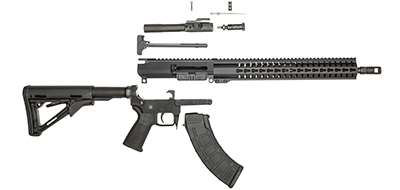
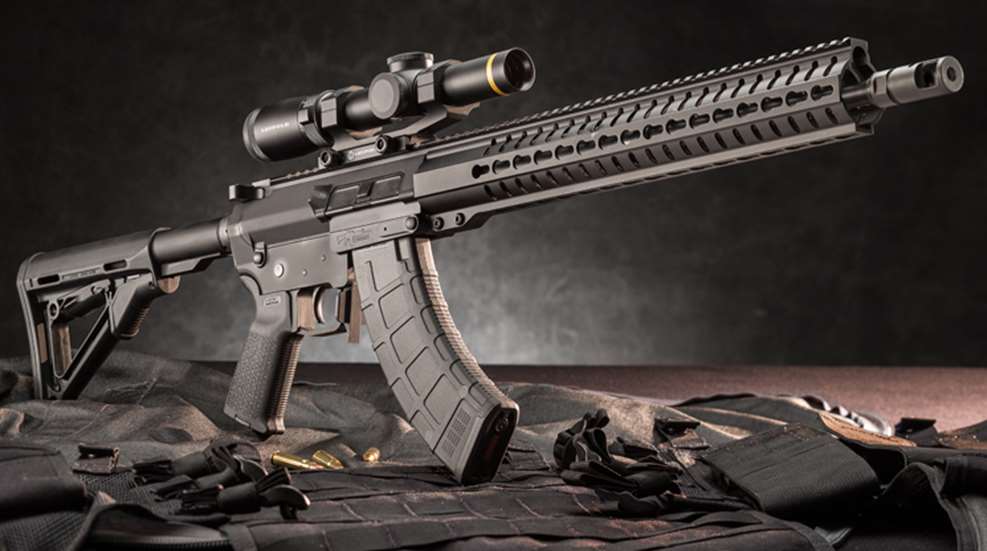
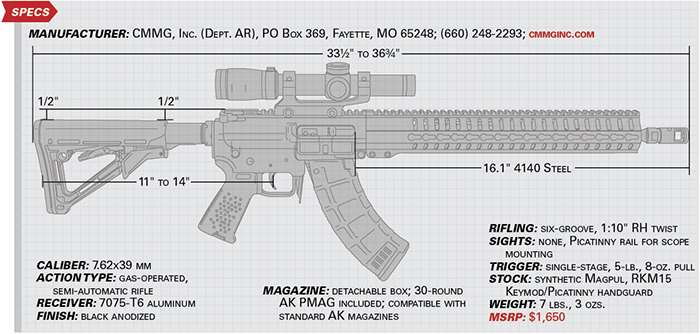
The Mk47 isn’t simply a 7.62x39 mm upper receiver pinned onto an AR-15-style lower. This is a completely different firearm that is nearly as large as the AR-10 in certain dimensions—CMMG builds its 7.62x39 mm rifles on what it refers to as a “mid-size” receiver. Rather than attempting to alter AR-15 magazines to navigate tapered cartridges through a straight vertical magazine well, CMMG designed the carbine to accept traditional AK magazines. However, accommodating them necessitates a vastly different lower receiver configuration that more closely resembles that of an FN FAL than a traditional AR-15. The remaining lines are far more AR-like, but careful examination reveals some necessary differences.
Operationally, the Mk47 follows the AR-15 pattern with a rotating bolt and a carbine-length, direct-impingement gas system. Fieldstripping the carbine reveals a critical difference, though, a beefy bolt and carrier designed specifically around the 7.62x39 mm cartridge. The bolt carrier group from the Mk47 weighs 17.2 ozs., while a standard AR-15 unit weighs 11.6 ozs. For comparison’s sake, the bolt carrier group from an AR-10 weighs 19.4 ozs. The heavyweight bolt carrier in the Mk47 is balanced by a heavy buffer, which dampens the effects of mechanical recoil upon firing.
Loading and shooting the Mk47 is similar to that of a standard AR, with the noted exception of the AK-style magazines. While AR-15 magazines are inserted vertically into the magazine well with relative ease, loading AK magazines requires a bit more technique. To load an AK magazine into the Mk47, the shooter hooks a protrusion at the forward edge of the magazine into a slot in the receiver before rocking the magazine rearward and upward into position. It can be done incorrectly, and doing so will render the gun inoperable until the magazine is removed (often with great effort) and reinserted correctly. With practice, AK magazines can be inserted and removed very rapidly, but it does take some getting used to for those unfamiliar with the process. AK-type magazines lock into the receiver at the rear, and the Mk47 incorporates a generously sized, bilateral, paddle-type magazine release that works very well. Like most AK variants, the Mk47does not lock the bolt to the rear when the magazine is empty. The rifle will accept most polymer and steel AK magazines, including drum types.
The AK is often touted for its reliability, much of which is credited to the generous internal tolerances of the design. A lesser-known factor in the AK’s legendary reliability is the generous taper of the 7.62x39 mm cartridge. Though modern cartridge designs often trade taper for propellant capacity, the tapered cartridge’s geometrical advantage lies in its ability to feed and eject with minimal friction. The Mk47 fed, fired and ejected with 100 percent reliability throughout our testing. Due to the increased mass in critical areas, and an efficient AK-74-style muzzle brake, the rifle’s recoil was only slightly more significant than that of a 5.56 mm-chambered AR.
The Mk47 uses a standard AR-style buffer tube and comes equipped with a Magpul MOE collapsible buttstock and grip, which can be easily changed based on the shooter’s preference. The handguard is CMMG’s RKM15 keymod free float tube, which incorporates a Picatinny top rail for optics mounting with keymod slots along the 3-, 6- and 9-o’clock positions. The keymod system allows users to attach a variety of accessories to the handguard without the sharp edges of a rail system.
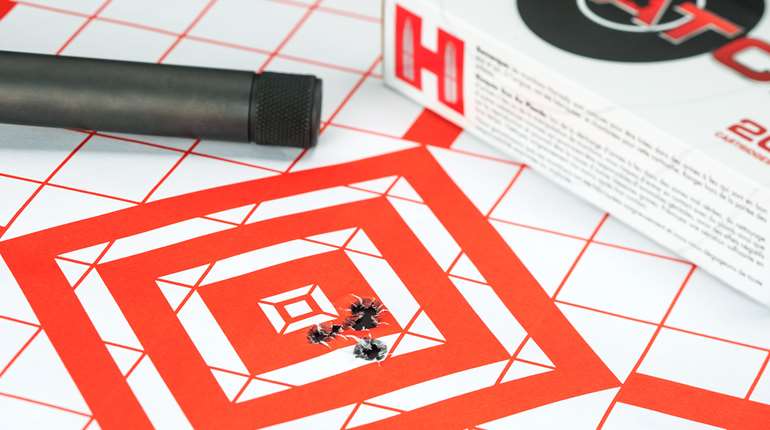
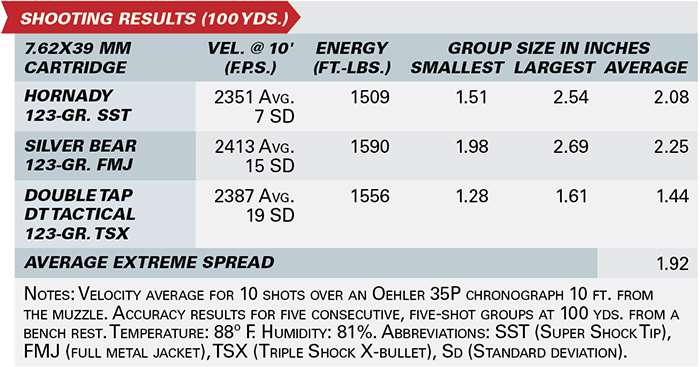
We mounted a Leupold VX-6 1-6X 30 mm MultiGun scope and fired the rifle from both the bench and field positions. The length of 30-round AK magazines can interfere with bench rest shooting and can require some adjustment when shooting prone—a 10-round magazine is a useful accessory. The carbine was pleasant to shoot, and the 123-gr. bullets struck the steel test targets with noticeable authority. Handling differences between the Mk47 and most ARs were more a factor of the carbine’s increased mass than variation in caliber. Accuracy was nothing to brag about with the steel-cased ammunition, but DoubleTap’s TSX load produced some good five-shot, 100-yd. groups as seen in the accompanying table. Bear in mind that all of the groups were fired with a 6X scope with fairly heavy crosshairs, hardly a benchrest scope.
Both the 5.56x45 mm NATO and the 7.62x39 mm have their advantages and disadvantages. Some advantages of the latter include adequate supplies of affordable loadings, increased bullet mass and frontal area, and legality for hunting in some jurisdictions where .22-cal. center-fires are not allowed. Shooters who seek those advantages but value the fundamental design features of the AR-15 should give the Mk47 a close look. CMMG went back to the drawing board on this design, and the result is a functional and reliable hybrid.
Most Popular