“Hey, Tam,” asked my editor, “Leupold’s launching a new optic. Wanna go cover the launch event?”
“What kind of optic?”
“Well, it’s embargoed and they’re playing their cards pretty close to their chest.”
Hmmm. I generally don’t cover hunting stuff, and while the idea of Precision Rifle is interesting in the abstract, long-range shooting is basically full-contact math and I’m terrible at math, so I doubted he’d ask me to cover anything like that.
“Should I brush up on my pistol or carbine shooting before I go?”
“Oh, carbine. Definitely.”
The Leupold event, co-hosted by Hornady at the fantastic Heartland Public Shooting Park just outside Grand Island, Neb., took the form of a day and a half of training on carbines with the new Leupold LCO Pro F2 red-dot optic. The class was run by Army SOF veteran Kyle Lamb, backed up by competitive-shooting legend Doug Koenig. After the class, there was one more day on the range with Koenig running us journalists and influencers through a four-stage mini carbine match.
Some of you may remember the original Leupold LCO (Leupold Carbine Optic) red dot. You must, because they’ve been bringing obscene prices on the secondhand market since they were discontinued, so there’s definitely a cult following out there.
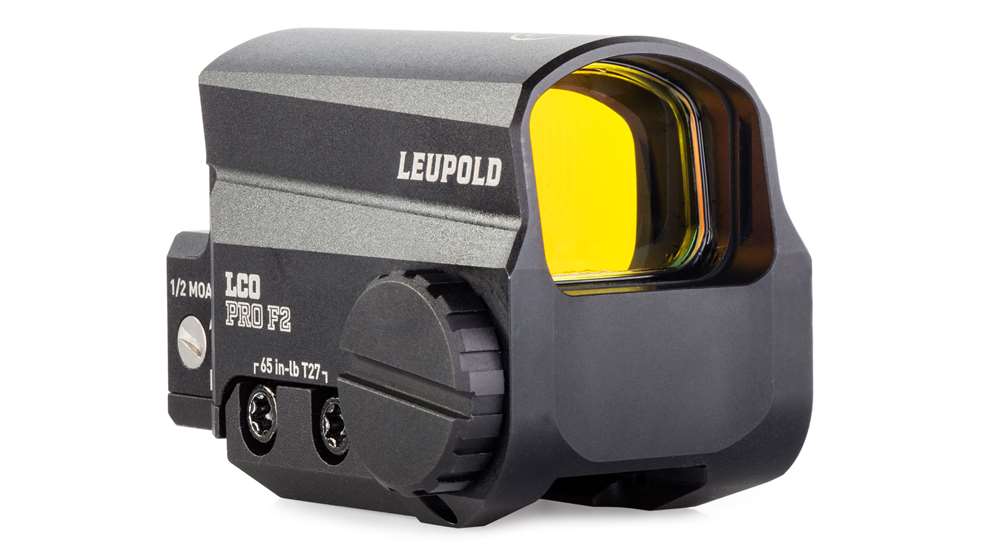
One of only a handful of companies able to play credibly at this end of the price spectrum, Leupold has relaunched the LCO as the Pro F2 version, the first of what we were informed would be a series of rugged, high-grade electro-optical sights. As the name implies, the sight has all the features expected on a professional optic and adds numerous nice touches over the original.
Four user-selectable reticles are present: a plain, 1-MOA dot, the 1-MOA dot with four “compass point” hashes, a 65-MOA circle around the 1-MOA dot or a circle-dot configuration with hashes. Like the original, all the controls and adjustments are in the base, so nothing clutters the periphery of the view through the big, clear window. Unlike the original’s 16 brightness settings, the LCO Pro F2 has 20, plus an additional 10 night-vision levels, all easily adjusted by a twist knob with clicks and detents. Furthermore, if you twist the knob slowly, one click at a time, it steps through the brightness levels one at a time, whereas if you just grab it and spin like you’re dialing for dollars, it functions as a rheostat.
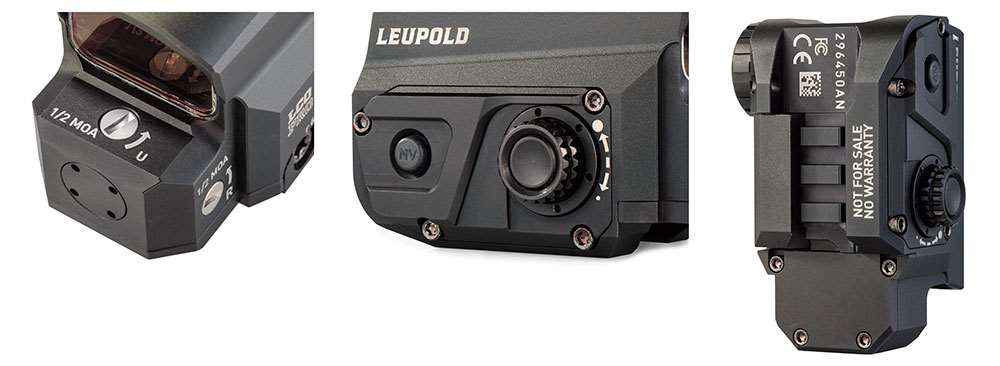
Another difference from the legacy unit is that the Pro F2 features MST (Motion Sensing Technology, which is Leupold-speak for “shake awake”) that automatically powers the unit down after 5 minutes without moving. This extends the useful life of the single CR123 battery to a claimed 30,000 hours. A lockout feature will disable both the MST and setting changes if you want to maintain a certain configuration in the field. Like the original, it’s in a machined aluminum housing rugged enough to withstand a loaded carbine landing optics-down and waterproof to 66 feet.
It was easy to sight in at the class atop the provided AR carbines, and all units held zero despite getting handled roughly over two-and-a-half days and probably 600-plus rounds of hard range training and match shooting. Then, when I got my hands on the test sample, it dialed in again quickly on my own FN PS90 for extended testing. Mounting is ridiculously secure on any Picatinny rail, with three cross keys and two tension screws.
Size-wise, it’s fairly compact, measuring 3.5 inches long, just more than 2 inches tall and weighing 9.6 ounces all juiced up with a battery. It’s barely bigger than some of the popular small red dots in the same market segment, while offering a view through the window comparable to much larger classic competitors like the M68 CCO and its ilk, albeit without the cluttering projections around the periphery of the tube.
Hopefully, we’ll be writing you one glowing long-term follow-up after another, and even more hopefully there are multiple additional meaningfully updated dots waiting in the wings from Leupold’s rejuvenated electro-optical division. But for a new take on a trusted carbine optic, the LCO Pro F2 is an excellent upgrade.