Situated almost on the equator, and about halfway between the Hawaiian Islands and New Guinea in the Pacific Ocean, the British colonial possessions comprised of the Gilbert and Ellice Islands was occupied by the Japanese in early 1942, and they began building their easternmost defensive line there against an expected attack by the Americans. In concert with a drive up from Australia toward Japan, the Americans would have to secure the Gilbert Islands as the first part of the island-hopping war across the central Pacific to Japan. When the 1st Marine Division landed in August 1942 on Guadalcanal (located in the Solomon Islands to the northeast of Australia), strategic planners tasked the Marine Corps with staging a diversionary raid on Makin Atoll in the Gilberts to draw Japanese reinforcements away from the Solomons.
During the preceding two decades, the Marine Corps had been developing ways of attacking heavily defended islands by amphibious assault, and one of these innovations was the employment of “rubber boat” companies of Marines that could land behind enemy lines. One company on the East Coast expanded to a battalion led by legendary LtCol Merritt “Red Mike” Edson (later MajGen Edson and president of the NRA), and another battalion was formed on the West Coast under the command of LtCol Evans F. Carlson. Carlson was a friend of President Franklin D. Roosevelt, and the president’s eldest son, James Roosevelt, was serving as the battalion’s executive officer. Enamored with the British concept of “Commandos,” FDR embraced the units now designated as “Marine Raiders,” and he supported the selection of Carlson’s Raiders for the raid on Makin Atoll.
The two Raider battalions differed greatly in philosophy and methods. Edson was a no-nonsense Marine hero of the Second Nicaraguan Campaign, while Carlson had been an observer of Mao Zedong’s Chinese forces on their “Long March” during the ongoing Sino-Japanese War, and Carlson strove to adopt some of the methods he saw in China. Carlson’s most familiar legacy is the Chinese term “Gung Ho,” which roughly translates into English as “Work Together.” Carlson also insisted on making command decisions by group consensus. Just a few days after Edson’s 1st Marine Raider Battalion landed in the Solomons with the 1st Marine Division in August 1942, Carlson’s 2d Marine Raider Battalion headed for the Gilberts on two submarines, with their inflatable rubber boats and outboard motors stowed aboard.
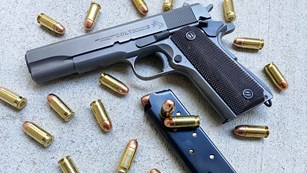
Arming the two Raider battalions had been formalized in their “Table of Organization and Equipment” (TO/E). While most of Carlson’s Raiders carried the newly adopted M1 Garand .30-caliber, semi-automatic rifle, there were some atypical firearms involved, like the British .55-caliber Boys anti-tank rifle. Apparently, there was some leeway afforded to Carlson, as his Raiders also acquired a few 12-gauge, pump-action Remington Model 31 riot shotguns, which were not in the Marine Corps’ supply system. According to a 2008 PBS TV interview with former Raider Pat Almond, the Raiders could usually get anything they wanted by going through James Roosevelt, and shotguns were not listed on the Raiders’ TO/E. In his 1947 biography of Carlson, “The Big Yankee,” author Michael Blankfort relates a planning session where several of the battalion’s officers decided on increasing the firepower of their innovative “three-man” fire teams, but shotguns are not mentioned. However, shotguns appear to have been distributed to some officers and non-commissioned officers, in addition to their M1911 and M1911A1 .45-caliber, semi-automatic pistols.
The U.S. government acquired nearly 9,000 Model 31 Remington shotguns during World War II, mostly for training aerial gunners, but some “riot” models with short-length barrels were also obtained for guard duty. Introduced in 1931, the Model 31 was Remington’s answer to the popular hammerless Model 12 Winchester pump-action shotgun, and, by all accounts, it was a well-made, sturdy and dependable firearm. The Model 31 was Remington’s first pump shotgun to eject from the side, replacing the company’s previous Model 10 and Model 17 shotguns (which fed and ejected from the bottom of the receiver), and the gun had its slide release positioned at the front of its trigger guard, with its safety switch at the rear of the guard. While Remington made shotguns in 12, 16 and 20 gauge, the military only procured 12-gauge guns.
Most of these shotguns received by the Army were marked with ordnance inspectors’ stamps on their receivers and often on their stocks. Some show evidence of being arsenal-reworked before being reissued, both as aerial training guns and as riot guns. The “back-door” Model 31s of the 2d Marine Raiders, not being an official USMC procurement item, most likely did not have any such markings. Since none of them exists today, we will never know if they did. As is most often the case, the serial number ranges are not as consistent as modern collectors would like them to be (since manufacturers often filled orders with those guns that were most handy and not necessarily as they came off the production line), with most of the numbers being in the 50,000-60,000+ range. With four 12-gauge 00 buckshot rounds in the magazine and one in the chamber, the Model 31 Remington was a formidable firearm.
If anything could go wrong with getting on and off the Makin Atoll, it certainly did. Despite their weeks of training in Hawaii, in which the 2d Marine Raiders had debarked from submarines into their rubber boats and motored ashore, their efforts were almost stymied when they opened the submarines’ hatches off Butaritari Island (their intended target in the five-island Makin Atoll) and found themselves in a major storm. Equipment and fuel were lost, Marines were injured, and outboard engines were flooded with seawater during the disembarkation. Nevertheless, the battalion landed , but a small detachment commanded by Lt. (later LtGen) Oscar F. Peatross ended up behind enemy lines. As related in a fellow officer’s account of the raid in two issues of the December 1943 edition of The Saturday Evening Post, Peatross killed three Japanese messengers with his Remington Model 31. When Lt. Gen. Peatross wrote a history of the Raiders in 1995, he rarely talked about himself and instead dwelled on the exploits of his fellow Raiders, omitting any mention of the shotgun he used on Makin.
Meanwhile, Sgt. Clyde A. Thomason employed his Remington Model 31 to great effect in the assault of the main Japanese position. A native of Georgia, Thomason had enlisted in the Marine Corps in the 1930s and served a “cruise” as a seagoing Marine with the Asiatic Fleet on the China station. After his discharge, he then joined the Marine Corps Reserve and worked at an insurance firm in Albany, Ga., but immediately volunteered for active service after the Dec. 7, 1941, Japanese attack on Pearl Harbor. With his spotless prior service record and eager patriotism, the 6-foot, 4-inch Thomason was just the kind of Marine Carlson needed for the ranks of the 2d Marine Raider Battalion, and he was rapidly promoted to sergeant.
At a 2004 Marine Raider reunion, former Raider Howard Young talked about the Makin Raid to noted Raider collector and historian Doug Bailey. Young stated he “was lying next to Clyde Thomason and tugged on his trouser leg trying to get him to stay down, but Clyde kept standing and blasting with that pump shotgun until they (the Japanese) finally got him.” Sgt Clyde Thomason was the first enlisted Marine to be awarded the Medal of Honor in World War II, and his citation reads, in part, “Landing the advance element of the assault echelon, Sergeant Thomason disposed his men with keen judgment and discrimination and by his exemplary leadership and great personal valor, exhorted them to like fearless efforts. On one occasion, he dauntlessly walked up to a house which concealed an enemy Japanese sniper, forced in the door and shot the man before he could resist. Later in the action, while leading an assault on an enemy position, he gallantly gave up his life in the service of his country.”
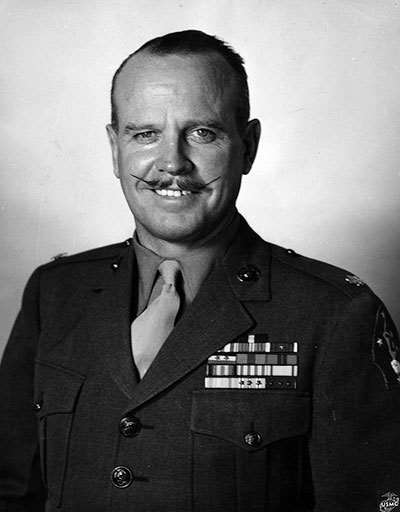
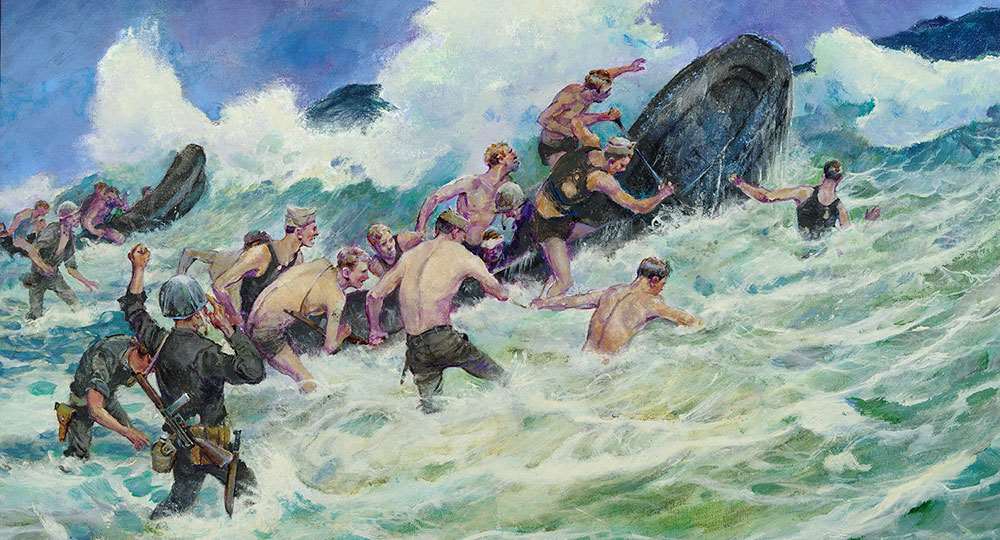
After eliminating the Japanese garrison, and, incredibly, downing Japanese seaplanes with a shoulder-fired Boys anti-tank gun, Carlson’s Marines gathered around him as he consulted with the group, now reduced by at least 30 Marines who had died in the attack. They all agreed to try to make it back to the awaiting submarines, although the surf was so rough that many of their rubber boats capsized repeatedly while trying to get through the pounding waves. Bidding farewell to the island’s police chief, who had promised to bury his dead Marines, Carlson gave the remaining shotguns to him for use by the natives if the Japanese returned. Marines were already losing guns trying to get through the surf, and since their Remington shotguns did not have slings and sling swivels (later versions did have quick-release swivels) the shotguns would have been difficult to carry in the rubber boats and thus were the most expendable arm to leave behind. Thus, the battalion returned to Hawaii without any of its Model 31s.
After securing the Solomon Islands in a series of bloody battles throughout 1942 and 1943, the Allied drive westward through the central Pacific could commence. Tarawa Atoll, about 140 miles to the south of Makin, was heavily fortified by the Japanese, and their commander bragged it would take “a million men a thousand years” to take it. After what was thought to be a devastating pounding by Navy and Marine aircraft from carriers at sea and from airfields in the neighboring Ellice Islands, the 2nd Marine Division made a head-on assault over the reef surrounding Betio Island in November 1943. The tide was too low for most of the landing craft (LCVPs) to float over the reef, so those Marines who were not riding in the open-tracked amphibian tractors (LVTs or “amtracs”) had to wade hundreds of yards ashore, carrying full combat packs and under intense enemy fire. With most of the amtracs stalled at the coconut log seawall surrounding the island, and with most of the Japanese defenders still alive and shooting from their dug-in defenses, individual Marines went forward to lead their men.
One of these was Maj (later Col) Henry P. “Jim” Crowe, a Kentucky-born long service “Mustang” Marine who had enlisted in Chicago at the end of World War I and had seen service, but not combat, with the 5th Marine Brigade in France. Crowe re-enlisted after the war and excelled at every assignment he was given while being posted everywhere one would expect Marines of that period to serve—Santo Domingo, Quantico, Nicaragua and China, among others. He competed on various rifle teams and steadily advanced in rank before becoming a warrant officer (Marine Gunner) in 1934. By the outbreak of World War II, he was a Chief Marine Gunner and commanded a platoon of light artillery in San Diego. His unit, the 8th Marines, was quickly sent to American Samoa to help defend the South Pacific against Japanese expansion.
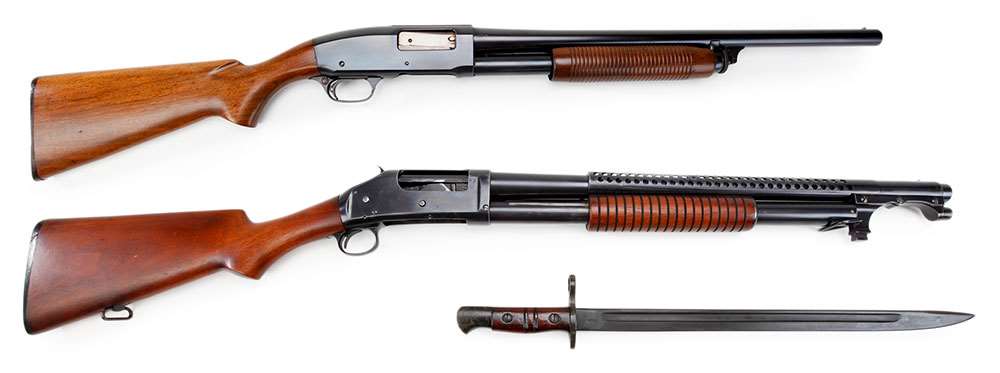
In addition to his skill with the .30-caliber M1903 Springfield rifle and the M1911/M1911A1 pistol, Crowe had spent time as an ordnance officer and was well-acquainted with the Marine Corps’ arsenal. He felt the need to have additional firepower and did not rely solely on his pistol, as did most other senior NCOs, warrant officers and officers. Known for his rigorous attention to physical conditioning, he marched his Marines all over Samoa while armed with his weapon of choice—a Model 1897 Winchester 12-gauge “trench” shotgun. As a newly appointed captain and now the intelligence officer of the 8th Marines, he carried his shotgun on numerous patrols across Samoa.
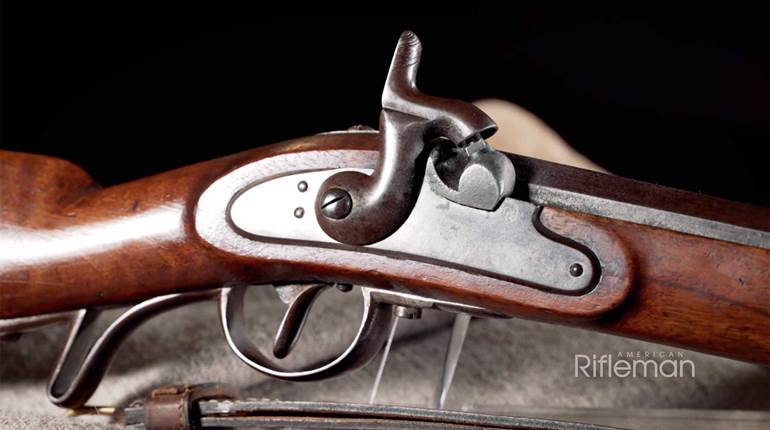
Designed by John Moses Browning, the Model 1897 Winchester was an improved version of the black-powder Winchester M1893 pump shotgun. The Spencer pump shotgun (among others, like the Burgess and the Colt “Lightning” pump-action rifles) had ushered in the era of pump-action sporting guns in the late 19th century. The Model 1897 not only incorporated an additional safety feature of a slide lock but also had an exposed hammer that could easily be put on “half-cock” safety when loaded. The M1897 carried five paper and brass, or all brass, cartridges in its tubular magazine under the barrel, with one round in the chamber. In 1912, Winchester introduced its improved hammerless version of the M1897, dubbed the “Model 12” or, in military parlance, the “M1912.” According to author Bruce Canfield’s findings, the Marine Corps acquired its first M1912s in the spring of 1942, months after the 8th Marines had already sailed for Samoa, and these shotguns were later put to good use by Marines in the Marianas, Palau, Iwo Jima and Okinawa.
“Jim” Crowe put his ’97 shotgun to good service on Guadalcanal after the 8th Marines arrived in November 1942 to reinforce the weary and hungry—but still combat-ready—1st Marine Division. In fact, he was carrying his shotgun during the action for which he was awarded the Silver Star—taking out a Japanese artillery position and killing five of its defenders. After the island was finally secured in 1943 and turned over to the Army, Crowe and his fellow Marines of the 2nd Marine Division went to New Zealand for refitting and regrouping. While there, he was promoted again, and, now a major, was made executive officer of the 2nd Battalion, 8th Marines, in preparation for the assault on Tarawa in November.
In that charge across Betio Island, Crowe was conspicuous in his efforts to get the Marines moving up from behind the sea wall at Red Beach 3 and attacking the Japanese defenses, and the Marine Corps and British government recognized this by awarding him the Navy Cross and the British Distinguished Service Order. With his Winchester ‘97 pump shotgun in hand, he exhorted his men by claiming “the Japs can’t hit a barn door with their rifles, so get moving!” Crowe is thought to be the central figure in a miniature diorama currently on display at the National Museum of the Marine Corps. Coincidentally, the Marine Corps historian who interviewed Col Crowe for his oral history in 1979 also carried a Winchester ‘97 shotgun while serving as a stretcher bearer on Peleliu in 1944, as did the director of the Marine Corps’ historical program (while commanding a support unit during the invasion of Guam in 1944) who, upon Crowe’s death in 1991, wrote a two-part article about Col Crowe for the former Marine Corps History & Museums Division’s quarterly publication.
Although the Marine Corps’ use of shotguns was limited in World War II, Marines found them to be effective, and shotguns were later used in the Korean War and in Vietnam. Shotguns are an integral part of today’s Marine Corps’ special-operations units and embassy guards. Then, as now, five or six rounds of 00 buckshot at close range most often does the trick.