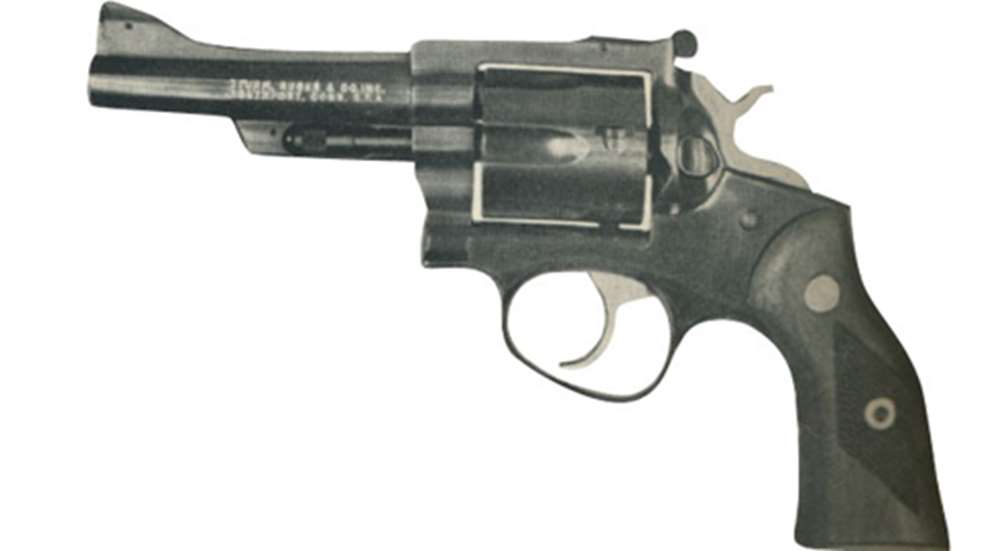
The Ruger Security-Six double-action revolver is the result of imaginative designing and modern production techniques. this solid-frame handgun with side-swing cylinder and simultaneous ejection was introduced in 1970. It is offered in .38 Spl. and .357 Mag. chamberings and with choice of fixed or adjustable target-style sights.
Trim, compact, and strong, this six-shot revolver with four-in. barrel weighs 33 ounces unloaded and measures 9 ¼-inches long overall. It is also available with 2 ¾- and six-inch barrels. To quote the manufacturer: “It is a handsome, rugged holster revolver—compact in the overall, yet massive enough to properly be designated as a heavy duty revolver for the rigors of police and military service.”
Among several desirable features of the Security-Six is that it can be disassembled easily for cleaning and lubrication without use of special tools. After turning out the grip screw with a cartridge rim, coin, or screwdriver, the grips, lockwork, and cylinder assembly can be removed. Except for windage and elevation adjustment screws in the rear sight of the target version, the only screw in this revolver is the grip screw.
Unlike most other handguns, the frame, crane, hammer, trigger, trigger guard and several smaller parts of the Security-Six are produced from chrome-molybdenum steel investment castings. The barrel is a machined forging and the cylinder, which rotates to the left, is machined from bar stock. All springs are of durable coil type. The frame is not fitted with a sideplate as in many other revolvers. This aids strength.
Integral with the barrel are an ejector rod housing and a raised grooved barrel rib. Pinned to the front of the rib is a Baughman-style quick-draw front sight.
In pleasing contrast with the blued finish of the other metal parts, sides of the hammer and trigger are polished bright. The grips are oil-finished American walnut, each fitted with a smaller circular Ruger medallion of white metal. Cut checkering in a diamond-shaped area on the grips is nicely executed.
An excellent safety feature of this revolver is the system of transmitting the hammer blow to the spring-loaded firing pin by means of a transfer bar. The hammer nose rests on the frame, and the transfer bar does not align with the firing pin until the trigger is fully to the rear. This prevents accidental firings should the gun be dropped with the hammer down, or should the hammer be struck when down and with the trigger forward.
Another excellent safety feature is that the hammer cannot be cocked when the cylinder has been swung out, and the cylinder cannot be opened when the hammer is cocked. The cylinder assembly is released to swing out to the left by depressing the cylinder release button in the left recoil shield of the frame.
Handling and pointing qualities of this well-made reliable revolver are excellent, and its overall precision is very good. Its double-action trigger pull is satisfactorily smooth, without excessive buildup of resistance when the trigger pressure is increased. The single-action pull weighs approximately three pounds, and has very little creep.
The Security-Six is well made and finished throughout, and its design shows considerable ingenuity.
Disassembly Instructions
1. Determine that revolver is unloaded before attempting disassembly. Unscrew grip screw (48) with coin or cartridge rim, and remove grips (42) (47). Cock hammer (24) with thumb. Insert disassembly pin (43), stored in left grip, through hole at bottom of hammer strut (19). Pull trigger, lower hammer with thumb, and remove mainspring/hammer strut assembly from grip frame.
2. Pull trigger fully to rear and remove hammer pivot assembly (20). Keeping trigger fully depressed, roll hammer forward and lift straight upward from frame.
3. Working through frame opening, depress trigger guard plunger (60) with punch. Pull rear of trigger guard (57) downward and remove from frame. In the field, trigger guard plunger may be depressed by rounded head of hammer strut.
4. With the gun on its right side, press crane latch (37) and open cylinder (34). Draw cylinder/crane assembly forward and out of frame. Remove cylinder latch (38).
5. If cylinder/crane assembly must be taken down, clamp knurled head of ejector rod (25) between wood blocks in vise or locking jaw pliers. Insert empty cartridge cases in opposite chambers and unscrew cylinder, turning clockwise. (Assembly is secured with left-hand threads.) When cylinder is fully unscrewed, squeeze crane (28) and cylinder together and remove from ejector rod. All parts may then be separated.
To reassemble cylinder/crane assembly, replace cylinder latch spring and plunger (29) (30) within crane pivot. Insert ejector rod washer (31) and ejector spring (32) within cylinder axle, making sure that the washer seats squarely upon its shoulder. Assemble ejector (39), cylinder, and crane. Slide center pin spring (26) over center pin rod (27) and insert through threaded end of ejector rod. Holding cylinder/crane assembly, turning ejector rod counter-clockwise to start its thread. Tighten in vise, as before.
6. Assemble rest of gun in reverse order. When installing trigger guard assembly, locate transfer bar (49) and pawl (56) ahead of their internal frame shoulders, and enter lug at front of guard within its frame seat. Pivot assembly upward into contact with frame. Determine that transfer bar is situated to rear of internal crossbar of frame latch, and snap guard home. Pulling trigger will cycle cylinder, if assembly is correct. When replacing mainspring assembly, position mainspring seat (45) with offset hammer strut hole to rear.
7. Cutaway indicates relationship between assembled parts. Gun is shown unloaded, with all springs at rest. Crane latch has been omitted for clarity; its crossbar would lie between center pin lock and transfer bar. Parts are number keyed to parts legend.