Glock has been striving to fill its customers' requests for semi-autos with longer barrels and slides since the introduction of the 6.02" barrel 9 mm G17L in 1988. The benefits of an extended slide assembly include a longer sight radius for a more precise sight picture, more rifling to stabilize the bullet, longer burn times for the powder which in turn can increase bullet velocity, and a bit more weight at the muzzle end of the barrel to help manage felt recoil.
In 1994, the next Glock long slide arrived in the form of the .40 S&W G24. Both the G24 and G17L were either dropped from the Glock catalog or relegated to limited production with the arrival of the "Practical Tactical" G34 (9 mm) and G35 (.40 S&W) in 1998. These competition models have slightly shorter 5.31" barrels, cut outs in the tops of the slides to accommodate ported barrels and they are currently available in both Gen3 and Gen4 Configurations. 2014 heralded the arrival of the first Practical Tactical chambered in.45 ACP, the G41.
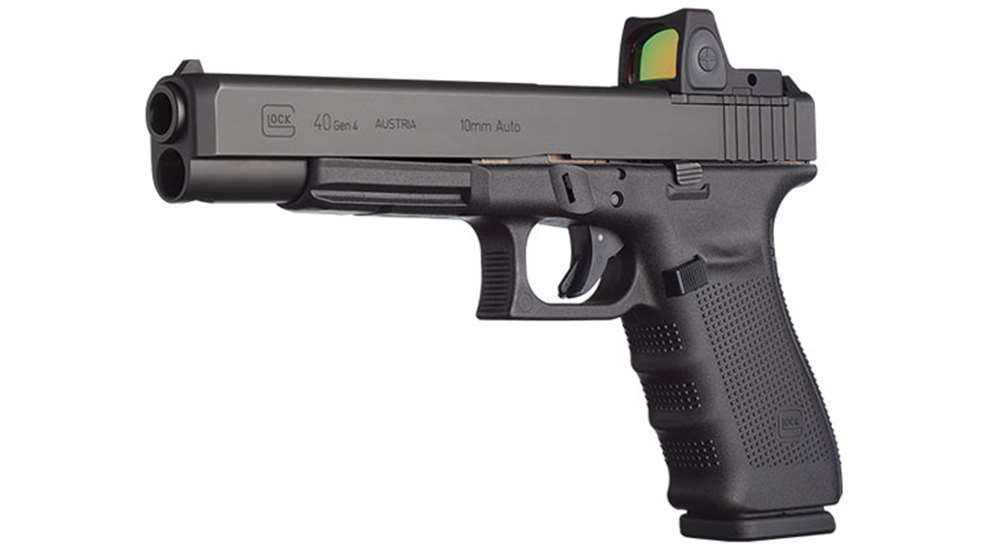
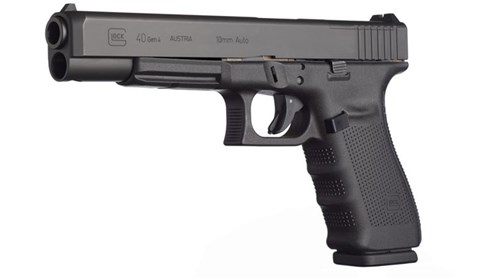
Now, at last, Glock has come around to taking care of its handgun hunting fans with the release of the long-slide Gen4 G40 chambered in 10 mm, which has been lovingly dubbed Glockzilla by some enthusiasts. It's no coincidence that this model arrived the same year that the company launched the factory installed MOS (Modular Optics System) for mounting reflex and red dot sights. The MOS feature is currently available on four Glock models including the G34, G35, G41 and the G40. I had my first opportunity to shoot the G40 at the 2015 SHOT Show, so I was looking forward to shooting it again for this review.
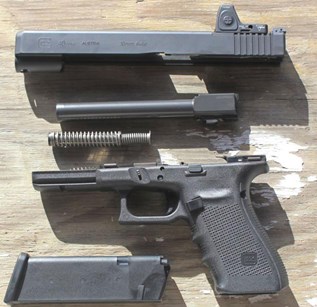
When designing the G40 10 mm, Glock engineers followed the same design ideas used for the G41 .45 ACP. The polymer frame, recoil assembly, controls and 15-round magazines are lifted directly from the Gen4 G20 10 mm. The Gen4 features include the Rough Texture grip frame, 2" accessory rail for lights and lasers, removable back straps and an enlarged reversible magazine release button. The polymer sights, consisting of a white dot front and windage-adjustable white outline rear, are a common factory option.
However, instead of just elongating the G20's heavy-duty slide to accommodate a longer barrel (making the pistol unnecessarily weighty), a slim, thinner-walled slide with external dimensions comparable to the Practical Tactical models was installed. Even though the G40 does not have a cut out in the top of the slide, the pistol still weights 2.5 ounces less than the Standard size G21. The result is a 10 mm pistol with a much better balance in hand than one might expect from a long slide.
The G40 ships with the MOS Adapter Set 02, which is a package of parts containing four numbered optics base plates, screws and a small wrench. The pistol’s slide is milled, drilled and tapped to accept a removable plate located between the chamber and rear sight. This plate is contoured to match the shape of the slide when an optic is not in use. 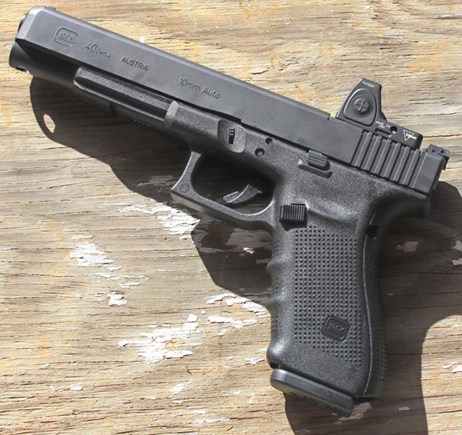
Installing an optic using the MOS components is a simple process. Start by removing the magazine, locking the slide in the open position and verifying the pistol is completely unloaded. If you have a gunsmith’s pistol stand, you are ready to get started. If not, it will be easier to install the optic if you field strip the pistol so that the slide can rest directly on a flat work surface. Remove the contoured slide plate from the slide by loosening the two slightly longer retention screws using the provided wrench. Then select the correct optics base plate by pairing the plates with the optic until you find the right fit. Attach the base plate to the slide using the shorter screws provided in the MOS package. The slide is now ready for the installation of the optic. 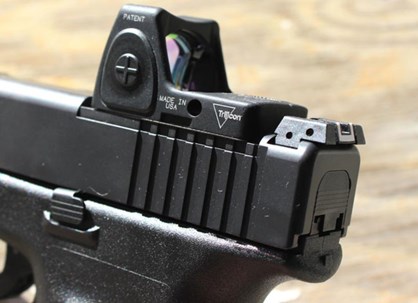
For this test, I opted to use the top notch Trijicon RMR 1.0 MOE Red Dot sight (RM09-700304) which arrived from the factory affixed to a clamping base designed to fit Picatinny rails. In order to mount the RMR using the Glock MOS system, it was necessary to order the Trijicon AC32064 RMR Mounting Kit so as to have the correct set of mounting hardware. So when selecting your optic, make sure to communicate with your product provider to ensure you have all the right bits and pieces.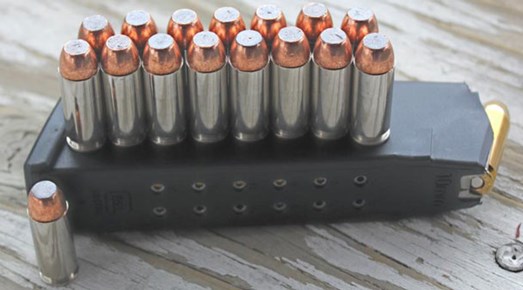
The G40 arrives with a substantial set of accessories in addition to the MOS adapter set. Along with three 15-round magazines, a magazine loader and a tiny sight adjustment tool, there's a set of four removable back straps with a retention pin and a punch. The purpose of these back straps is to help the operator adjust the grip shape and trigger reach to fit their hands. Two of the straps maintain the standard grip shape but increase the trigger reach by 2 or 4 mm respectively. The other two back straps also change the trigger reach by 2 or 4mm with the addition of an extended beaver tail to help protect the shooting hand from slide bite.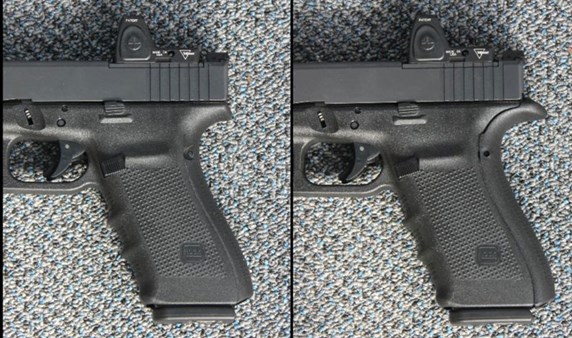
At the shooting range, the G40 demonstrated Glock's usual level of reliability. I fed, fired and properly ejected every round of ammunition with no malfunctions during informal or formal testing. All of the controls worked properly with the slide locking open on the last shot and magazines dropping free from the grip when the magazine release was pressed. The trigger exhibited the typical love-it-or-leave-it Glock qualities with a slightly mushy take up and a distinctive click when the trigger reset.
I brought along the little wrenches provided with the MOS system and Trijicon RMR just in case any screws shook loose in the course of fire but none of them did. The RMR reflex optic was easy to sight in and provided for quick target acquisition. It doesn’t take long to appreciate why this sight system has become so popular for sporting and defensive applications.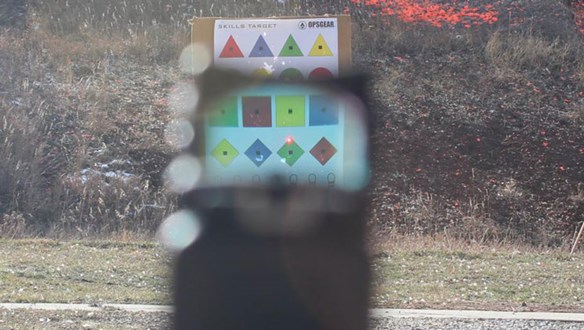
As expected, the felt recoil produced by the pistol when firing a variety of 10 mm ammunition ranged from brisk to stout. However, the recoil was not painful or punishing even with the hottest loads. The elongated slide and other ergonomic features made the pistol controllable, and thus enjoyable, to shoot. Even though the 10 mm cartridge is not as popular as some semi-auto calibers, there is a good selection of practice, defense and hunting grade ammunition available from several different manufacturers these days.
While checking the pistol's accuracy with bench rested 25-yard 5-shot groups, bullet velocity was measured by firing 10-shot groups next to a LabRadar chronograph to see how the 6.02" barrel affected ammunition performance. Surprisingly, the extra barrel length did not produce as much of a velocity boost as I would have expected.
Armscor International produces a moderate recoil practice load topped with 180-gr. full-metal jacket bullets which has performed reliably for me in several guns. The average velocity when fired from the G40 was 1148 fps., which is statistically the same as the company's listed velocity of 1150 fps. This round produced a best single 5-shot group of 3.09" with an average of 3.29".
The most accurate load was the Double Tap 125-gr. Tac-XP jacketed hollow point with a best single group of 2.74" and an average of 2.89". Flying along at a respectable list velocity of 1600 fps., this round also exhibited the greatest velocity increase of the test set with an average of 1685 fps. Federal Premium's 180-gr. Trophy Bonded jacketed soft points turned in a best group of 2.75" and an average of 3.01". Velocity only increased a little, from a list speed of 1275 fps. to an average of 1289 fps.
The Glock G40 Gen4 is a pistol I've been waiting to see for some time. When the G41 .45 ACP was released I had my fingers crossed that there would be enough customer demand for Glock to produce a similar long slide configuration in 10 mm. The Gen4 frames fit my hands more comfortably than the Gen3 models and the addition of the MOS feature is certainly a plus. The timing of the G40's arrival couldn't be better. Finally, we can enjoy a reasonably priced 10mm long slide with the rugged reliability of a Glock without the need for expensive aftermarket parts or gunsmithing.
Specifications
Manufacturer: Glock; us.glock.com
Model: Glock 40 Gen4 MOS
Action: Safe Action
Caliber: 10 mm
Finish: Gas Nitrate Slide, Polymer Frame
Grips: Rough Texture, Multiple Back Strap System
Sights: White Dot Front, Adjustable Outline Rear
Barrel Length: 6.02"
Overall Length: 9.49"
Sight Radius: 8.19"
Trigger Pull: Listed 5-lbs. 8-oz., Tested 5-lbs. 4-oz.
Trigger Travel: ~0.49"
Height: 5.47"
Slide Width: 1.13"Inches
Frame Width: 1.28"
Accessory Rail: 2"
Weight: 28.15 oz. (Unloaded)
Capacity: 15+1 Rounds
Twist: 1:9.84” RH
Rifle Grooves: Hexagonal
Accessories: Hard Case, 3 Magazines, Magazine Loader, MOS Adapter Set 02, 4 Removable Back Straps, Back Strap Tool, Rear Sight Adjustment Tool, Cleaning Brush, Lock, Owner's Manual
MSRP: $699
Most Popular