It was once said, “The purpose of a handgun is to fight your way to a rifle.” While most civilians will thankfully never find themselves in this situation, the saying is a nod to the power difference between the two, and closing this gap has been a driving force of handgun-cartridge development for many decades. As velocity has more influence than weight in the energy equation, manufacturers have achieved excellent results with small-caliber bottleneck designs, as evident in cartridges such as the .357 SIG and 5.7x28 mm. Taking things a step further, the .30-caliber 7.5 FK continues this legacy and is now chambered in its most compact firearm yet, the FK Brno PSD-C.
Carrying the namesake of the Czech city where it is made, the FK Brno PSD-C (short for Police Sport Defense–Compact) is a semi-automatic, centerfire, repeating pistol. Although it looks slightly unorthodox, it functions on John Moses Browning’s tried-and-true recoil-operated mechanism. When a cartridge is fired, the barrel and slide move rearward together. After a short distance, the chamber tips down toward the frame, unlocking the breech and allowing for the extraction and ejection of the fired case. This delay allows chamber pressure to drop to a safe level before unlocking occurs. An external hammer is cocked during the slide’s rearward stroke before a specialized recoil spring returns the gun to battery, stripping a fresh round from the detachable-box magazine in the process. Smoothing the overall operation is a bushing that aligns and captures the compressed spring, while also serving as a counterweight, ensuring the slide cycles without skewing.
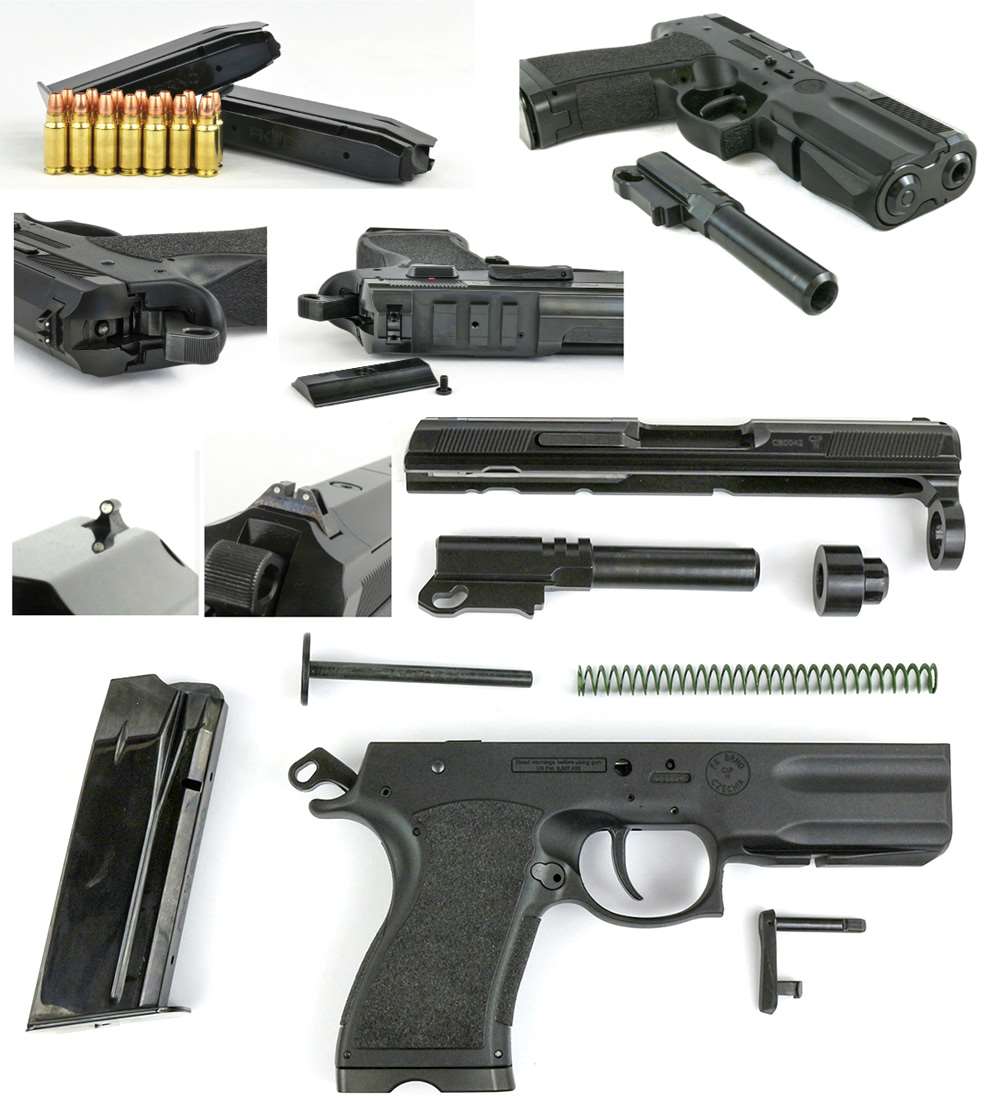
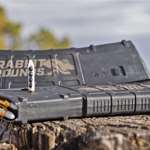
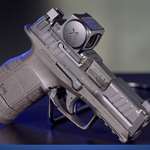
The PSD-C is designed for concealed carry through the use of a polymer frame and an abbreviated slide assembly. Its frame is smaller than that of both the company’s original Field pistol and its polymer-frame PSD (full-size), accommodating a 14-round magazine compared with the larger pistols’ 15-round capacity. The barrel has also been shortened to 4.25 inches from the 6 inches of the Field pistol and 5.25 inches of the full-size PSD. While these reductions are notable, they pale in comparison to the gun’s more palatable $1,700 price compared with the $7,500 MSRP of the Field model.
Picking up a PSD-C will be familiar to anybody who has handled a CZ 75, as the slide rides inside the frame in the same manner. Using a simple, single-action firing mechanism, the pistol can be carried “cocked and locked” like a standard M1911 using the thumb safety on the left side of the frame. Below this is a reversible, push-button magazine release. A slide stop is located on the left side and must be removed to facilitate disassembly.
Aside from generating more energy than the .357 Mag., FK also bills its cartridge as being more accurate than most other pistol cartridges, particularly at extended distances. Accordingly, the gun’s sights are geared more toward precision use than rapid self-defense. The “FK Pinpoint” front sight is intentionally thin to avoid obscuring far-off targets; it is paired with a U-notch rear. The PSD-C’s slide is also cut for ACRO-footprint optics.
As of this writing, there are only three loads of 7.5 FK ammunition, so it can be tough to source. The cartridge is not SAAMI-approved, as FK Brno is keeping it proprietary. It is, however, CIP-approved. To that end, 7.5 FK ammo must be purchased from FK Brno’s importer, the Italian Firearms Group, or its stateside manufacturer, Tascosa Machine & Tool. Although the cases are reloadable, finding .307-diameter bullets and dies to load the obscure cartridge may be difficult. To that end, conversion barrels are available to fire 10 mm or .40 S&W from the pistol using the same magazine. Interestingly, the owner’s manual explicitly okays the use of both cartridges through the barrel, something often discouraged in other 10 mm pistols. A conversion to fire 9 mm also exists, but it requires changing both the magazine and recoil spring.
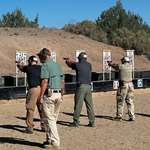
For evaluation, I assembled a group of testers who varied in age, dexterity and stature, and allowed them to fire each type of ammunition sent with the gun. The sample also included the 10 mm/.40 S&W barrel (normally sold separately), so each shooter had an opportunity to try that as well. We started with the 7.5 FK and were impressed by the velocities it produced, as well as the tight 25-yard groups that most were able to punch. Younger eyes praised the tiny sights, while older ones cursed them, so an optic might be a wise option for some.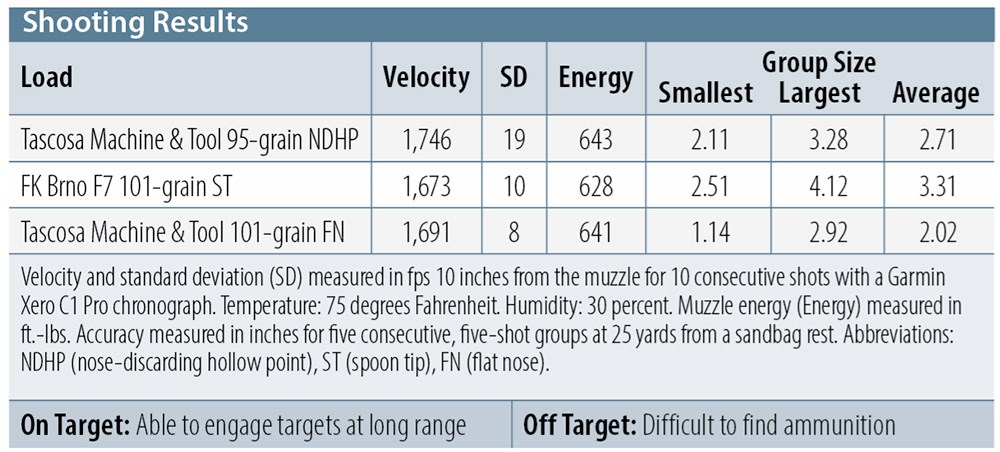
All parties found recoil quite manageable for such a powerful cartridge, noting that 7.5 FK was considerably tamer than 10 mm through the handgun. Reconfiguring the pistol for this use happened right on the firing line and was a toolless endeavor, taking less than a minute. Filling a magazine with alternating rounds of 10 mm and .40 S&W, everyone was impressed with how effortlessly the gun cycled both chamberings.
Testing concluded by swapping the 7.5 FK barrel back in and firing at a bevy of Caldwell animal silhouettes placed out to 150 yards. The PSD-C was certainly up to the task, even if some of our participants weren’t. At this distance, the bullets still carried a substantial amount of energy, so hits made the AR500 steel targets dance delightfully.
Overall, I’m satisfied with what the PSD-C had to offer and found that it met all of the claims the manufacturer promised. My only wish is for a wider selection of ammunition and perhaps better reloadability, which isn’t entirely out of the question down the road. In the meantime, if you’re intrigued
by the cartridge and on the prowl for something a bit more concealable, this is the pistol for you.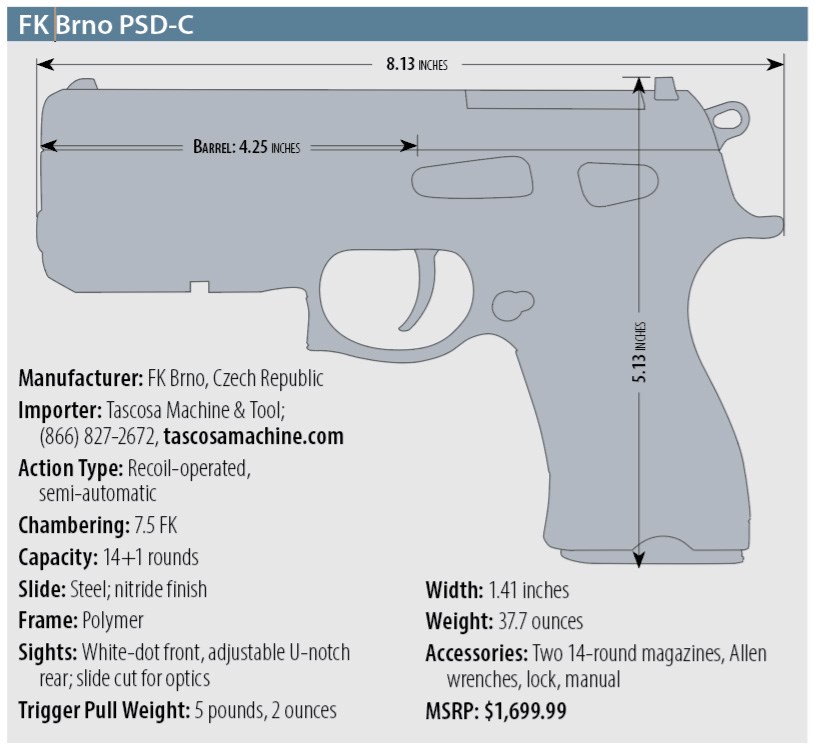
Most Popular