When it comes to reloading, a cardboard box brimming with .357 Mag. or .223 Rem. brass represents a daunting task. A powder measure eases and speeds up the process by dispensing a charge with the flip of a lever; however, before the reloading begins a handloader needs to make sure the weights of those volumes of propellant remain constant from the first to the last cartridge.
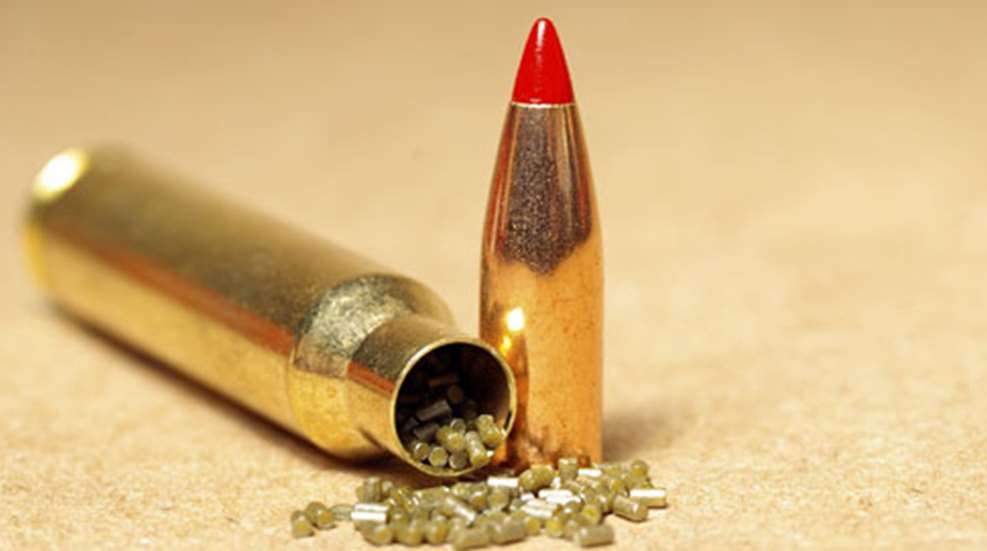
How precisely a measure meters out propellant depends a great deal on the shape and size of the granules. Flake-shaped propellants pack tightly in a measure. But some, like Alliant’s Unique and Steel, are rather fluffy, which can lead to variations in dispensed weights. Cylindrical-shaped propellants vary quite a bit in length. These “stick” propellants with shorter granules, such as Hodgdon Benchmark and IMR 7828 Super Short Cut, flow easily through a measure. However, cylindrical versions with longer granules, such as H4831 and Reloder 22, fail to pack tightly in a measure’s reservoir. Such long sticks can also jam between the edge of the measure’s drum cavity and the measure. Force on the measure handle vibrates the apparatus and throws off the dispensed weight. Spherical propellants, such as the entire Ramshot line, closely pack in a measure reservoir and meter easily.
Properly operating a measure can decrease propellant weight deviations. A measure firmly mounted on a bench or screwed into a progressive reloading press keeps vibrations to a minimum. Throwing the handle up and down with the same force and cadence also helps keep weights consistent. Too, keeping the hopper near the same level lends a hand in throwing uniform charges. My Ohaus measure nearly filled with Alliant Power Pro 2000-MR spherical propellant varied only 0.1 grains-from the 37.0 grains it was set on-for the first 10 cycles of the measure. After 35 cycles, though, the propellant level in the hopper had dropped quite a bit, and the charge weight decreased 0.4 grains.
Placing a baffle in the bottom of a reservoir helps keep propellant at an even pressure as the reservoir drains. With the baffle in place to regulate flow, 37.0 grains of 2000-MR dropped only 0.2 grains after 35 cycles.
Shooting Results
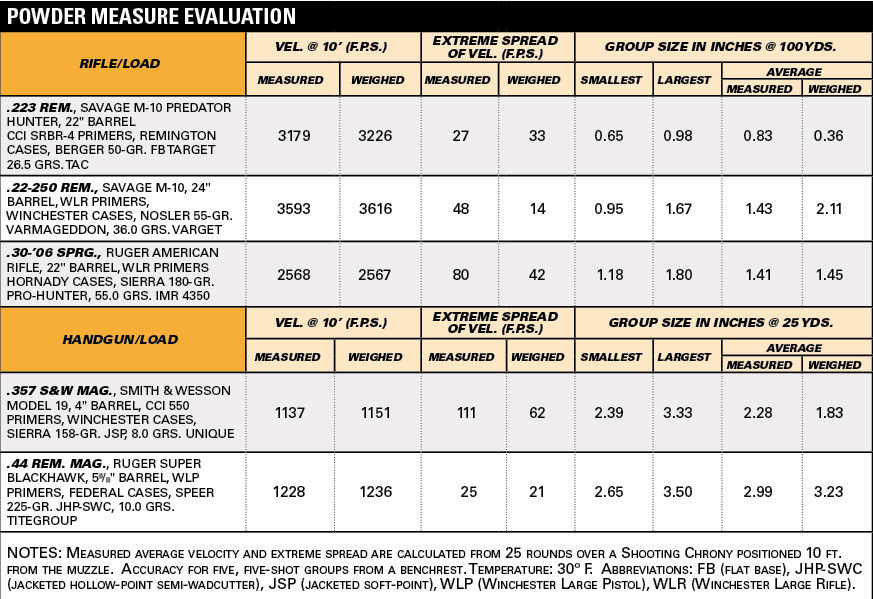
To determine velocity variations with metered versus weighed charges I tried several different propellants in two revolver cartridges and three rifle cartridges and shot five, five-shot strings with each load. A five-shot string, with propellant weighed to 0.1 grain, was also fired with each of the five loads as a comparison.
Ramshot TAC is a fine-grained spherical propellant that compacts tightly in a measure’s reservoir. It flowed easily through my Ohaus, and measured charges fired 25 Berger 50-grain bullets with an extreme spread of only 27 fps from the .223 Rem. That spread was a bit lower than the 33 fps from weighed TAC.
Hodgdon Varget has relatively small extruded kernels., but granules can hang up in the measure and require a jerk on the handle to drop a charge. That caused an extreme spread of velocity of 48 fps shooting 25 Nosler 55-grain Varmageddon bullets through a .22-250 Rem., compared to 14 fps with the weighed charges.
IMR 4350 was the first propellant I loaded when I took up handloading 41 years ago. I may forget birthdays and anniversaries, but my .30-’06 Sprg. load back then was 55.0 grains of the propellant with Sierra 180-grain bullets. I dribbled the last few grains of the pencil lead-size granules in with my fingers to bring the charges up to the correct weight. Using a measure was about five times faster. Extreme spread was 80 fps for the measured loads, which was about twice the 42 fps for the weighed load. Average size of five metered groups was 1.41inches-nearly the same as for the weighed charge.
Unique’s fluffy flakes do not meter precisely from a measure. After setting my measure to throw 8.0 grains of Unique for .357 Mag. loads I weighed a few charges and they varied 0.2 grain. That weight inconsistency resulted in an average extreme spread of velocity of 111 fps for the Sierra 158-grain bullets. Still, the average velocity of 1,137 fps and 2.28-inch groups for those 25 shots were very close to the 1,151 fps speed and 1.83-inch group of weighed Unique.
TiteGroup spherical propellant measured more precisely. Speer 225-grain bullets fired with measured TiteGroup had an average velocity spread of 25 fps fired in a Ruger Super Blackhawk .44 Mag., which was only 4 fps more than weighed charge. Accuracy of the measured loads was also slightly better than that of the weighed group.
From this test, it’s clear that metered charges are capable of near-identical performance compared to weighed charges. As such, this would be the preferred method for high-volume loading.