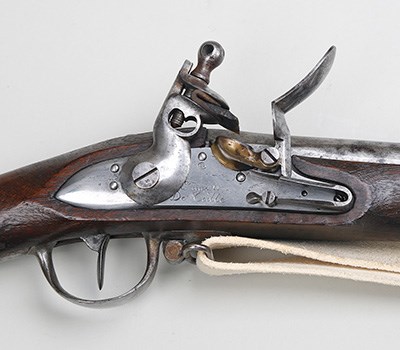
FIREARM: Fusil d’infanterie modèle 1777 corrigé an IX
MANUFACTURER: Manufacture Imperial de Tulle
CALIBER: 17.5 mm (.69)
MANUFACTURED: c. 1805
CONDITION: Fine (NRA Antique Gun Standards)
VALUE: $2,750
By the early 1700s, small arms began to take on increasingly uniform aspects. Circa 1727, the British introduced what would be the precursor to a line of fine flintlock infantry arms that, somewhere along the way, picked up the nickname “Brown Bess.” France, in 1717, fielded a standardized musket of its own, the progeny of which would later generically be referred to as “Charlevilles.”
Origins of the cognomen of the British family of muskets are still unsettled, but the French guns’ nom de guerre is easier to pin down, having been borrowed from one of the armories where they were produced—Charleville-Mézières in the Ardennes. Many muskets, carbines and pistols also emerged from factories such as Tulle and Saint-Étienne, with their lockplates noting the place of origin.
Charleville muskets are a fascinating study in improvement, having evolved from a loosely uniform pattern to what was likely the first military longarm with truly interchangeable parts.
 The individual responsible for this breakthrough, Honoré Blanc, was a French gunmaker and designer born in Avignon in 1736. Blanc, who studied military reformer Jean-Baptiste Vaquette de Gribeauval’s work, felt Gribeauval’s concept of compatibility in the construction of artillery pieces could be similarly applied to small arms. Though he tried to interest other powers in his mass-production techniques, not surprisingly, French officials, already familiar with Gribeauval, most appreciated the merits of his system.
Accordingly, the French began fielding muskets constructed using Blanc’s ideas. The signature Model 1777 was a handsome, serviceable arm that, superficially, followed the lines of the earlier 1763/66 issues but achieved a far superior degree of compatibility. This flintlock in 17.5 mm (.69)-caliber was constructed mostly of iron and steel finished in the bright, the only brass part being a forward-slanting brass priming pan. Other changes involved a slightly modified walnut stock with a generous cheek rest cut into the left side of the butt.
What really set the ‘77 apart, though, was the fact that its parts were genuinely interchangeable, produced, more or less, on an assembly line with tolerances carefully checked by precise gauging.
Manufacture proceeded apace, and ‘77s began to be turned out in numbers. Their issuance was widespread enough to arm French troops sent in 1780 to aid the Continental Army in the American Revolution. The Model 1777 was employed during the French Revolution and in various conflicts against European and British forces starting in 1791.
When Napoleon Bonaparte became First Consul of France in 1799, there was little doubt that the European monarchies were not going to leave the upstart, unsettled French Republic in peace. Large quantities of arms were going to be needed. Napoleon decided to institute a few modifications to the 1777 to streamline it.
In September 1792, the French Republican Calendar was instituted, marking its Year 1. Also, a fanciful reworking of the names and lengths of the months and days of the week was also put into effect. Thus, when, in 1800, it was decided to revamp the 1777, the new musket’s title became modèle 1777 corrigé en l’an IX (Model 1777 corrected in Year 9).
Despite its involved redesignation, modifications to the Year 9 were minimal, such as the removal of an upturn on the tip of the battery, sling swivels being riveted in place, the cock shape slightly changed, the jaw screw lengthened and the ramrod spring modestly revamped. Year 9 modifications were also carried on in further 1777 incarnations: Year 13, Model 1816 and Model 1822. This family of muskets soldiered on in service well into the first half of the 19th century.
The Year 9 here is in excellent condition with most metal parts largely untouched, with limited spotting and exhibiting much proper period brightness. The stock is in very good condition, exhibiting, among other marks, a later Garde Nationale stamping of a French cockerel with the initials “PLD” (pour le droit—“for the right”). Lock engraving affirms the piece was manufactured at Tulle. As a good, solid Napoleonic Wars vintage piece, value would be $2,750.
Most Popular