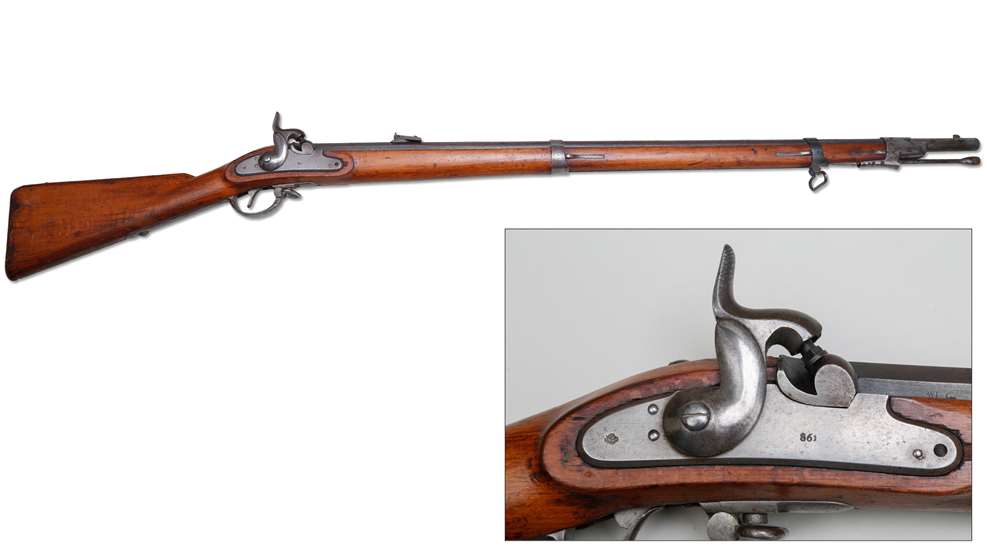
Gun: Model 1854 Lorenz rifle musket
Manufacturer: Carl Heiser (Austria)
Caliber: .58
Manufactured: 1861
Condition: NRA Fine (Antique Gun Standards)
Value: $1,850
The Austrian Model 1854 Lorenz rifle musket, designed by Lt. Joseph Lorenz around 1852, saw use in numerous European conflicts and was the third most common longarm seen in the American Civil War—its popularity being right behind that of the U.S. Model 1861 Springfield rifle musket and British Pattern 1853 Enfield. Unlike its predecessor, the Delvigne-style Model 1849 “Garibaldi” (a later U.S. nickname) Kammerbüchse that fired a round ball, the 1854 employed an interesting “compression” projectile. Though a hollow-based bullet as used in the British Pattern 1851 Minié Rifle was achieving considerable attention at the same time the Lorenz was being developed, the Austrians felt their deeply cannelured, solid-base bullet was equally promising.
The Austrian bullet, rather than relying on a hollow base to engage the lands and grooves, relied upon set-back expansion caused by the force of the explosion of the powder charge. Evaluations proved the system to be reliable and effective; thus, it was adopted in a 13.9 mm (0.5473") rifle musket version and designated the Infanterie Feuergewehr M1854. The rifle itself, ultimately manufactured by a number of contractors, was seen in two basic versions—one with a fixed block rear sight adequate for the normal ranges encountered by the majority of Austrian infantrymen and another with an adjustable rear graduated from 300 to 600 schritt (paces) for longer-distance use by NCOs and chosen marksmen.
First issued to Austrian infantrymen in 1855, the Lorenz received its baptism of fire during the Italian Second War of Independence (1859). It was a sturdy percussion arm with a full-length beech stock, all-iron furniture, a 37½" barrel, an overall length of 52½" and a weight of 9 lbs., 7 ozs.—specs not all that different from the U.S. Springfield Model 1855 rifle musket and the British P53 Enfield. Though it proved a more-than-adequate arm, the Lorenz evolved over its production time from the initial version to an “improved” Model 1862, which saw such changes as universal adjustable rear sights, walnut stocks, steel barrels and more streamlined lockplates.
The plates were normally marked with an Austrian Eagle proof and the date of manufacture expressed in three numerals, eliminating the initial “1.” Contracts were issued by the Austrian government to a number of makers, so interchangeability of parts could be a problem. As well, minor bore variations often affected accuracy to greater or lesser degrees.
With the outbreak of the American Civil War, purchasing agents from both the United States and the Confederacy descended upon the Austrians, snatching up as many Lorenz rifles as possible. While the original caliber of the gun was .54, arrangements were made to have quantities of these arms bored out to handle the more common .58" or .577" ammunition used by the North and the South. Unfortunately, depending upon the maker, these altered bore sizes could vary widely, causing reliability and logistical problems. The schritt rear-sight markings were also considerably different from those of Springfields and Enfields expressed in yards (29.8" as opposed to 36"), and it became difficult for a Lorenz-armed Yankee or Confederate to reliably determine aiming distances.
Ultimately, the Union bought 229,924 Lorenz rifles and the Confederacy bought 100,000. While the majority of U.S. Lorenz rifles were in .58 (or thereabouts) caliber, the Southern purchases were largely .54 and were normally used with Minié-style loads in that caliber, which resulted in mediocre accuracy. Finishes on export guns can vary from armory bright to all-blued, depending on the source.
The rifle seen here is undoubtedly a Northern import, as it has been bored out to .58 caliber. Its lock is dated “861” (1861), and barrel markings indicate the contractor was Carl Heiser of Vienna. The bore is quite good. Interestingly, Lorenz rifle muskets are among the few types of Civil War longarms that have actually increased in value over the past few years. A minty Lorenz can sell for as much as $3,000. This one, in NRA Fine (Antique Gun Standards) condition, is worth $1,850.
Most Popular