CCI is probably best known for its extensive line of rimfire ammunition, but the company also offers the affordable Blazer line of handgun ammo, reloading primers and now even air-gun slugs. Throughout my shooting career I’ve used lots of CCI’s innovative ammunition products, never once wondering what those three letters stood for, but always finding satisfaction with how the products performed.
I’ve always felt one of CCI’s most unique products was its shotshell loads for handgun cartridges. I’ve been a fan for a long time, particularly for venomous snakes. Timber rattlers and copperheads are abundant where I live in West Virginia, and while it’s not legal to hunt or eradicate them, provisions exist for property owners and farmers to legally dispatch them around sheds, structures, gardens and fields. Additionally, in a similarly legally authorized control situation in Africa, I used a 9 mm CCI shotshell to take care of a seriously venomous boomslang snake lurking beside a residence where young children were playing.
One of the newest handgun shotshells from CCI is the 10 mm load available with No. 9 lead or No. 8 bismuth shot for locations where lead shot is not permitted. I tested the No. 9-shot version out of a Dan Wesson 1911 with a 6-inch barrel at 6, 9 and 12 feet, by shooting a 2-inch circle inside a 6-inch circle. CCI advertises a payload of 105 grains of No. 9 shot, which works out to about 140 pellets. This counted out right on the 6-foot target where 43 pellets went into the 2-inch circle and 97 went into the 6-inch circle. Based on my experience, at 6 feet, this should work very well on venomous snakes and even pests as large as raccoons and skunks with careful shots. (But, I can also tell you from experience that shooting skunks at close range can be a stinking gamble.)
At 9 feet, the center 2-inch circle contained 30 pellets, which would probably still do the trick on snakes and vermin, especially rats. At 12 feet, the effectiveness on snakes would be reduced due to only 18 pellets impacting the center 2-inch circle, but for other vermin I think you would still find success. Of course, not everyone has a 6-inch-barreled 10 mm pistol. With a 5-inch barrel, I’d reduce these performance expectations in distance by about 10 percent, and with a 4-inch barrel by about 25 percent. Like all the other handgun shotshells from CCI, they work very well when used within their limitations, and it’s advisable to first test them in your handgun. It’s worth noting that these loads generally will not fully cycle semi-automatic pistols, requiring you to manually cycle the slide after each shot.
Though not brand new, the new .22 LR Uppercut load from CCI is a great illustration of the broad spectrum of specialty rimfire loads the company offers. This load was intended to provide a self-defense option for the .22 LR in handguns, and it’s loaded with a 32-grain copper-plated, jacketed hollow-point bullet. Out of a 4-inch-barreled SIG Sauer P322 pistol, this load had a muzzle velocity of 1,274 fps, penetrated almost 10 inches in Clear Ballistics, and the bullet upset with a frontal diameter of .30 inch. Few would argue the .22 LR is ideal for self-defense, but if that’s your choice, the CCI Uppercut load is a great option.
The Blazer line of ammo from CCI has always been an affordable option for handgun shooters. The Blazer line was originally loaded in aluminum cases—mostly with full-metal-jacket bullets—however, CCI now offers reloadable brass-case Blazer loads with jacketed hollowpoint bullets. I used the 115-grain JHP load recently when I tested the new Bulwark pistol from Wilson Combat and the compact version of the Springfield Armory Echelon 4.0FC COA pistol. Out of both, that ammunition consistently turned in five-shot groups right at the 1-inch mark at 10 yards with no failures to feed, fire or function.
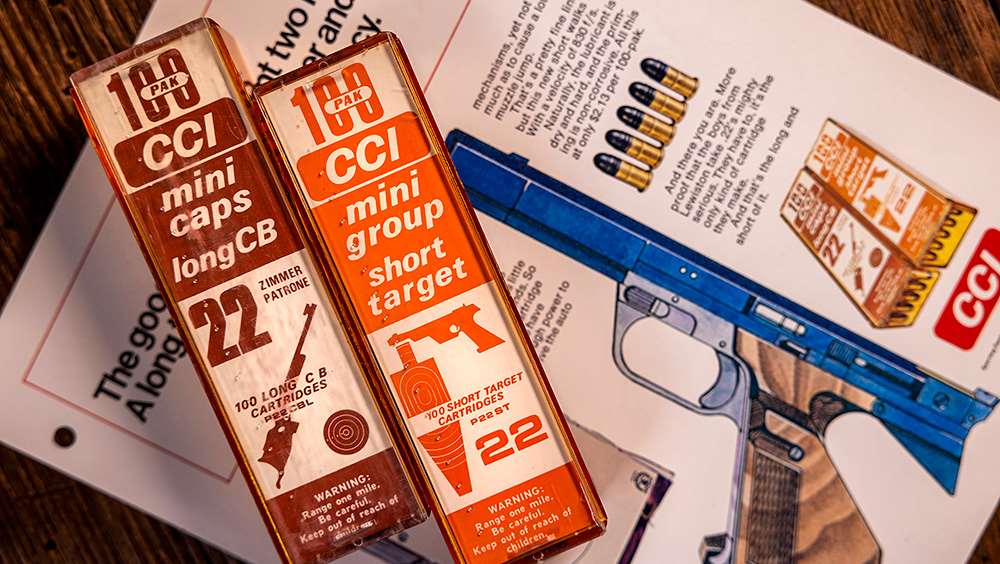
CCI began its ammunition innovation 75 years ago when Dick Speer—the brother of Vernon Speer, who started Speer Cartridge Company—decided to start his own company making primers for centerfire ammunition. He got a large contract with the military and eventually the company began manufacturing rimfire loads for nail guns. The next step was obvious; it wasn’t long until CCI was making rimfire ammunition. Eventually, CCI added rimfire shotshells, handgun shotshells and the Blazer line of centerfire ammo. Today, CCI catalogs 149 products, and it offers the largest line of rimfire ammunition and primers in the industry.
From its humble beginnings in a chicken coop located in Lewiston, Idaho, about a mile from his brother’s company, Dick Speer’s CCI has become one of the most trusted ammunition brands in the world. Yet, most shooters (including me) have never known what the “CCI” acronym actually stands for. When you pick up a box of CCI ammunition, primers and now even air-gun slugs, you’re holding in your hands a product of Cascade Cartridge Incorporated. So, the next time you find yourself gathered around the gun-shop water cooler, you can impart this tidbit of knowledge to the others present (unless they, too, are readers of American Rifleman).