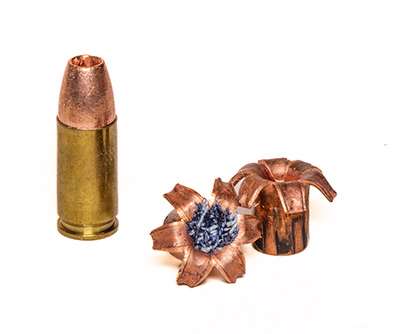
Because of the fast rotational velocities the 9 mm can produce, the modern bullets it fires tend to expand quite well over a wide velocity range from long and short barrels. This expansion is critical to the projectile causing enough disruption to stop a threat.
Americans thought they were done with the 9 mm in 1986, after the disastrous FBI shootout in Miami was blamed on a single 9 mm bullet failing to penetrate deeply enough. Immediately, .45 ACP aficionados and proponents of the then relatively new 10 mm began declaring, “I told you so,” and in less than a decade, most law enforcement agencies had transitioned to the new .40 S&W cartridge. After all, a larger-diameter bullet that hit harder seemed like it would be better at stopping bad guys.
That might have been true back then, but not so much today. The FBI’s historic shootout ultimately gave us the .40 S&W, but more importantly, it put tremendous emphasis on terminal performance—bullet design and development. It also proved that an Austrian by the name of Georg Luger actually got it right back in 1902.
Legacy American self-defense pistol cartridges like the .45 ACP (1905), .380 ACP (1908) and .38 Super (1929) all use a rifling-twist rate of 1:16-inch. A number of more modern American pistol cartridges like the 10 mm (1983), .40 S&W (1990) and .357 SIG (1994) have the same slow twist rate, and the .38 Spl. and .357 Mag. have an even slower twist rate of 1:18.75-inch. But, the 9 mm has a rifling twist rate of 1:10-inch, and that can give the cartridge an advantage.
Rifling twist rates have come to the forefront with shooters since the introduction of the 6.5 Creedmoor in 2008. Faster twist rates are mostly thought of as a way to better stabilize longer, more streamlined and more aerodynamic—high ballistic coefficient—rifle bullets. With rifle cartridges, a simple twist-rate advantage of a couple of inches can have a tremendous impact on external ballistics, especially at long range. This is because faster twist rates increase the rpm (rotations per minute) of the bullet for better stabilization while in flight. However, more rpms can also enhance the terminal performance of a bullet through rotational energy.
As ballisticians began to work to develop better bullets—bullets that would perform better in the FBI’s testing protocol—the faster rotational velocity of the 1:10-inch-twist 9 mm cartridge began to show its worth and made it easier to make bullets work better. For example, a 124-grain 9 mm bullet has a rotational velocity that is 73 percent faster than a 165-grain bullet fired from a .40 S&W. By leveraging this additional rotational energy, 9 mm bullets could be designed to perform better over wider velocity ranges, and in some cases rival and even exceed the terminal performance of bullets fired from larger-caliber cartridges. The slow twist rates and rotational velocities of other handgun cartridges—especially the .38 Spl.—are why you commonly see special short-barrel loads for them. The projectiles need to be made differently to work at slower linear and rotational velocities.
Yes, it’s true: On average, the .40 S&W and .45 ACP have more kinetic energy than the 9 mm, but it’s also true that those larger-caliber and heavier bullets require more energy to deform, and they must do their shape-shifting with less rotational energy than the 9 mm provides. The difference in linear velocity and the energy it develops, and rotational velocity and the resulting rotational energy, is that as bullets move forward, their linear velocity and kinetic energy decrease. Rotational velocity, on the other hand, degrades very minimally over distance. To put it in layman’s terms, bullets fired from a 9 mm barrel have more centrifugal force.
When you combine this mostly unconsidered ballistic advantage and how it helps to make 9 mm ammo more effective with the cartridge’s other attributes like higher capacity and less recoil, it’s easy to see why the 9 mm has become the cartridge of choice for most folks who carry a pistol for personal protection. It’s also why the new and even smaller-caliber 30 Super Carry can be such an effective self-defense cartridge in a pistol. Like the
9 mm, it, too, has a 1:10-inch rifling twist rate that produces high rpm.
When most shooters think of rifling-twist rates, they mostly think of rifles with their high BC projectiles, but the rpm of a bullet also plays a part in terminal performance. With small twist-rate increases of an inch or two, such as what has been happening with modern rifle cartridges, the advantage in terminal-performance high rpms can provide is not as evident, except at extreme range. (The 8.6 BLK cartridge, with its twist rate of 1:3-inch, is an exception.) But, with pistol cartridges like the 30 Super Carry and 9 mm, the substantial increase in rpm does make a difference in how the bullets can be engineered to upset—change shape—at different impact velocities, which is exactly what we want them to do.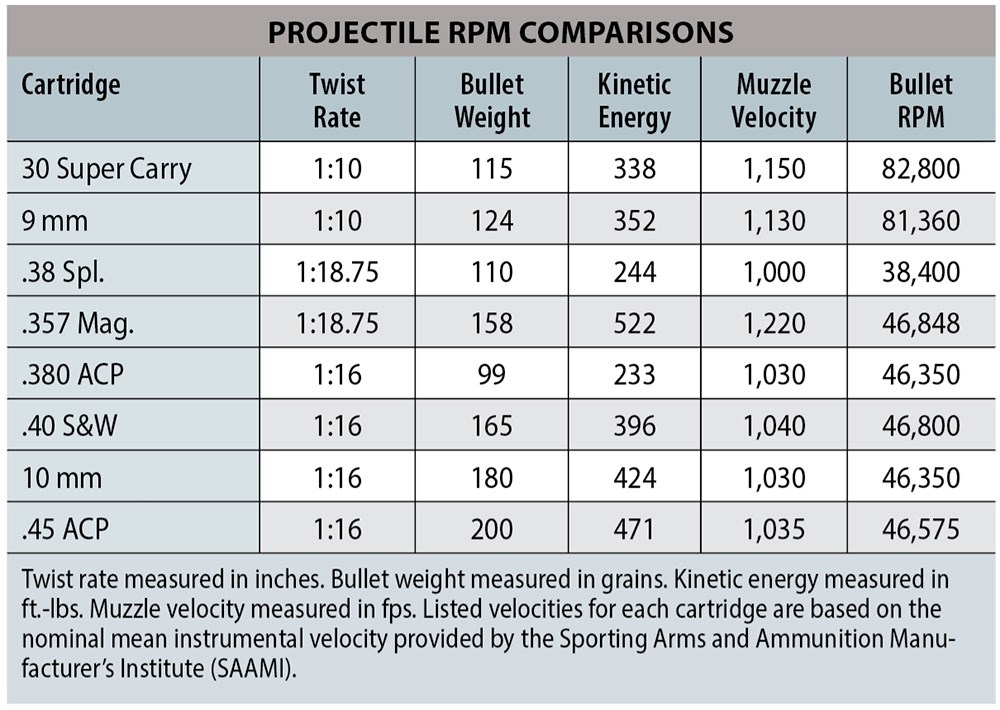
Most Popular