8/20/2012
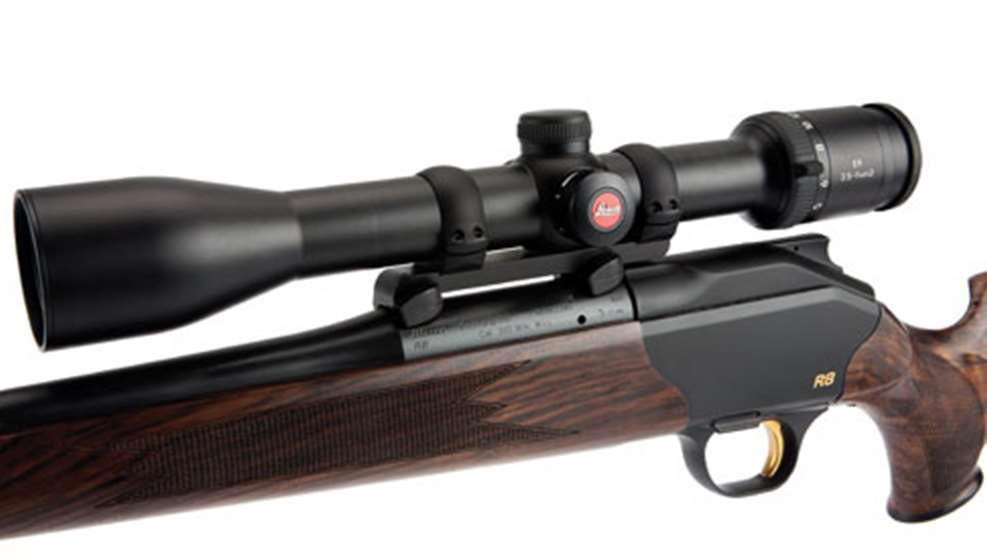
On the heels of previous aborted attempts to produce a riflescope that could live up to the excellence of its other optics, Leica unveiled its German-made ER scope series in 2009. Two models, a 2.5-10X 42 mm and a 3.5-14X 42 mm, are available with five reticle options. In addition to three familiar post and plex configurations, buyers can choose from two “ballistic” reticles, the Leica Ballistic Reticle (LBR) or the Integrated Ballistic System.
Built on a 30 mm main tube, our 3.5-14X 42 mm test unit measured 13.6 inches long and weighed 18 ounces, average dimensions for scopes in this category. Look close, however, and distinguishing features do stand out, notably a short, 2.68-inch ocular bell and lengthy free-tube areas (3.5 inches fore and 2.7 inches aft of the turrets). More tube eases mounting this scope on virtually any rifle without extension rings and also helps to ensure owners can take full advantage of the ER’s above-average eye relief, which, for our test shooters, exceeded 4 inches throughout the power range.
At the range, 200 nearly non-stop rounds of .300 Win. Mag. confirmed that our loaner was both durable and worked as advertised. Groups from the bench equaled the best ever fired from the test rifle, thus affirming the scope’s ability to hold point of impact. Precision of the 1/4-minute click adjustments also proved spot-on in “shooting the square,” wherein the 21st and final shot cut the bullet hole left by the first round.
With our scope zeroed at 200 yards, we experimented with its LBR to determine the proper holdover marks for 300 and 400 yards. Though the reticle provided a total of 20 alternating dots and hashmarks below the central crosshair, the exercise proved much easier than expected, as the first dot was dead-on at 300 and the short hashmark under it produced point of impact about 2 1/2 inches low at 400. Granted, our test Hornady Superformance GMX 150-grain load has an extremely flat trajectory; nevertheless, our results suggest that the scope’s built-in corrections will cover nearly every practical long-range scenario.
Shooters who prefer to dial-in adjustments as targets are encountered may find the clicks a bit “soft,” and that a steady hand is needed to avoid overdialing under stress. Once adjustments are made, the turret knobs can be freed by loosening with a small hex wrench, and then rotated to the “0” setting.
The ER’s matte-black finish appears to be extremely tough and resisted ring imprints. The power-change control felt stiff but smooth and was well-marked. However, markings on the parallax-correction knob were limited to “50” and “∞” and did not provide incremental references.
Notwithstanding its design advantages and infallible mechanics, the ER’s true hallmark was its optical performance. Light transmission and edge-to-edge sharpness proved to be unsurpassed in comparison to other hunting scopes we have tested in this class. There was zero discernible distortion or color-fringing. Given Leica’s track record, we took on this evaluation with extremely high expectations, and by all appearances the company is finally in the riflescope business to stay.
Importer: Leica Camera (; (800) 222-1118; www.en.leica-camera.com
Model: ER
Magnification and Objective: 3.5-14X 42 mm
Finish: matte black
Field of View (Ft. @ 100 Yds.): 32 Ft. (3.5X) 8.24 Ft. (14X)
Eye Relief: 4.12"
Click Value: 1/4 m.o.a. @ 100 meters
Windage and Elevation Adjustment Range: 32.5 m.o.a (w); 32.5 m.o.a (e)
Reticle: Leica Ballistic Reticle (tested)
Length: 13.6"
Weight: 18 ozs.
Features: side-focus knob for parallax correction from 50 meters to infinity; click-adjustable turrets
Accessories: scope cover
Suggested Retail Price: $1,479 to $1,679
Most Popular