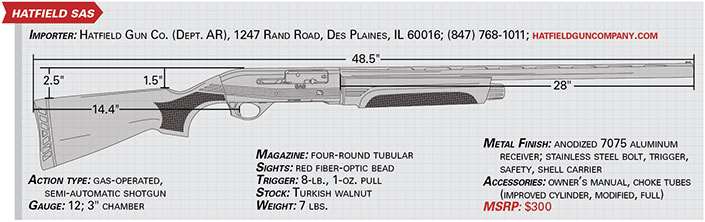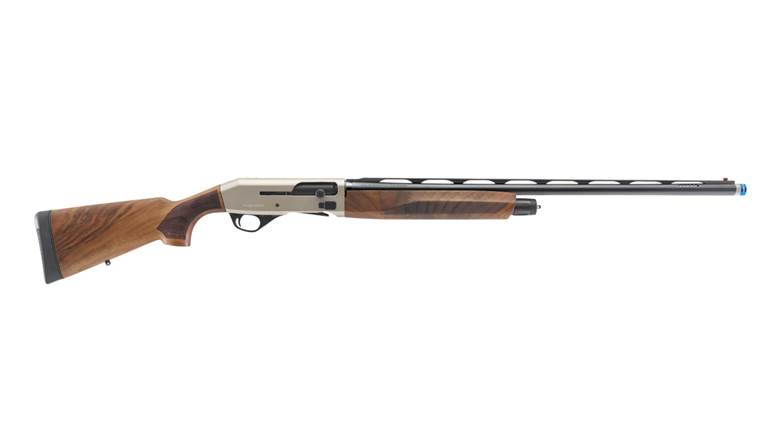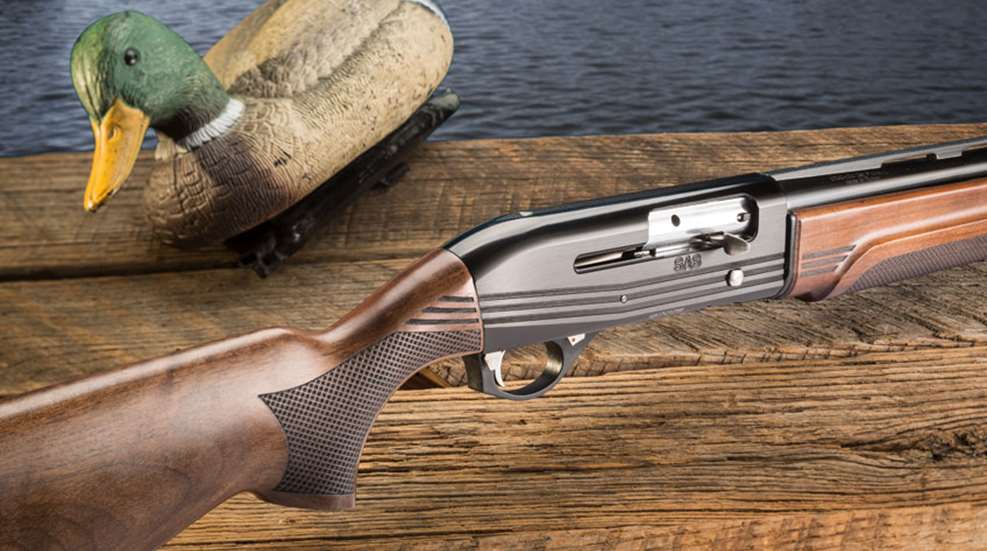
A workhorse shotgun priced for the masses, the Hatfield SAS is a 12-ga., 3", gas-operated semi-automatic that wears a walnut stock, a 28" vent-rib barrel with interchangeable choke tubes and an anodized aluminum finish. Sold principally through Walmart, the SAS has a sticker price of $300, prompting skeptics to question how Hatfield could build such an inexpensive autoloader and whether it can possibly work reliably at that price point.
In a nutshell, the SAS borrows some traits from other proven guns, and the company saves costs by manufacturing it at a facility in Antalya, Turkey. For example, the shotgun’s trigger group appears to be much like that found on Benelli semi-automatics—down to its magazine-release button that moves a shell onto the carrier from the four-round tube magazine upon demand. The trigger’s frame is polymer, while the working components, including the hammer, trigger safety, shell carrier, shell carrier spring, sear and magazine-release button, are, surprisingly, made from stainless steel. The trigger unit is held into the SAS’s machined 7075 aluminum receiver via one steel pin.
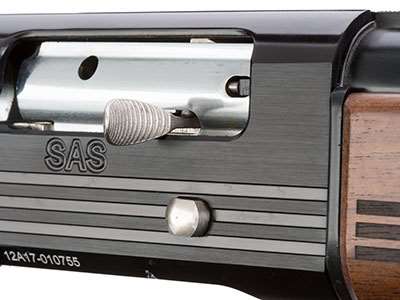
The receiver shape looks and feels much like a Remington Model 1100. Three superficial machined groves run across its length and continue a short distance across the walnut buttstock and fore-end in an attempt to add aesthetic value. Both the fore-end and pistol grip feature waffle-style checkering. A 3 1⁄8" ejection port expels both 2¾" and 3" shells. An oversize bolt-release button is located on the receiver’s right side.
The bolt, bolt body and action are unique to this design. Hatfield calls its action a “gas-inertia system;” it’s a short-piston system in which gas from the fired shell enters two ports located in the barrel’s gas ring to force back the bolt, much like most other gas actions on the market. What’s different about the SAS is that rather than having action bars directly connected to the bolt or carrier, the SAS’s 3" stainless steel bolt and 3 5⁄8" stainless carrier ride freely within the receiver so that they have little inertia and friction to overcome. Upon firing, a 2" piston welded to the left side of the gas check ring (Hatfield calls it a “thrust bushing”) strikes the bolt carrier. This starts the bolt backward approximately 2" before being opened fully by its own momentum. Then, as the spring in the buttstock returns the bolt into battery, it forces the thrust bushing back into a cocked position, ready for the next cycle.
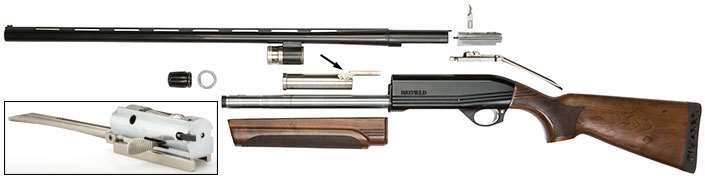
Three removable choke tubes come with the shotgun: improved cylinder, modified and full. At the end of its 28" barrel, the SAS employs a red fiber-optic front bead for the purpose of sighting. The Hatfield comes with two gas check rings that can be easily switched by simply removing the fore-end and barrel, then sliding them on or off the magazine tube. One is for heavier loads; it allows more gas to bleed from the shell without directing it into the gas ports. The standard ring features two metal O-rings that provide a tighter seal so that more gas is directed into the ports, thereby working the action even with light loads.
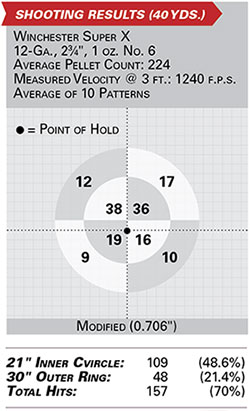 Although shotshells 1 1⁄8-oz. and above are recommended, during field testing our evaluators were curious whether the SAS would reliably cycle 1-oz. target loads. Throughout the first box of shells, the shotgun would fire but fail to load another shell fully into battery approximately 40 percent of the time. However, after adding oil to the dry gun, another 25 shells were fired through it. The second box of 1-oz. shells experienced three failures to cycle, the third box encountered only one and the fourth box suffered none. Meanwhile, heavier loads functioned perfectly. It is the opinion of the testers that the sample SAS simply required a break-in period before reaching optimal functionality. Oil it, shoot a couple boxes through it and clean the shotgun if issues are encountered right out of the box.
The Hatfield’s in-the-hands feel was surprisingly pleasant. Recoil mitigation was excellent for a 7-lb. gun. On the negative side, its oversize crossbolt safety has enough play that, if twisted slightly, loses an 1/8" of travel and its tactile, positive click. Regardless, it remains functional.
For roughly $200 over the counter, a buyer gets a lot of shotgun in the SAS. All around, the Hatfield was a higher-quality product than we expected. Fit, finish, wood quality, function (after the break-in period) were well above par for its price, and our test sample was a good-fitting, decent-handling semi-automatic that would be suitable for upland birds, ducks or clay games—and might also make a fine behind-the-seat gun as well.