Q: It seems that with the current growth of suppressor use for semi-automatic pistols some people might also have questioned whether that option exists for revolvers. Wouldn’t a gas-seal design such as the Nagant, lend itself to such an application? I would think that any such gun that didn’t allow the “spitting” of lead and brass particles and propellant gases through its cylinder gap could be suppressed. Are there any modern examples of revolvers like that? If so, I’d like to know more about them than just the campfire gun talk I’ve heard.
A: An article by former American Rifleman Technical Editor Pete Dickey (August 1986, p. 46) contains a lot of good information on this subject. It points out that attempts to seal the cylinder/barrel joint of revolvers is nothing new. The escape of gas at that joint, along with metal fragments and other products resulting from the ignition of propellant gases, both lessens the bullet’s velocity and is potentially dangerous to the shooter and anyone near him. Some of Sam Colt’s earliest revolver prototypes had a circular plate at the breech end of the barrel that covered the cylinder chambers at their muzzles. This would have done little or nothing toward improving velocity of the fired bullet, of course. And while it may have deflected the escaping gas somewhat from those standing near the shooter, it would also have contributed to the fouling of the base pin. Colt soon dropped the idea, probably because of the increased fouling, but that design was not a true gas-seal anyway.
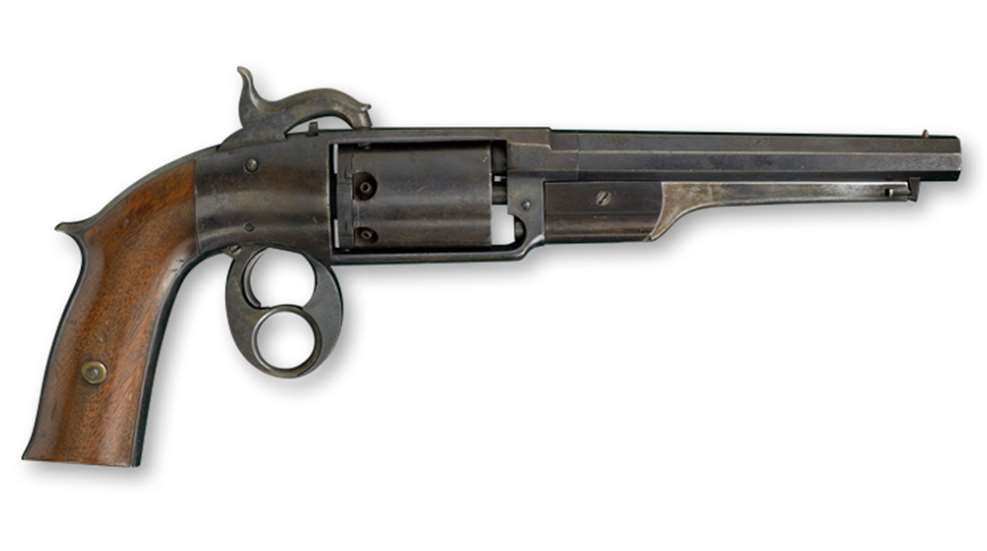
While other revolver inventors probably attempted to seal the cylinder/barrel breech gap before that, the earliest successful production revolver that I’m aware of that specifically addressed the problem was the North-Savage revolver, which was based on a June 17, 1856, patent by Henry North (Number 15,144). This revolver design included a toggle link to push the cylinder forward against the barrel to effect a gas seal. The earliest production revolver to use the patent was the “Figure 8” North-Savage revolver. Pulling back the lower trigger pulled the cylinder back, rotated it and cocked the hammer. This act also compressed a strong spring that encircled the cylinder arbor. Releasing the lower trigger allowed the cylinder to move forward under spring pressure and close the cylinder/barrel gap. The pistol was then fired by pulling the upper trigger. This certainly lessened the escape of gas, but did not truly seal the joint. Only a few hundred of the Figure 8 revolvers were made, and only about 20,000 of an improved version—the “Savage Navy” of the Civil War period—were manufactured, with about 12,000 of them being sold to the U.S. Army and Navy. They were very unpopular. The mechanism was more complicated than all other revolvers of the time (except the Starr self-cocking revolver), less reliable and more difficult to operate. Many officers and men of both the Army and Navy considered them dangerous to use.
The only other gas-seal revolver that has been manufactured in significant numbers that I’m aware of is the Nagant, which was based on a design by Henri Pieper and improved by Emile and Henri Nagant. Without repeating the history that is included in Dickey’s article, the significant points to be made are that unlike the Savage, the Nagant was a true double-action revolver with the single trigger both cocking the pistol and closing the cylinder/barrel gap. But the Nagant also uses a unique cartridge, the tip of which actually enters the barrel breech when the cylinder is moved forward and helps form the gas seal. Dickey estimated the gas seal improved the Nagant bullet’s velocity by approximately 19 percent. However, that improvement was at the cost of a very heavy double-action trigger pull that tended to negatively impact accuracy. While I don’t know of any complaints about the Nagant’s reliability, the gas-seal mechanism does also increase the pistol’s complexity and cost of manufacture, so the question becomes, is the gas-seal concept worthwhile? The answer is apparently that it is not, since there are no other mass-produced gas-seal revolvers being made. However, that is not to say that the concept is dead. I noted that a patent (US8621772 Bl) was awarded to Daniel J. Kunau on January 7, 2014, for a gas-seal revolver that uses a sliding sleeve on the breech of the barrel to make the seal. It remains to be seen whether or not it will be successful.
As you pointed out in your letter, a gas-seal revolver does have an additional advantage over a traditional revolver in that it makes possible use of a suppressor/silencer. There are videos on the Internet of Nagant revolvers being fired with a suppressor attached, and it clearly makes a big difference. But a suppressed revolver, although it would not exhibit the action noise of a suppressed semi-automatic, would still be fairly noisy comparatively; and suppressed semi-automatics seem to satisfy most of the market. The only suppressed modern revolver that I’m aware of is a small number of Smith & Wesson .45 ACP-chambered Model 625 revolvers (the PSDR-3) that were reportedly made for German SWAT teams by Peters-Stahl in the 1990s.
—Charles W. Pate
Most Popular