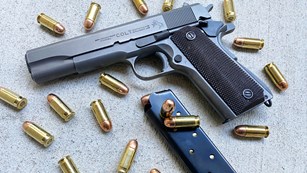
I love making and shooting lead projectiles for my 1911 pistols chambered in .45 ACP. My standard load consists of a 200-grain Lyman 452460 bullet seated over a healthy charge of Unique powder in a Winchester case, initiated by a Federal large pistol primer that chronographs slightly slower than 1,000 fps. It is more accurate than I can shoot, and it stops varmints as well as game animals decisively.
Being a fan of Colt pistols, I picked up a used Single Action Army chambered in .45 Colt not too long ago, to go along with a .45 Colt Ruger Vaquero I had purchased from a friend a while back.
It seemed reasonable to me that the Lyman 452460 bullet loaded in .45 Colt cases traveling at the same speed as the 1911 loads would be a shoo-in for accuracy and performance with these two revolvers equal to that of the 1911s.
Boy, was I wrong! The 452460 bullet that shot so well in my 1911s left lead in the barrel of the Colt revolver from one end to the other. At 25 yards, the bullets appeared to be tipping as they went through the paper as well. With the same load, the Ruger shot at an acceptable level, but left a buildup of lead at the forcing cone for no apparent reason.
Please tell me why these bullets shoot so well in my 1911s with little to no leading and so poorly with excessive leading in the revolvers. In addition, what are your suggestions for removing the lead from the revolvers and preventing this from continuing? I look forward to hearing your answers.
JW, Park City, Mont.
The fact that you are achieving success in your 1911 pistols at the performance levels you suggest indicates that the alloy of lead, tin and antimony is sufficiently hard to engage the lands of the barrel without slippage or leaving deposits behind due to gas cutting. Apparently, you are sizing the bullet to groove diameter or perhaps slightly larger, which is also a contributing factor to the performance you are getting. The amount and type of lubricant is another critical component of cast-bullet success in that it not only reduces the friction between the bullet and the barrel, but also aids in sealing the base of the bullet as it travels down the bore—preventing gas cutting on the bullet’s base, which is detrimental to accuracy.
Revolvers tend to present more obstacles to shooting cast bullets than semi-automatics because of a greater number of variables in the mechanical makeup of the gun. Semi-auto barrels are made consistent in dimension from the throat—just forward of the chamber—to the muzzle. Revolvers have multiple chambers, each with its own throat. The throat of each chamber should be within a few thousandths of an inch to the bore diameter of the barrel.
If the throat is too small, the bullet will be sized down so it will not fit the barrel, skidding on the lands and leaving lead throughout the barrel. If the throats are too large, a portion of the bullet is shaved off as it enters the smaller diameter of the barrel and is deposited at the barrel-cylinder gap. This build-up can prevent the cylinder from turning and the gun from firing. The barrel-cylinder gap itself should be regulated from .004 to .010 inch, which are considered acceptable limits.
Another relatively common phenomenon related to revolvers is the barrel is crushed slightly when it is screwed into the frame. This reduces the diameter of the bore just past the forcing cone, which causes lead deposits to accumulate there.
Couple these factors with the variables in the bullets themselves, and you can see why those that work so well in your 1911s do not fare as well in your single-action revolvers. One thing to consider specific to the .45 Colt cartridge is that bore diameter was originally .454, as opposed to the more current .452, which is a huge difference in cast-bullet terms.
In revolvers, it is important to match the bullet, chamber-throat- and barrel-bore diameters to compatible levels along with an acceptable barrel-cylinder gap. It would appear from your description that your revolvers have one or more dimensions incompatible with the bullets you are currently producing. Measuring the revolvers’ dimensions should provide the answers as to what the deficiencies are and what you need to do to achieve satisfactory performance.
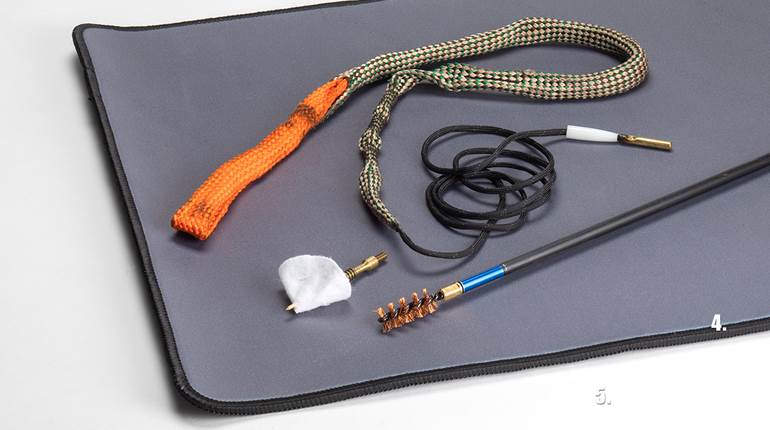
When removing lead build-up from cylinders and barrels, a good tight-fitting bronze bore brush pushed through the affected area while still warm from shooting usually does an acceptable job of removing the unwanted residue. A Lewis Lead Remover can be purchased from one of the many gunsmith supply houses to remove stubborn lead deposits that conventional cleaning methods will not eliminate.
Half the fun in shooting lead projectiles is finding the right combination that will make them shoot to your level of expectation, so don’t be discouraged.
Most Popular