Gun: U.S. Model 1841 "Mississippi" Rifle
Manufacturer: E. Remington, Herkimer, N.Y.
Serial Number: None
Condition: NRA Antique Good
Caliber: .54
Manufactured: 1853
Value: $3,400
America’s soldiers are fond of giving their favorite firearms nicknames-“Kentucky,” “Ol’ Slabsides,” “Horizontal Shot Tower”-but few are as evocative as the U.S. Model 1841 “Mississippi” rifle. Considered one of the most beautiful military longarms of the 19th century, the Model 1841 garnered its honors in a hard-fought engagement at the Battle of Buena Vista during the Mexican-American War in the hands of the 1st Mississippi Rifles, commanded by West Point graduate (and future Secretary of War and President of the Confederate States of America) Jefferson Davis.
The U.S. Percussion Rifle, Model 1841, as it was officially titled, was also known as “Windsor,” after two of its contractors and the “Jager,” (also “Yager” and “Yaeger”) because of its perceived German styling.
Initially manufactured at the federal Harpers Ferry Armory beginning in 1846 and (possibly) Springfield Armory in 1849, contracts were also given to civilian gun companies including Eliphalet Remington of Herkimer, N.Y.; Robbins, Kendall & Lawrence of Windsor, Vt.; Robbins & Lawrence of Windsor, Vt.; George W. Tryon of Philadelphia, Pa. (who also ostensibly made some 1841s for the Republic of Texas); and Eli Whitney of New Haven, Conn. The State of South Carolina contracted with Boatwright & Glaze of the Palmetto Armory in Columbia, S.C., to build 11,000 Model 1841s for state troops, though only about 1,000 were actually produced, 500 of which were incinerated when the Citadel in Columbia was razed by Union troops during the Civil War. Fakes of Palmetto ’41s are known, so potential buyers should be wary. Spurious Texas-marked Tryon guns have also been observed, as well, but as there is some speculation that none were really ever manufactured in the first place, it may be rather hard to counterfeit something that never existed.
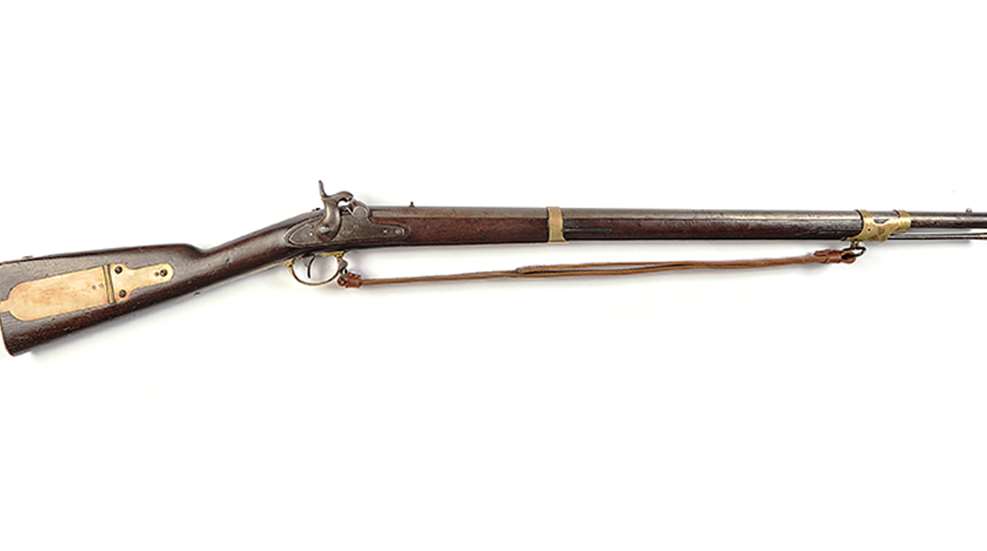
The Model 1841 measured 48½" overall, weighed 9 pounds, 12 ounces, and had a 33-inch round barrel, which was lacquer-painted brown. The lock was case-hardened and bore an American eagle with the date of manufacture on Harpers Ferry rifles, or the name of the maker and date on contract guns (excepting Palmettos). Rifling was seven grooves, and the rear sight a non-adjustable notch. All furniture was of brass, as was the front sight and head of the trumpet-shaped ramrod. The elongated butt box lid was hinged and concealed a compartment for bullet patches, nipple wrench/screwdriver tool, worm and spare nipple. The rifle had no provision for a bayonet, an omission that was criticized by many troops-the 1st Mississippi Rifles, for example, carried Bowie knives to compensate. Eventually several methods for attaching a bayonet to the Mississippi were developed.
As well as on the Frontier, Mississippis saw considerable use by both Yanks and Rebs in the early part of the Civil War-usually by state units-but their popularity waned as more Model 1861 Rifle-Muskets and Pattern 1853 Enfields became available. To accommodate newer technologies, some ’41s had their barrels re-bored to .58 caliber, and the simple notch rear sights replaced with more sophisticated adjustable long-range models.
The Model 1841 shown here was manufactured by Remington in 1853; and although no original finish remains, metal parts are sharp and exhibit a nice, even overall gray patina. Bore is fine, mechanicals tight, and the stock is excellent, still retaining its inspector’s cartouche. It is affected only by the period initials “A.J.T.” neatly incised into the butt. The butt box contains all original accessories. As such it’s worth $3,400. Generally speaking, guns with Mexican War dates will bring a premium.
Most Popular