Fred Barnes launched Barnes Bullets from a basement workshop in Bayfield, Colo., in 1932. The bullets he produced were constructed by surrounding a solid, pure-lead core with a thick jacket formed from copper tubing. These bullets were prized by hunters who bought them because of their dependable performance.
In 1974, the company was purchased by Randi and Coni Brooks with a plan to continue and expand upon Fred's legacy. The Brooks family worked diligently to grow the company using the lead core bullets they inherited, but Randy had an idea that inspired him to experiment with an all-copper bullet design. His goal was to produce a projectile that would expand rapidly, penetrate deeply and hold together when used for hunting the largest, toughest game. His work resulted in the release of the X Bullet in 1989. More than 20 years later, the company is still going strong with its current lines of all-copper bullets, including such offerings as the polymer-tipped TSX and LRX bullets for rifles, and the TAC-XP bullets for pistols.
Historically, Barnes has focused on providing bullets for both reloaders and ammunition manufacturers. About three years ago, Barnes decided to step into the factory-loaded cartridge market with its VOR-TX line of rifle, handgun and Safari ammunition. Following the success of this line, the company has launched a new-for-2013 line of self-defense handgun cartridges, the Barnes TAC-XPD.
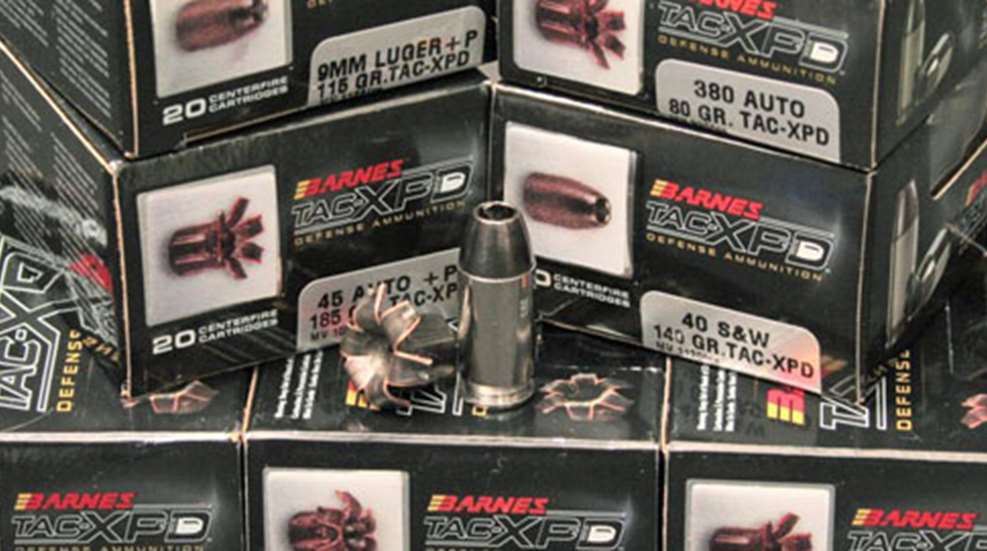
Barnes' TAC-XP bullets for handguns have been hot sellers with top ammunition makers for some time, such as ASYM Precision, Buffalo Bore and DoubleTap to name a few. Designed for use in law enforcement and personal-defense applications, this bullet contains a large, deep hollow-point cavity that expands and penetrates consistently. The all-copper construction allows them to maintain their original weight and to fly true, even after passing through intermediate barriers such as car doors, plywood and automotive windshield glass.
To get the ball rolling on this new line of products, Barnes launched its TAC-XPD ammunition in four loadings-an 80-grain .380 ACP, a 9 mm +P with a 115-grain bullet, a 140-grain .40 S&W load and a .45 ACP +P topped with a 185-grain bullet. The cases are nickel-coated for smooth operation, and the copper bullets are coated with black nickel to give them a distinctive appearance.
I had the opportunity to begin testing this new defensive-handgun ammunition with a visit to the Barnes Bullets factory, located in Mona, Utah. Along with impressive tool making, manufacturing and quality control centers, Barnes maintains a world-class ballistics and bullet testing laboratory. The setup and staff are so well respected that the company often leases them out to gun manufacturers and government agencies for product testing.
It was in this laboratory setting that I had the opportunity to belly up to a shooting bench and test fire the 185-grain .45 ACP +P TAC-XPD load. The round was fired from a benchrest using a Colt 1911 pistol with a 5-inch barrel. The test medium was 10 percent ordinance gelatin positioned 10 yards from the muzzle of the pistol and covered with four layers of denim. Both the distance of the gel blocks and the thickness of the fabric layers exceeded FBI testing requirements. At 10 yards (instead of 10 feet), the bullet penetrated 14 inches into the gel, yielding a maximum expansion of 0.763 inches. This was impressive, to say the least.
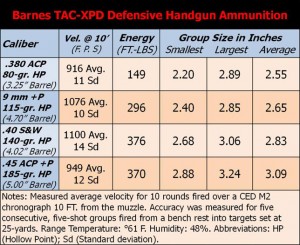
But as useful as laboratory results can be, it seemed logical to conduct additional testing out in the field. So arrangements were made for off-site testing of all four of the new TAC-XPD loadings. In order to mix things up a bit, the test-gun set included two tried-and-true personal pistols (Glock G23 .40 S&W and a Colt Government Model .380 ACP) and two factory-fresh test guns (Kimber Tactical Entry II .45 ACP and a TriStar T-120 9 mm). This test set had the advantage of representing guns that were old and new, imported and domestic, with sizes ranging from pocket pistol to full-size duty arms. Velocity was checked by firing 10-rounds over a CED M2 chronograph at 10-feet, while accuracy for all gun and ammunition combinations was verified by firing five consecutive, five-shot groups into targets at 25 yards.
The now discontinued Colt Government .380 with a 3.25-inch barrel has been a family favorite for years. Having proven to be quite accurate in the past, this pistol and ammunition combination outshot the larger handguns with the smallest five-shot group of the entire test, 2.2 inches. It averaged 2.55-inch groups with the 80-grain TAC-XP. Recoil was modest and manageable, suggesting that the .380 ACP load will be a good choice for the myriad of pocket .380s currently on the market. The fastest round of the test was the .40 S&W load fired from the 4.02-inch barrel of a Glock G23. The 10-shot average was 1,100 fps, which was only 20-feet below the published velocity.
Overall, accuracy from all the guns was excellent. The reliability required for defensive ammunition was certainly evident as there was not a single jam, failure to feed, failure to eject or misfire in the entire group.
Branching out into a new facet of the shooting industry could be a challenge for some companies. Sometimes it takes a while to work out all of the kinks and bugs before a product is at its best. This, however, is not the case for Barnes Bullets and its new TAC-XPD line of self-defense ammunition. The same dedication to quality that has made its bullets world famous is evident in the care that's been taken in developing and producing these new, fully loaded cartridges. This ammunition demonstrated a high level of performance, accuracy and reliability. Choosing handgun ammunition for personal protection requires some serious thought and testing, but the TAC-XPD is an excellent new option for semi-auto pistol owners. I’m looking forward to using this ammunition in the future, and hopefully we can anticipate the continued growth of this ammunition line with the addition of more calibers.
Most Popular