Ever since the advent of pocket sized, cartridge-powered revolvers and semi-automatic pistols, self defenders have been finding creative ways to stash them in and under their clothing. Among the more famous deep-concealment methods for small handguns has been the ankle holster. Although they don’t garner as much media attention as they used to, holsters made for ankle carry are more common than some members of the shooting sports community might suspect. Are they still a viable defensive option? The answer might surprise you.
Ankle carry has its roots in the Old West when knives and diminutive revolvers were slipped into the top of cowboy boots as backups to larger defensive tools. In the 1950s and ‘60s, when police carried six-shot revolvers on their hips, it became a common practice for officers and detectives to strap a second five-shot snubby into an ankle holster. It was this police practice that contributed to ankle-worn backup guns coming into play in the gritty cop dramas and films of the ‘70s and ‘80s.
Most of the benefits and trade-offs that came with strapping a second gun to your leg years ago still hold true today. Carrying a back-up gun has its advantages, regardless of the carry method. It provides a useful option if a primary gun suffers a serious stoppage or if it's dropped during a defensive situation. And under some circumstances, it could be passed to another responsible self defender.
Ankle carry has advantages that sometimes get overlooked. First and foremost, it relocates a second pistol well out of the way of your belt line and pockets. This is helpful if they are already being used to support or transport other items. In some cases, ankle carry may be necessary for primary carry if telltale bulges in and around the waist need to be avoided for work-related or social reasons.
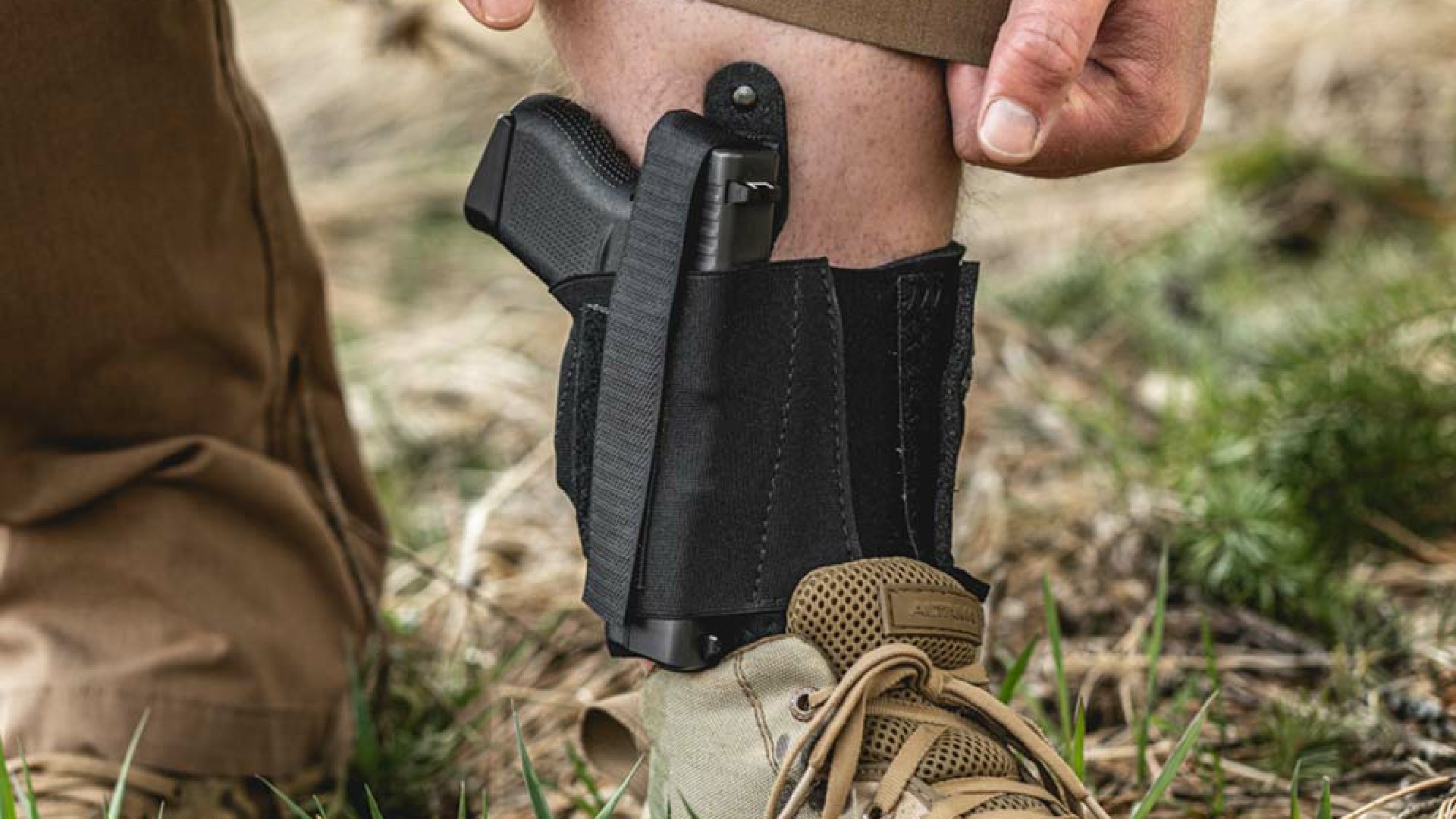
An ankle holster can provide either strong hand or ambidextrous access, depending on how it is positioned. Some of the photos of holsters included here show the pistol positioned on the outside of the strong-side leg, or a right-handed draw. This can be faster and more intuitive, like a strong-side hip holster. With the pistol positioned on the inside of the right or left calf, it can be drawn using either hand. Pulling up a pant leg and pulling the pistol out with the non-dominant hand only is not exactly the fastest draw in the West, but it will get the job done in a pinch.
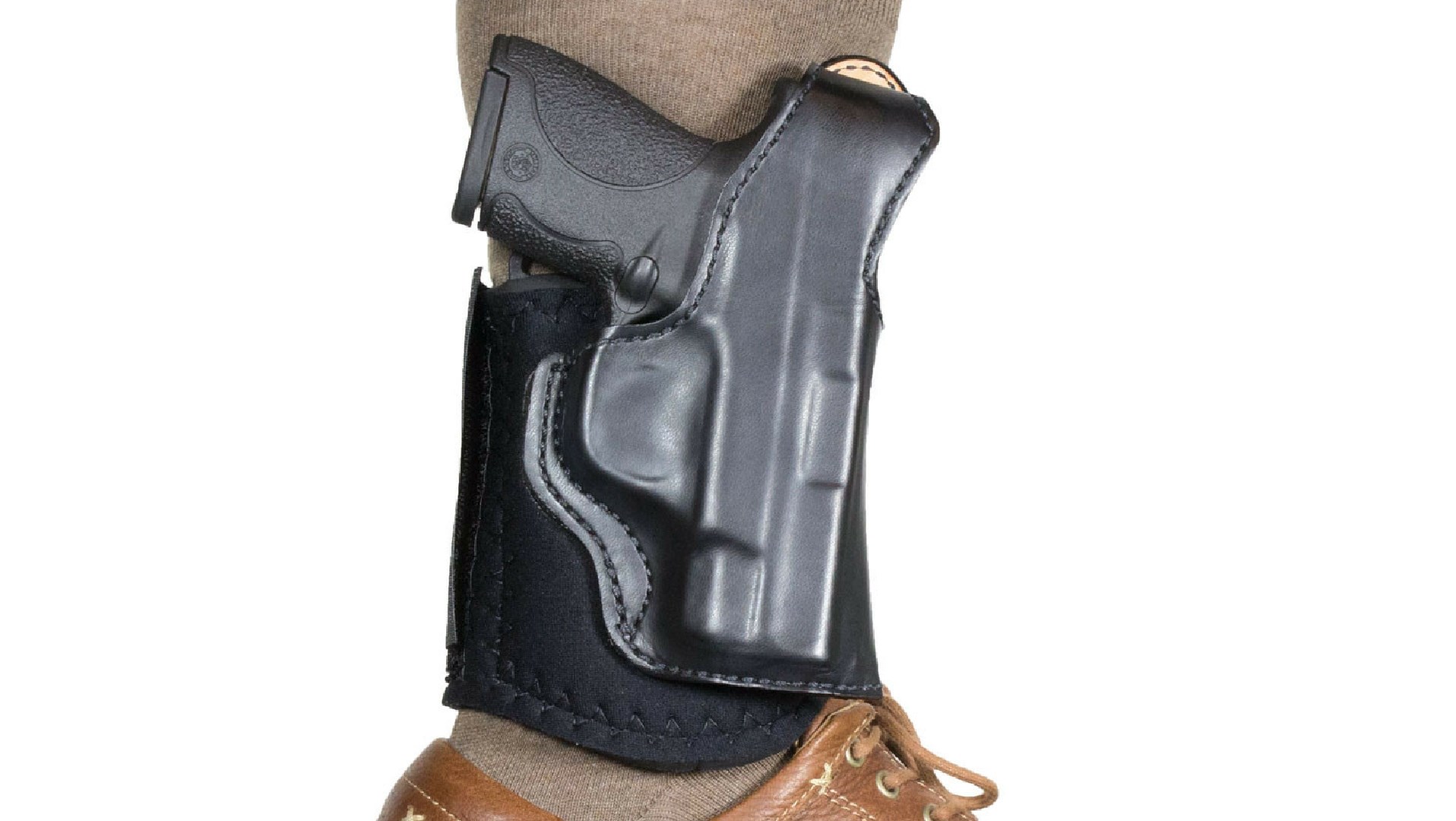
Ankle holsters are at their best when it comes to defensive situations encountered from a seated position. It can be difficult to draw a primary pistol from the hip, behind the back or from a pocket holster when sitting in a vehicle, especially when wearing a seatbelt. Some gun gurus point to appendix carry as a more accessible option when carrying at the waist. For those who have neither the body shape nor the inclination to point a gun, well, there, then a pistol in an ankle holster may be the better fit.
To be fair, ankle holsters do have notable limitations. They are functionally inaccessible from a standing position. One has to be sitting, bending or crouching down to reach the pistol. Because of their location on the body, most ankle holsters have a retention strap than needs to be pulled or unsnapped in order to draw the gun. This is an added step if you are used to a no-strap primary holster design. The holster you pick may not be a good fit with some types of footwear and it may be uncomfortable if you do a lot of walking. And depending on where you live, an ankle-worn pistol may be subjected to more dust, debris and moisture than other holster systems.
Perhaps the most prominent concern expressed about use of ankle holsters, historically speaking, is that they call for the use of a small handgun. Technically speaking, a sub-compact model like an all-steel J-Frame .38 Spl. revolver or a subcompact Glock can be fitted to and worn in an ankle holster. An acquaintance of mine gave this a try. After a night of dancing in a tuxedo with his wife while wearing a fully loaded Glock G26 strapped to his ankle, he reported that he would not be doing that again!
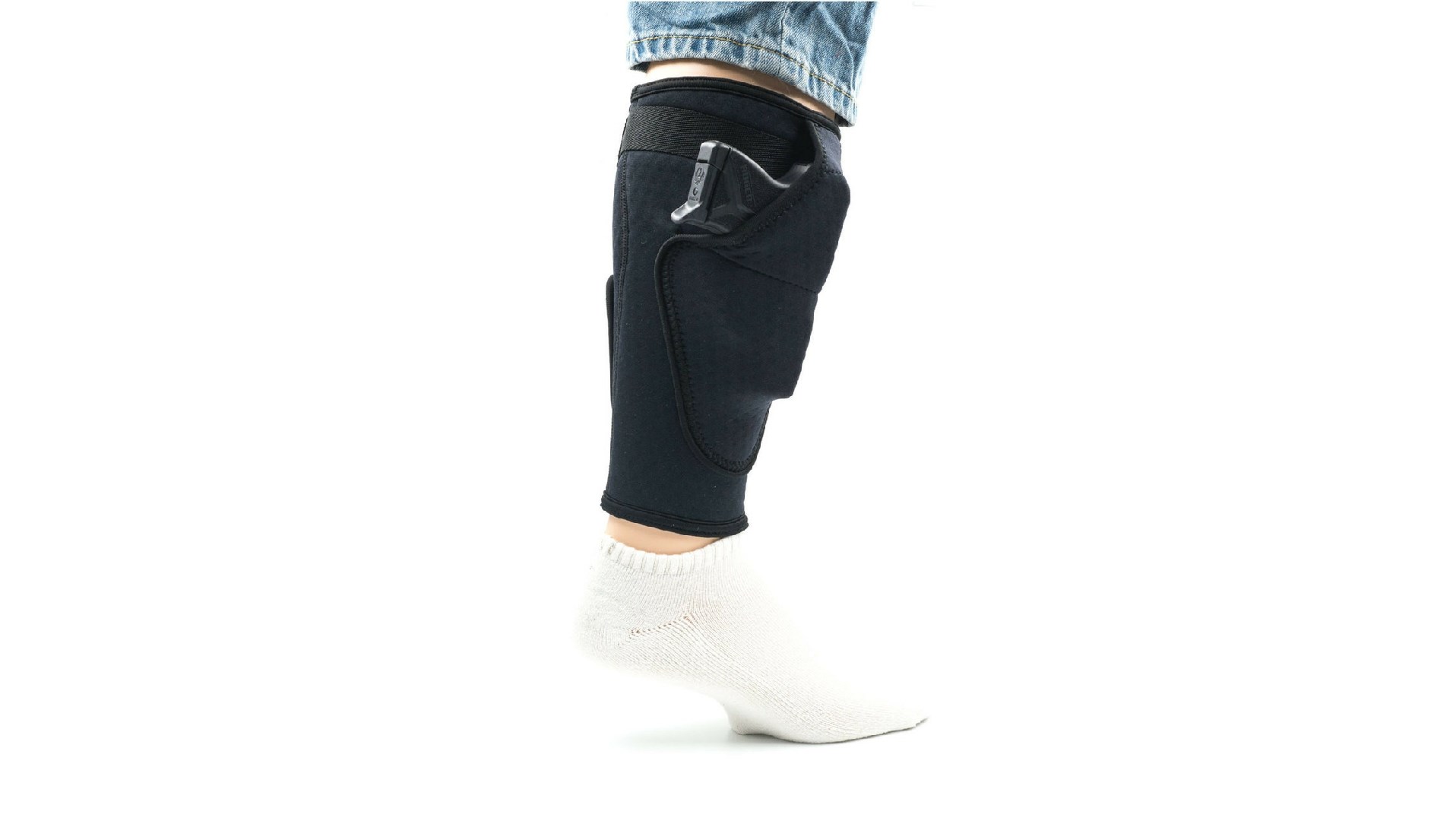
Prior to the late 2000s, a “small” pistol was one that fell neatly into the “mouse gun” class. These include pocketable semi-automatics chambered in diminutive calibers, like .22 LR, .25 ACP and .32 ACP, with single-stack magazines often limited to capacities of six to eight rounds. Although these guns are eminently portable, they lack the power, performance and features that many modern shooters prefer.
However, the modern “micro nine” pistols are a different story. The release of the Sig Sauer P365 in 2018 spurred other companies to offer their own version of a slimmed down, double-stack 9 mm pistol that is not all that much larger than the single-stack models that preceded them. And in some cases, like the Ruger LCP Max, this even-smaller pocket .380 ACP is now available with modern sights and a 10+1 ammunition capacity.
With guns like this, an ankle rig no longer has to be a mouse house. Instead it can comfortably support a small gun with a respectable performance potential and ammunition capacity. This is especially useful on those occasions in which an ankle-strapped backup has to serve as primary pistol. Is an ankle holster a good fit for your needs? With the right gun, it is still a viable option, depending on your lifestyle. But like most deep concealment methods, the only way to know for certain is to give it a try.
Most Popular