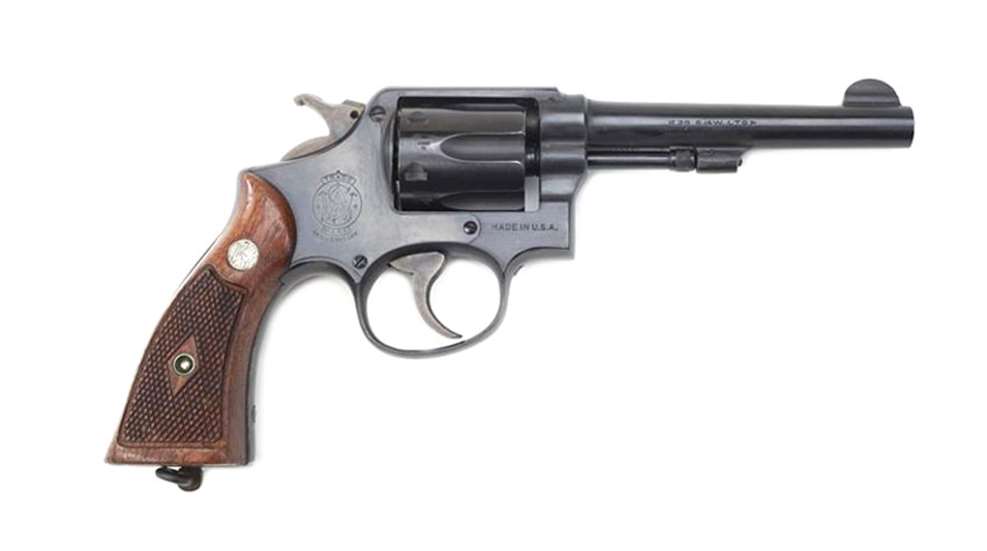
Here's a quick question for all you budding handgun historians—and you don't get to open your copy of Supica and Nahas Standard Catalog of Smith & Wesson and look it up. What is a Smith & Wesson Model 11? As a hint, I can tell you that the legendary gunmaker made the model in the hundreds of thousands. I would be very surprised if any significant number of readers knew this bit of handgun esoterica, but the discussion leads us to to a fascinating look back into American history, as seen in the Republic's ability to design and manufacture arms. The S&W Model 11 got this designation when all S&Ws were numbered in 1957, but the gun had been made since some of the darkest days of World War II. In plain terms, the Model 11 is the Military & Police Model K-frame revolver, long a standard of the nation's policemen and a gun made in the millions of copies. Most of these reliable revolvers were made as .38 Specials, but the Model 11 was a .38 S&W. The difference between the two is irreconcilable and they are in no way interchangeable.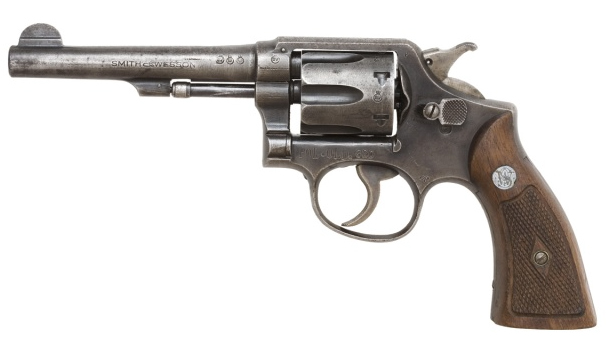
Smith & Wesson Model 10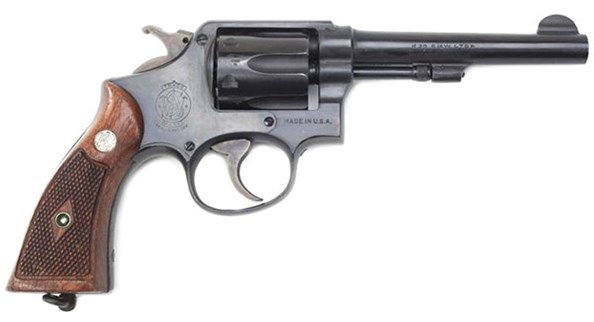
Smith & Wesson Model 11
So what's the difference? The Model 10 and the Model 11 (and their predecessors in the days before the numbering system was initiated) are almost identical. The difference lies in the dimensions of the bore and the cylinder's chambers. Let's look close at the two calibers, taking them in chronological order. First up is the .38 S&W round, which is sometimes referred to as the .38 Colt New Police. A really old cartridge, the .38 S&W dates to the late 1870s. At that point in time, the maker was expanding its line of break-top (hinged-frame) revolvers and wanted a medium cartridge to go in those slick Baby Russians. The guns had short cylinders, so a short cartridge was in order. They came up with one that was .775-inch long, with a case body .388-inch in diameter and a rim diameter of .40-inch. It was a short, stubby little round that worked well, using a 146-gr. round-nosed slug at less than 700 fps. Remember that this was a first effort to build such a thing. Hundreds of thousands of lightly constructed .38 S&W revolvers were sold by many makers. It was actually pretty much of a milestone cartridge.
But as a medium revolver round, it was doomed when the company introduced a new series of revolvers that were much stronger. The .38 Hand Ejector series was first offered in 1898-1899. Chambered for a new cartridge called the .38 S&W Special, these guns—the K-frames—have been made by the millions and are still in the catalog. They are the Model 10s and 11s that got this discussion started. The point to recall is that the .38 S&W Spl. is not a lengthened version of the .38 S&W. I have seen it in print but it is not true. Case length is 1.155 and rim diameter is .440-inch. The actual body of the case is .379-inch. Compare these with the .38 S&W specifications in the preceding paragraph. Even the barrels are different, with bore diameter at .360-inch for the .38 S&W and .357-inch for the .38 Special.
However, as the 1930s wound down, certain events brought the two cartridges to cross purposes. The United Kingdom preceded us into World War II with the Axis powers. Woefully underarmed, they chose to build their Webley short-cylinder revolvers for the .38 S&W cartridge. It was a little light for a war service round, so they came up with a unique way to give it a performance boost. They made the ammo with a rather unusual round-nosed bullet, which weighed 200 grains. Even though velocity was barely 700 feet per second, the UK forces found the combination acceptable and they called this the .38/200 cartridge. In the World War II setting, those forces grew overnight and the demand for arms out stripped the Empire's ability to produce them. Two years before we entered the war, the Brits were in it. They turned to the United States to fill the gap.
The UK Armed Forces contracted with S&W to build huge quantities of their M&P revolver, chambered for the .38/200. They were made, delivered, issued and used. When the war was over, the military went back to peacetime size. All those M&Ps were still there, but not really needed. The British Government sold them to surplus dealers—in the United States.
I well remember the surplus stores of that era (late '40s to '50s), full of $40 Lugers, $30 Walthers and $20 S&W M&Ps. The things were everywhere. Most of them had been given a rather coarse military finish, but quite a few were carefully polished pre-World War II S&W quality. They were all the old long action, much favored by old-time revolvermen. I can even remember seeing a couple of them (with new barrels and cylinders) made into superb PPC revolvers. Great buys, for the most part, but they were still .38 S&Ws and not .38 Specials. In an effort to get them sold, some of the many importers “modified” these war babies. By running a .38 Spl. chambering reamer into the .38 S&W chambers, you could create a gun that would accept .38 Specials.
It was also effectively ruined. For one thing, the bore was oversize, and accuracy is seldom good when the bullet goes skipping down the barrel. Also, since the .38 S&W's case body was larger than the Special's, it was a loose sloppy fit at the back end. Firing it usually allowed the cartridge to at least bulge and stick in place, if not split. It was a dangerous situation that would have lawyers making a fortune in these litigious times. Back in those years, it was shrugged off as the shooter's fault and “... playin' with World War II junk!” Smith & Wesson makes fine revolvers, but they can't keep them out of the hands of fools, criminals and opportunists.
The lesson here is be sure of your caliber. Fixing one of these old guns would require both a barrel and cylinder, plus the services of a revolversmith who knows how to install them. Better yet, leave the damned things alone—the .38 S&W ammo is still made and so are loading dies. Model 11 revolvers in .38 S&W haven't been made in years.
Most Popular