We are currently living in a unique moment in history—one that hasn’t been experienced before and can never be experienced again. This year marks the 250th anniversary of the founding of the United States of America. Consequently, one wonders if, a quarter of a millennium ago, our Founding Fathers envisioned that the guns used by the patriots to win our independence would come to epitomize the very concept of freedom itself. Indeed, as they noted in the Second Amendment to the Constitution 15 years later, individual firearm ownership is an inalienable right that helped solidify the nation that became America.
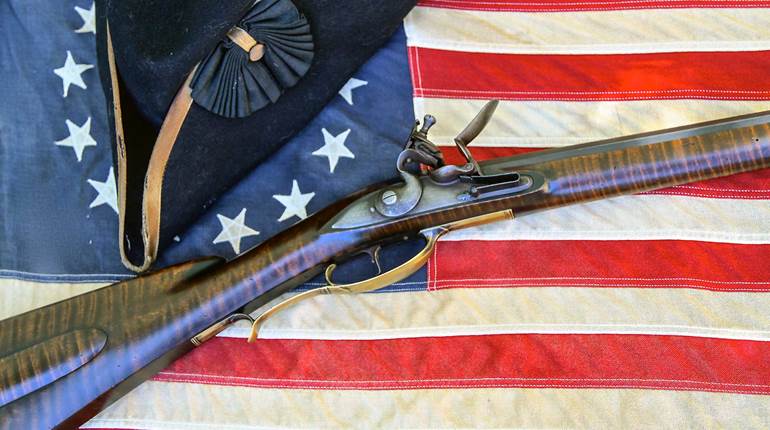
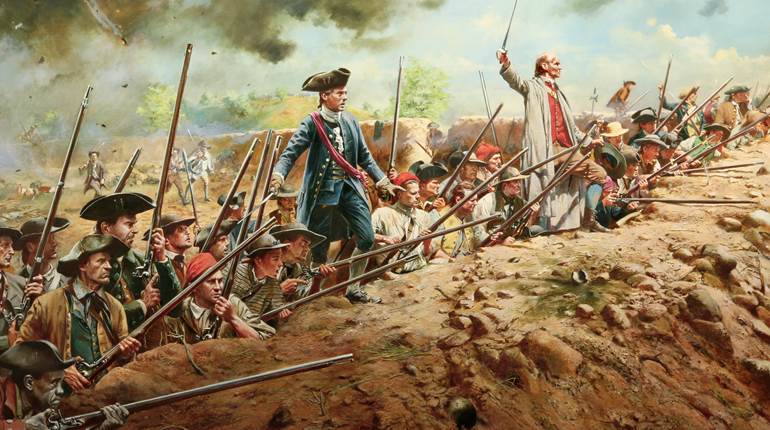
Consequently, just as the Civil War centennial of the 1960s was the impetus for much of the current-day replica industry, our country’s semi-quincentennial is now inspiring a heightened interest in replicas of the guns used in our nation’s fight for independence. But, unlike the blackpowder cap-and-ball arms of the 19th century, the Revolutionary War of the 18th century was fought with flintlocks. The British military’s Brown Bess and the French army’s Charleville muskets were well-represented in the conflict, while the colonials countered with firearms they had primarily used for hunting, including longrifles, smoothbore fowlers, German Jägers and European trade guns, along with a variety of pistols carried for close-quarter combat by both military officers and civilians alike.
In addition, numerous guns were assembled from battlefield-acquired and remanufactured parts to offset the lack of gunmaking facilities in the fledging republic, for, as noted by Richard Sullivan, the lead gunsmith at Colonial Williamsburg, “There was a very serious shortage of skilled labor in colonial America. An American shop could have produced rifles, fowling pieces and pistols in addition to (making) huge numbers of repairs.” Many of these “repairs” were actually rebuilds, mostly using captured Brown Bess stocks and assorted barrels and locks with often crudely forged trigger guards and other components. As a result, there emerged hybrid longarms that were commissioned by individual colonies and states. Few of these firearms were marked with the maker’s name, for in those war-ravaged years, the British considered colonial gunmaking an act of treason punishable by death.
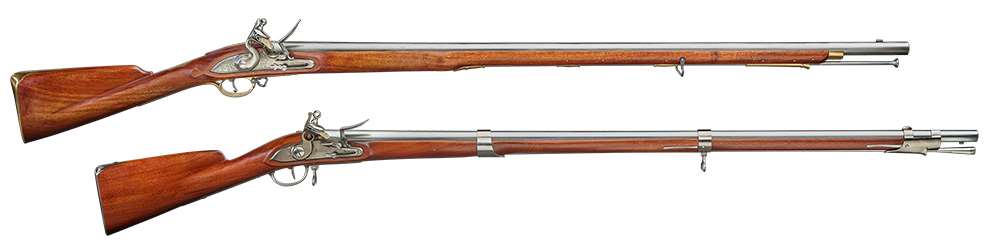
Today, many reproductions of most of the guns used by both sides of the Revolutionary War are available as fully assembled, ready-to-shoot replicas, or—should you wish to emulate those patriots who built their guns from parts—you can save a lot by building replicas.
Smoothbore military muskets are by far the most ubiquitous firearms associated with the Revolution. Specifically, the .75-cal. British Short Land Pattern Brown Bess musket was the standard infantry arm of the Redcoats, while the .69-cal. Model 1777 Charleville musket was issued to the French army that fought as America’s allies. In addition, a number of earlier Charleville Models 1763, 1766 and 1774 muskets were supplied by France to the colonists. Those guns that were conscripted into service by the Continental Army were stamped, at various times, “US,” “U. States” or “United States” on lockplates or buttstocks.
Today, the Italian firm of Davide Pedersoli is one of the largest manufacturers of ready-made, Revolutionary War-style muzzleloaders. Having owned, shot and written about its replicas over the years and having been to the company’s Gardone Val Trompia factory, I can attest not only to Pedersoli’s meticulous and modern manufacturing operations, but also to second-generation owner Pierangelo Pedersoli’s deep admiration and respect for American history. Consequently, some of the best replica Brown Bess and Charleville muskets are made by his company, specifically the Short Land Pattern 1768 Brown Bess ($1,925), the 1766 Charleville ($1,900), and the 1777 Charleville ($1,995), the latter of which is notable by its distinctive cheek rest on the stock’s left side.
Some major suppliers of these guns include Italian Firearms Group (italianfirearmsgroup.com), MidwayUSA (midwayusa.com) and Dixie Gun Works (dixiegunworks.com), which also lists a Brown Bess kit for $1,375 and a 1766 Charleville kit for $1,650. However, I have found that prices for these muzzleloaders can vary, and recent import complexities, coupled with tariffs on European products, have made them difficult to find. Internet sleuthing often proves rewarding, though.
In addition to being the U.S. importer of Pedersoli muzzleloaders, Italian Firearms Group is the exclusive source for Pedersoli’s new, limited-edition 250th Commemorative Brown Bess and Model 1766 Charleville muskets. Priced at $2,049 for the Brown Bess and $2,249 for the Charleville and limited to 50 guns each, both have special 1776 serial numbers, are hand-assembled with deluxe oil-finished stocks featuring a commemorative silver plaque and come with a certificate of authenticity signed by Pierangelo Pedersoli.
Pedersoli also makes a .54-cal. Early American Jäger ($2,500), similar to the short-barreled hunting rifles used by German colonists as well as some of the Hessians who fought as mercenaries for the British. It is available (when in stock) from the aforementioned sources. Keeping more in the traditional American longrifle style used so effectively against the British by Patriot marksmen, Pedersoli’s Frontier Flintlock in .45, .50 .and .54 calibers ($1,290) is a current iteration of the rifle produced by the late Ted Hatfield during the 1970s and ’80s.
But, if you’re handy with chisels, wood files and sandpaper, you can create your own longrifle from a number of kits that require various levels of skill. The easiest to build—even for first-timers—as well as being one of the most historically accurate and most popular, are those made by Jim Kibler (kiblerslongrifles.com), who utilizes CNC technology to produce fully shaped, pre-inletted, highly detailed stocks. These are precisely fitted to Kibler’s own Ketland or English-style locks and brass furniture and precisely mated with barrels from Rice, Colerain and Green Mountain, which in turn are shaped, rifled and crowned in-house by Kibler. All of this translates into handsome, authentically styled longrifles that can be assembled in as little as one or two long weekends, rather than the months normally required for most kits.
Kibler currently offers three maple- stocked, Revolutionary War-correct 1760s- to 1770s-pattern longrifle kits: the Colonial American in .50 caliber, as well as .54 and .58 calibers, rifled or smoothbore ($1,300); a Shenandoah Valley-inspired Woodsrunner in .45 caliber, as well as .54 caliber and .58 calibers, rifled or smoothbore ($1,350) and a smoothbore Fowler in 16 or 20 gauge ($1,475). Wood upgrades—including fancy-grade maple, cherry and walnut—are available, along with historically correct and attractive optional CNC relief carving.
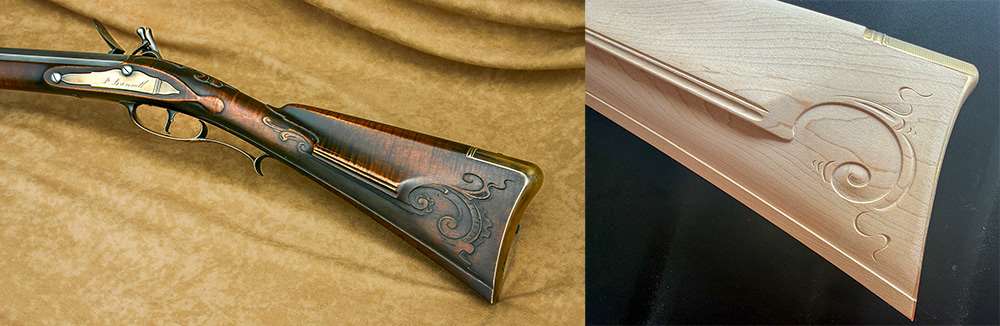
Other Revolutionary War longrifle kits are much more involved and require greater stock inletting and metalworking abilities, but of these, one of the most highly regarded comes from Jim Chambers. These kits are approximately 80 percent complete and include the company’s 1765-1775 Early Lancaster Pennsylvania Rifle in either .50 or .54 caliber, and a 1760s to 1770s smoothbore Pennsylvania Fowler in 20 gauge. Although Chambers recently retired, his muzzleloader kits are now available, priced at $1,250 each, from Calvary Flintlocks (flintlocks.com).
As its name implies, Dunlap Woodcrafts (dunlapwoodcrafts.com) specializes in wood products and consequently, it offers a wide variety of ash, cherry, American and European walnut and curly maple in varying grades for its Revolutionary War “component sets.” “Most of what you need is provided,” says Daniel Dunlap, including barrels and locks, but you still will have to come up with a few items, like a ramrod, pins and wood screws, in addition to doing the final stock shaping and inletting. The company’s Revolutionary War sets include an Edward Marshall-styled longrifle ($1,100), a Jäger ($1,100) and an English fowler ($1,500). Various wood upgrades and stock blanks are available.
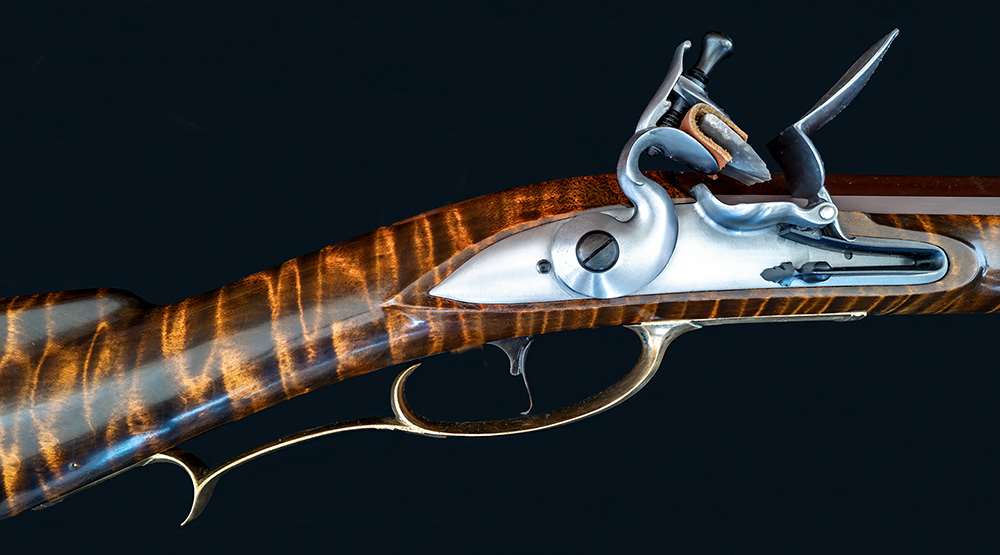
For those wishing to tackle the challenge of building a Revolutionary War replica from scratch and have the skills and tools to do so, historically correct parts can be sourced from specialized suppliers such as The Rifle Shoppe (therifleshoppe.com), Pecatonica River Long Rifle Supply (longrifles-pr.com) and Track of the Wolf (trackofthewolf.com), which, on occasion, also sells completed rifles. Dixie Gun Works is another established supplier of replica parts and accessories for muzzleloaders.
In addition, a search on online forums dedicated to such firearms, such as American Longrifles (americanlongrifles.org), The Muzzleloading Forum (muzzleloadingforum.com) and the Contemporary Longrifle Association website (longrifle.com) will bring up any number of experienced gunsmiths who can do everything from building a kit gun to creating custom-built Revolutionary War rifles, fowlers and pistols, although costs for these often run well into the loftier four-figure ranges.
Many of the better muzzleloading riflemakers are often backlogged for years, but one of the best and most versatile is David Stavlo of Lodgewood Mfg. (lodgewood.com), who uses his skills for everything from assembling and antiquing muzzleloading rifle kits for customers to creating one-of-a-kind, museum-quality replicas of 18th-century guns. He has even taken a Pedersoli Brown Bess and—by reducing the “swell” in the forestock, removing lockplate markings and installing a swivel on the trigger guard, among other details—transformed it into a Committee of Safety musket patterned after an original.
Just as a replica Brown Bess can be turned into a Committee of Safety musket, you can “Revolutionize” a kit-made fowler by cutting approximately 3.5 inches from the front of the stock to expose enough of the barrel to shim and fit a Brown Bess bayonet, as was often done by colonial patriots in their preparations against the British. Replica Brown Bess bayonets are available from Dixie Gun Works for $265.
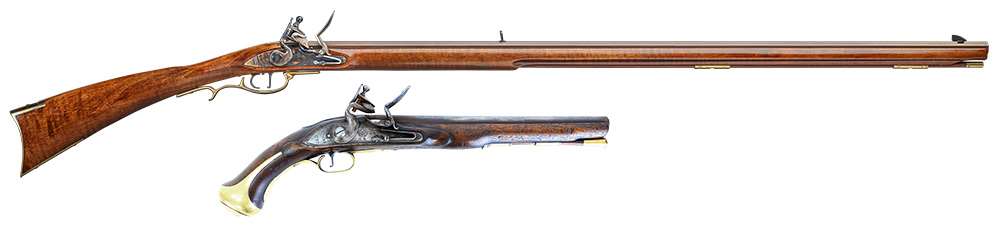
Re-working reproduction muzzleloaders to make them visually similar to the originals, which includes reshaping the stocks and adding or removing stampings, is known as “defarbing,” a term meaning “historically correct” that originated during the Civil War centennial. You will generally have to employ defarbing techniques if you’re on the hunt for a Revolutionary War pistol, as most flintlock versions on the market are of later “Kentucky” or mountain-man “trapper” styles. One of the few exceptions is the Colonial American Pistol Kit ($995) offered by Cabin Creek Muzzleloaders (cabincreek.net). Produced by the father-and-son team of Brad and Shane Emig, it is based upon the colonial gunmaking styles of eastern Pennsylvania. In addition to made-to-order muzzleloading kits and gunsmithing services, the company also offers historically correct custom-built Revolutionary War rifles, with prices depending upon the style wanted and components used.
Whether it’s factory-assembled, a do-it-yourself kit or custom-built, there is no better way to appreciate and experience the firearms of our nation’s forefathers than with replicas of the guns they used, whether for hunting, re-enacting or simply for the sheer pleasure of creating the proverbial “flash in the pan” at the range. After all, these were the guns that fought for—and won—America’s freedom.
Most Popular