Although powerful center-fire rifles may hold allure for many shooters, the humble and often-overlooked air rifle can play just as important a role. In fact, the evolution of the modern-day air rifle has resulted in offerings that are a far cry from what many envision.
The one tested here, the Tech Force Contender Series Model 89, is an excellent example of this breed of modern air rifles. Imported by Compasseco, Inc., of Bardstown, Ky., the Model 89 is manufactured in China under Compasseco's strict manufacturing directives and is backed with a limited lifetime warranty.
Mechanically, the substantial Model 89 is a spring-piston driven break-barrel action air rifle. Available in either .177 caliber or .22 caliber, the Model 89's long-stroke piston is claimed to allow the rifle to propel .177-cal. pellets at roughly 1100 f.p.s., or .22-cal. pellets at 900 f.p.s. This power level, combined with the dimensions and 7-lb., 12-oz. weight of the Model 89, make it seem more like a conventional rifle than an air rifle. Adding to this perception is the gun's construction from the traditional materials of wood and steel.
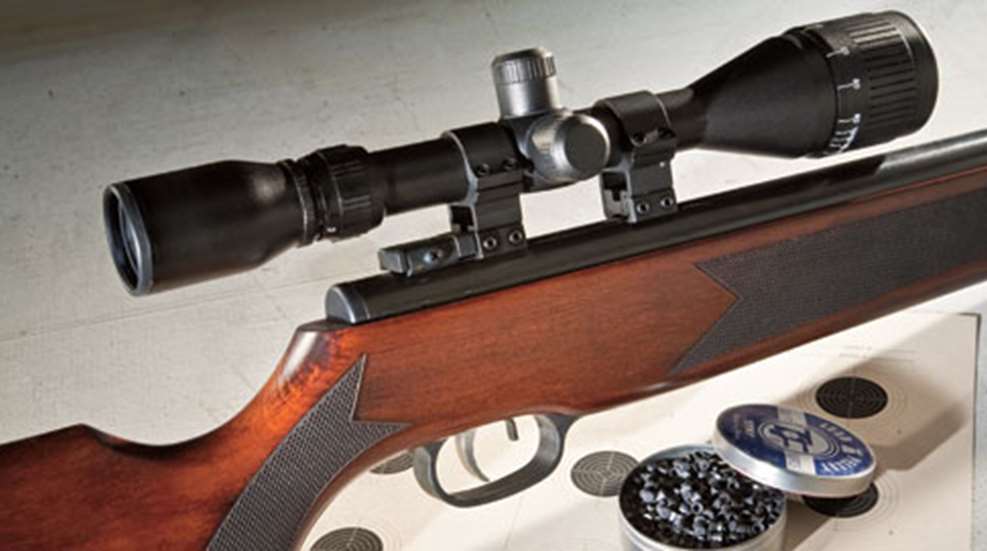
The .177-cal. Model 89 received for testing was fitted with a 3-12x 44 mm variable-power Tech Force scope fully mounted and ready to shoot. It is important to note that scopes such as this one are designed specifically for use on air rifles. As an air rifle's recoil impulse is forward due to the nature of the spring piston action, a traditional scope can be severely damaged when used on an air rifle. The Tech Force 89 sported a scope stop with a synthetic bumper pad that butted up against the back of the rear scope ring mounted on the scope-mounting rail of the receiver.
The fit and finish of the Model 89 was good for an air rifle at this price point, with the steel parts such as the 18-inch barrel and the receiver featuring an attractive blue finish on their evenly polished surfaces. The stock of the rifle is of oil-finished beechwood and sports a raised Monte Carlo comb and cheekpiece. The pistol grip and fore-end of the stock feature panels of checkering. Although one could question its necessity, a half-inch thick rubber recoil pad adorns the butt of the stock of the Model 89. The wood-to-metal fit was acceptable, although the area around the plastic trigger guard featured some uneven edges and gouges.
Although the Model 89 came equipped with a pre-mounted scope, it also sported a set of standard, barrel-mounted iron sights. They consisted of a click-adjustable rear unit with a square notch and a ramp front. Elevation adjustments to the rear sight are made with a large-elevation adjustment disk, and windage adjustments are made with a side-mounted screw.
To help wring out the best accuracy possible, the Model 89 has a two-stage adjustable trigger. By engaging a small adjustment screw located behind the trigger and accessible through a hole in the rear of the plastic trigger guard, the trigger pull of the air rifle can be adjusted from 3 to 6 lbs. Located just forward of the trigger inside the upper portion of the trigger guard is the Model 89's manual safety. Pushed forward to disengage, the paddle safety lever is automatically engaged when the break-action barrel of the rifle is opened, placing the rifle on safe as soon as it is loaded.
The Model 89 exhibits one of the more appealing characteristics of single-shot break-action air rifles-stark simplicity. To load the rifle, one simply grasps the pistol grip area of the stock with the dominant hand (keeping the trigger finger out of the trigger guard), and then uses the supporting hand to break open the action and pivot the barrel down.
Our testers noted that it takes a good deal of force to get the barrel to break open, requiring a smart slap of the hand to the top of the barrel to get it started. Closer examination revealed the source of this-a ball detent located on the lower face of the barrel's breech end just below the chamber, designed to keep the action positively closed. The added safety of this feature more than offset any concerns over the extra effort required to open the action.
Roughly 32pounds of cocking force is required to pivot the barrel through its full arc to cock the Model 89's spring piston. Caution should be taken to fully grip the barrel as it can snap back up with great force if released before the piston is fully cocked.
Once open, a single pellet can be placed into the breech end of the barrel. The barrel can then be swung back up and gently closed to lock the action. As noted before, opening the action of the Model 89 places the rifle on "safe" automatically. Once the safety paddle is pushed forward, the trigger can be pulled.
For testing, we tried the Model 89 out with a selection of three types of .177-cal. pellets from Gamo and Tech Force. The rifle performed well during testing, and accuracy was good. There were no malfunctions, and the rifle handled and balanced well. One thing noted during testing was that the safety lever had some play in both positions, without a particularly positive stop for each setting. It did function correctly, however.
Considering its modest retail price ($190 for just the rifle and $270 for the combo with the 3-12x 44 mm scope and rings), the Tech Force Contender Series Model 89 certainly offers a great deal of air rifle for the money. For those who may not have access to a range for practice with a conventional rifle or simply enjoy plinking, the Model 89 offers a lot of performance for a relatively modest sum of money.
Importer: Compasseco Inc.; (800) 726-1696
Caliber: .177 (tested), .22
Action Type: Spring-piston, single-shot, break-action air rifle
Receiver: Blued steel
Barrel: 18", blue
Rifling: 12-groove, 1:10" RH twist
Sights: Fully adjustable square-notch rear, ramp front
Trigger Pull: Single-stage, 3 lbs., 8 ozs.
Stock: Length of pull 15", 13¾"; drop at heel, 1¾"; drop at comb, 1¾"
Overall Length: 46"
Weight: 7 lbs., 12 ozs.
Accessories: Owner's manual
Suggested Retail Price: $270
Most Popular