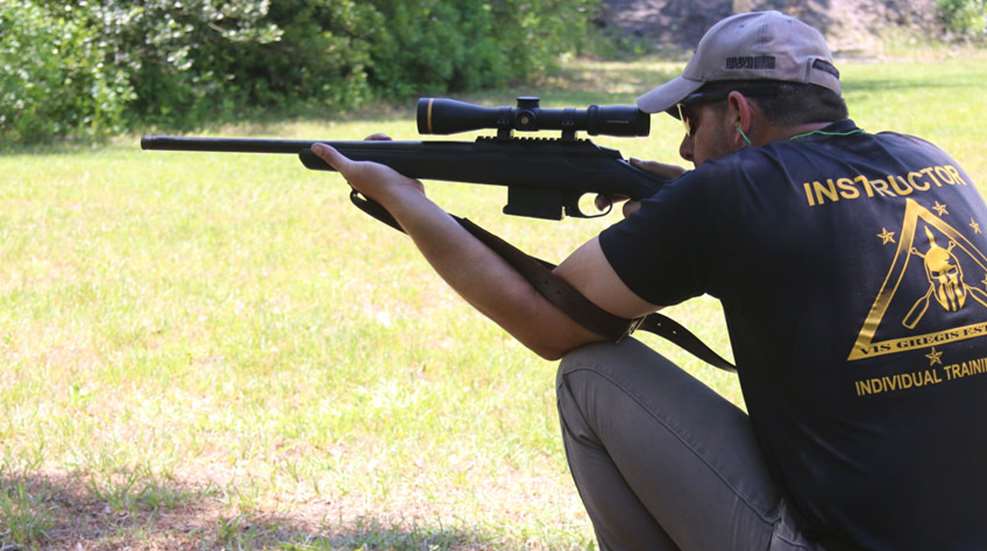
Shooters today have many options for steadying the rifle. There are more bipods on the market than ever before; tripods are increasingly popular for longer ranges; shooting sticks of every shape and size, and purpose-built rest bags stuffed with lightweight fill are readily available. However, for versatility and pure performance that is guaranteed to be with the rifle at the moment of need, it is hard to beat a good shooting sling. A shooting sling is usually some variation of the classic M1907 loop sling that allows the sling to function as a carry strap but can also be adapted to wrap around the support arm's triceps (“looping up” in rifleman speak), which allows the sling to take the weight of the rifle and connect the shooter to the gun in a structural, vice-muscular approach. The Rhodesian by Andy's Leather (starting at $75) is an excellent rendition of the shooting sling, and is a worthwhile consideration for the shooter looking to become a more capable rifleman.
There is an elegant simplicity in the design of the Rhodesian; a simple loop formed by the adjustment buckle with the running ends secured to the interior of the sling with Chicago screws. The loop length is easily adjustable, but is just involved enough to discourage adjustment on the spot. The sling length is a balancing act between firing support ideals in the prone, kneeling, and sitting positions (each having a different 'best' length for most shooters), and the length that best carries the rifle on the shoulder while simultaneously not drooping and swaying unacceptably in hand carry or offhand shooting. I set the length on my slings to be ever so slightly shorter than what might be perfect for prone, which worked out acceptably across the range of requirements.
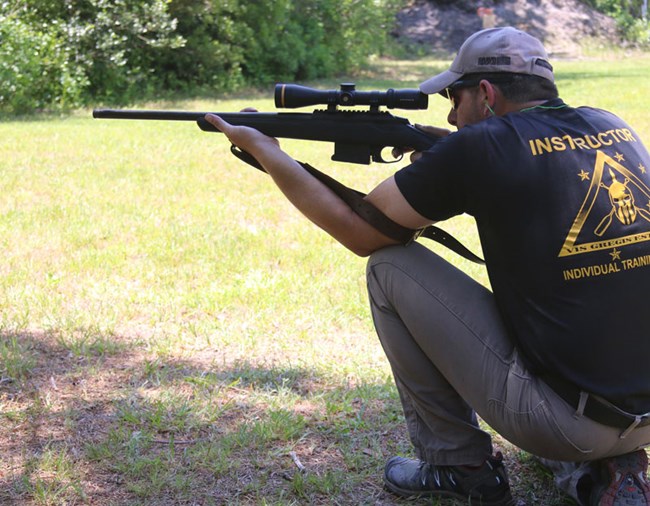
The Rhodesian's loop remains mostly open to accept the support-side arm sliding in to 'loop up' and gain stability as the rifleman's body drops into a shooting position. It is straightforward and simple, lending speed in the process. I suspect that many shooters will find they can break a better shot somewhat faster with the use of the sling than the hit they would produce using only bone support, assuming a moderate to high difficulty shot. I know that on my rifles, looping into the Rhodesian steadies the reticle or irons significantly more quickly than waiting for the rifle to settle into bone support alone. In either case, the time to acquire a correct natural point of aim from the shooting position is a sunk cost, although the sling support may help slightly if the shooter is close and pushing the rifle gently onto target.
I've used the inch and a quarter width Rhodesian on vintage rifles where it is a great fit, both complementing the look and function. Using the sling from prone I've fired groups in my Krags that are near the limit of what I can do with iron sights from a rest. The thinner one-inch model is a great match for lightweight carbines—I have them on a lightweight Ruger American Predator as well as vintage Model 94 Winchesters.
As traditional as the appearance of the leather strap is, I've found it to complement the function of the most current rifles such as the Tikka T3X CTR . After using the Rhodesian on a CTR for a while in positional training and drill development, I had an idea to directly compare the sling's performance to the benchmark of a Harris bipod, both from prone. I set up at 100 yards and fired a series of three, three-round groups at a deliberate pace from a field prone using the Harris bipod. The CTR punched nice groups with Hornady's American Gunner 155-grain boat-tailed hollow points. The bipod averaged .84 inch, with the best a .71 cluster and the worst a whisker under an inch. I suspect that from a bench or with a more substantial rear bag I could shave off a tenth of an inch or so, but it is probably fair to assume the average is a pretty good approximation of what the Tikka can do from the bipod on demand with that load.
After a short break, I looped into the Rhodesian and fired another series of three-shot groups from prone. The first launched the American Gunners into a 1.97-inch cluster, but with some variation I knew was there from where the Leupold's reticle had been as the shot broke. The next group was similar; slightly better but with one shot that pickled a bit high. By the third group I was able to put three downrange with confidence and a little more discipline, and the spread was a tight .96 inch. The Rhodesian averaged 1.60 inch and I suspect that number would tighten up some with additional strings. Even though a short test, adding an average of less than 3/4 m.o.a. to bipod-supported groups is a great level of precision from a simple sling.
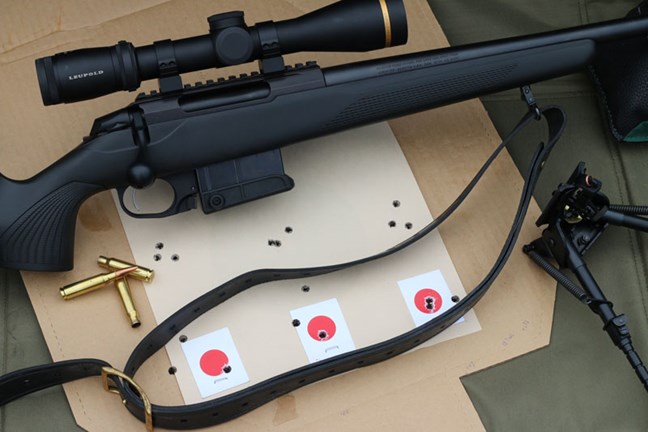
I was impressed with how well the sling had stabilized the rifle, even with the VX-6 2x12 scope run up to significant magnification I was able to keep the crosshairs swaying gently within and around the one-inch red pasters I had downrange as a precise aiming point. I was able to cut the one-inch sticker with nearly half of the shots from prone, a solid outcome that speaks to how much support I was able to wring out of the sling.
The Rhodesian will more likely be used from some type of sitting position in hunting or field conditions, and it works well in that mode also. I fired a group at 200 yards to verify the support the sling provided. The Rhodesian allowed me to consistently keep five shots in a 2-m.o.a. group from cross-ankle sitting, an eminently useful level of precision. This is both better and more repeatable than I could shoot without the sling from sitting, and a fair fight with the level of precision from shooting sticks.
There are, of course, other shooting slings on the market such as the "Ching Sling" popularized by Jeff Cooper and still offered by Galco. I like the Ching but it does require the custom installation of a mid point sling swivel and even then doesn't provide me a noticeable difference in support. The newish MagPul Rifleman Loop Sling (RLS) is a near cousin to the Rhodesian and more easily adjustable, but I prefer how the Rhodesian's leather tends to stay in place on the support arm compared to the nylon RLS.
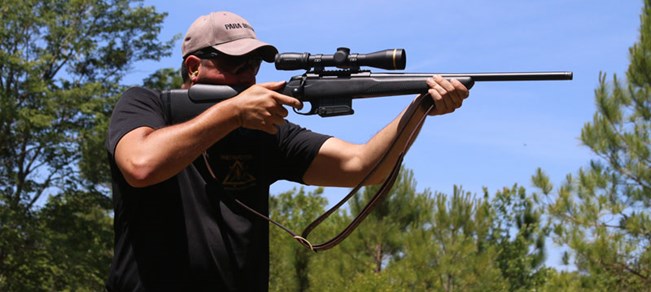
I’ve spent a sizable chunk of time connected to mother earth and a rifle with a loop sling, as a junior shooter, as a Marine on the 500, 600, and 1,000 yard lines, and recently with the Andy’s Leather Rhodesian. There is something distinctly satisfying in being completely connected with the rifle and having the sights or reticle almost perfectly still, leading to a center hit right where you intended. It is just that much more organic and rewarding than artificial support and rests. The shooting sling has the added benefit of being always on the rifle and ready to work, either as a strap to carry the weight or as a loop to "carry the load" and make the shot.
Additional Reading:
The Sling Is The Thing
Most Popular