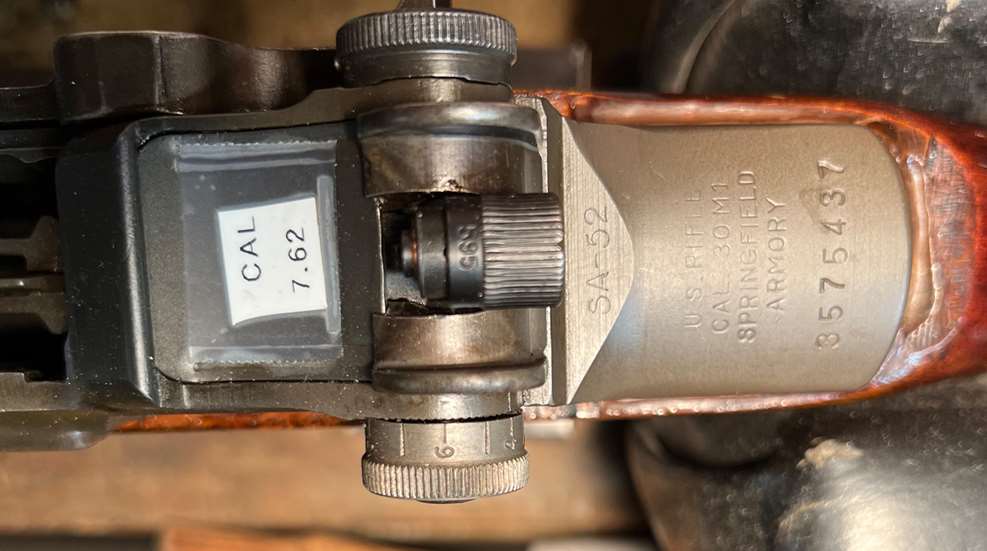
Q. We are a father-and-son NRA member tandem in search of an answer regarding the branding of an M1 Garand rifle. We own an M1 rifle that has markings indicating it was a “lend lease to England,” and it also has a .308 barrel/sleeve. The barrel markings do not indicate “NATO 7.62” as other U.S. Navy M1 models do. There are markings near the rear sight, barrel and receiver, but they do not clearly indicate the origins or history of the rifle. What does the “SA-52” marking on the area near the rear sight signify?
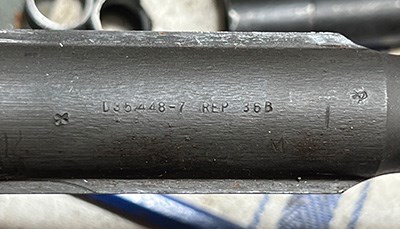
A. Your rifle’s serial number is the first piece of evidence; No. 3575437 was produced by Springfield Armory early in 1945. As you pointed out, the British proofmarks reflect its having been one of 38,000 rifles conveyed to Britain in 1941. This is supported by the date (11-41) on the exposed barrel, upside down, and partly covered by the British proofmarks. The drawing number and its revision, D35448-7 REP 36B, on top of the barrel, also translate to November 1941. As you can see, there is a disconnect with the vintages of the two pieces.
 M1 rifles were subject to repairs and refurbishing at any time during their useful lives, however, there were efforts at different times to “rebuild” numbers of rifles within a time frame, bringing large numbers up to then-current standards. One such effort was in 1952, with all rifles modified being marked SA-52. It is likely that your rifle received its new T105E1 rear sight at that time and perhaps its birch stock as well. The 1952 effort would likely have resulted in the replacement of the forged trigger guard for one of the improved stampings.
What appears to be epoxy bedding suggests that your rifle has been subject to an effort to “accurize” it and that, along with the specialized aperture affixed to the rear sight, it was intended to serve as a competitive match rifle for civilian use.
As you pointed out, any of the surviving Navy conversions to 7.62 NATO are well-marked as such, and, as we know this barrel was originally chambered for .30-’06 Sprg., the only likely conversion of the rifle to the NATO round would involve the insertion of one of the commercially available bushings. A rifle’s retention of one of these chamber bushings is always suspect and will usually result in its extraction and ejection with a fired round sooner or later. There is a possibility that your rifle features a more sophisticated bushing-retention system, but it will require closer inspection to determine if that is the case. Due to the fact that the bushing provides approximately a 1/2" of additional free bore, the accuracy of the resulting conversion can leave a lot to be desired.
Most Popular