Most of us are familiar with the idea of harnessing the resultant gas from burning gunpowder to cycle an action, but how about using it to keep an action closed? This is the exact idea behind the Walther CCP M2 line of semi-automatic pistols, and with that handgun’s design also come mitigated felt recoil and reduced racking effort.
Expanding the line for 2020 is the CCP M2 .380, and by chambering the pistol for the smaller .380 ACP cartridge, Walther has made the already soft-shooting and easy-handling CCP pistol even friendlier to fire.
Like its 9 mm Luger-chambered predecessors, the .380 CCP employs Walther’s Softcoil gas-delayed-blowback design that temporarily retards the opening of the action. This is accomplished via a piston attached to the front of the slide that rests within a cylinder below the barrel.
Following ignition of the cartridge, some of the resulting gas is bled through a port in the chamber to pressurize the cylinder, acting to hold the piston forward against the rearward force of the slide. Once the bullet leaves the barrel and pressures drop, the slide is allowed to safely blow back. The system eliminates the need for both a locked breech and a heavy recoil spring.
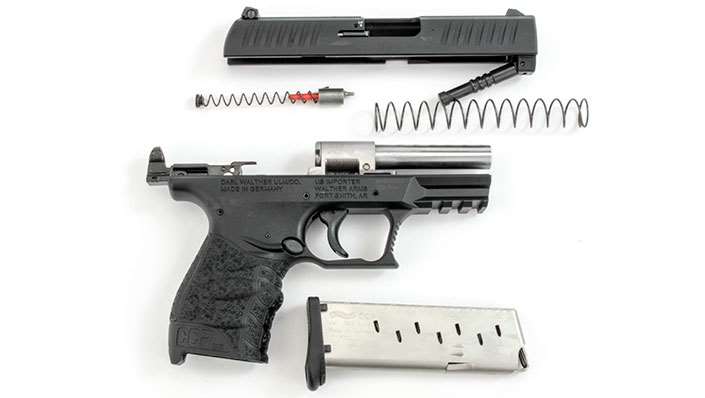
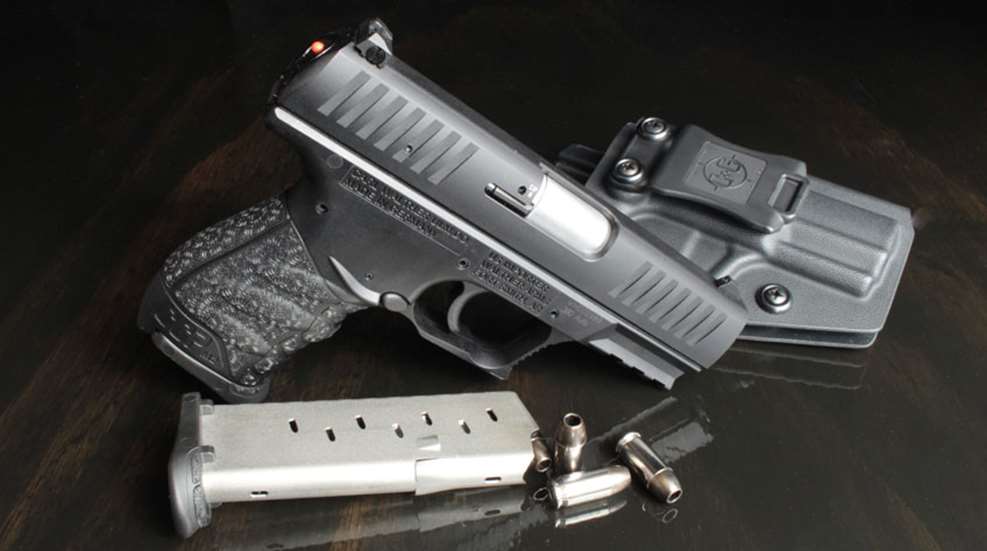
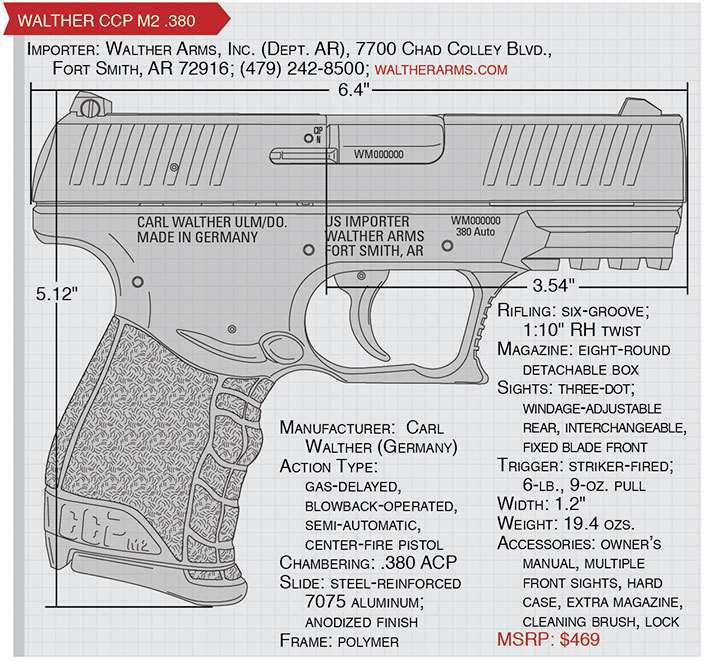
The new CCP M2 .380 employs that same polymer frame as does its 9 mm Luger big brother, featuring finger grooves and cross-directional grip texture. Directly behind the trigger guard is a reversible, push-button magazine release. Above and slightly rearward of the trigger is a low-profile slide stop, intended to be actuated by the right thumb or left trigger finger.
A fixed 3.54" barrel is mounted to the frame, delivering greater accuracy potential than conventional tilting designs. Forward of the trigger guard is an accessory rail with three Picatinny slots for accessories.
While the slide dimensions of the .380 ACP CCP M2 are identical to the 9 mm Luger versions, it differs in terms of its composition. Given that the smaller cartridge generates less pressure, the slide needed to be lighter for reliable function.
Walther accomplished this by replacing the all-steel slide of the 9 mm with one machined out of solid 7075 aluminum. In order to help ensure long-term reliability, critical stress points retained their hardened steel composition. This also shaves a few ounces off the gun, resulting in a weight of just 19.4 ozs. with an empty magazine in place.
The firearm uses a simple three-dot sight system; the rear sight is windage-adjustable, and elevation can be adjusted through an included set of interchangeable front sight posts. Serrations are cut into both the front and rear portions of the slide.
Completing the package is a hard-anodized finish in either matte black or silver to suit the end user’s tastes. The CCP M2 .380 retains the tool-less takedown system of the 9 mm Luger M2 version to ease maintenance, and Walther includes a special cleaning brush to keep the chamber port clear of debris and fouling to ensure reliable function.
Concealed carry comfort was tested with a C&G inside-the-waistband holster. Although 6.4" is a greater overall length than most pistols chambered in this cartridge, it didn’t seem to get in the way while driving or conducting other administrative tasks preceding our live-fire test. The use of an eight-round, single-stack magazine contributes to the pistol’s slime profile, as the CCP M2 .380 measures only 1.2" wide at its broadest point.
Safe carry is ensured through a passive drop safety and a left-side frame-mounted lever that disengages the trigger. The CCP also utilizes a magazine disconnect, thwarting its ability to fire without a fully seated magazine, and a disconnector prevents the gun from firing when out of battery.
In our dry-fire testing, we noticed that if the pistol is slightly out of battery it is forced closed while the trigger is being depressed and closes completely before firing, a great feature for something you might trust your life on. Another feature that adds to carry confidence is the red cocking indicator at the rear of the slide that protrudes when the striker is in the cocked position.
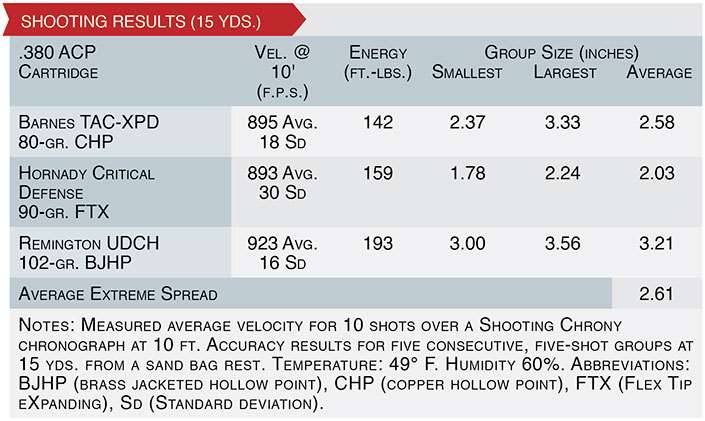
For accuracy testing, we chose the Barnes 80-gr. TAC-XPD, Hornady 90-gr. Critical Defense and Remington 102-gr. Ultimate Defense loads. The light bullets in the Barnes loading didn’t seem to generate enough pressure to completely cycle the action, thus resulting in a few stovepipes, while the Hornady and Remington loads didn’t have any issues. The Hornady FTX rounds grouped the tightest, managing a five-shot, five-group average of 2.03" at 15 yds.
Finishing the day, we conducted some close-range double-taps, and found that the Softcoil technology really lived up to its name when producing controlled pairs. The reduced muzzle flip put both rounds particularly close together in rapid engagements and drastically cut down our split times.
The only limiting factors to faster follow-up shots were the 6-lb., 9-oz. trigger pull and the 0.5" reset. However, many shooters desire these features, as they necessitate deliberate trigger squeeze and follow-up shots. We also found the trigger to be a touch gritty, but it had negligible overtravel, so we’ll take the good with the bad in this case.
Given the advancements made to modern defensive ammunition in recent years, if placed well, the .380 ACP cartridge is capable of getting the job done, and the Walther CCP M2 .380 is a great option for anybody in need of a concealed carry pistol who struggles with slide manipulation or may be recoil-shy.
It's also the rare carry gun that is comfortable enough to shoot to allow for enjoyable regular practice—which should be a major consideration during the selection process.
Most Popular