The government-run Israel Military Industry (IMI), famed maker of the Uzi submachine gun, was privatized in 2005 and its small-arms manufacturing division spun off as Israel Weapons Industry (IWI). IWI took a free-market approach to its products, updating classic IMI products, like the Uzi, Galil rifle and Jericho pistol, as well as introducing brand-new designs such as the Tavor TS12 shotgun and Masada pistol. Its latest clean-slate offering is the Carmel (following the company’s convention of naming products after geographic locations in Israel), a modular, durable and thoroughly modern sporting rifle.
Introduced in 2019 to the international military market, the Carmel fits the mold of the contemporary service rifle, which the company defines as “adaptive, adjustable, ambidextrous.” A descendant of ArmaLite’s AR-18 (and IWI’s own Tavor rifles), it uses a multi-lug rotating bolt housed in a square carrier and is operated by a short-stroke gas-piston system. Made of steel, aluminum alloy and polymer, it is customizable for user fit and optimized for modern sighting systems and accessories, such as suppressors. The modular nature of the design means it would be easier to adapt the Carmel to other cartridges and even magazine platforms, though none are offered at this time.
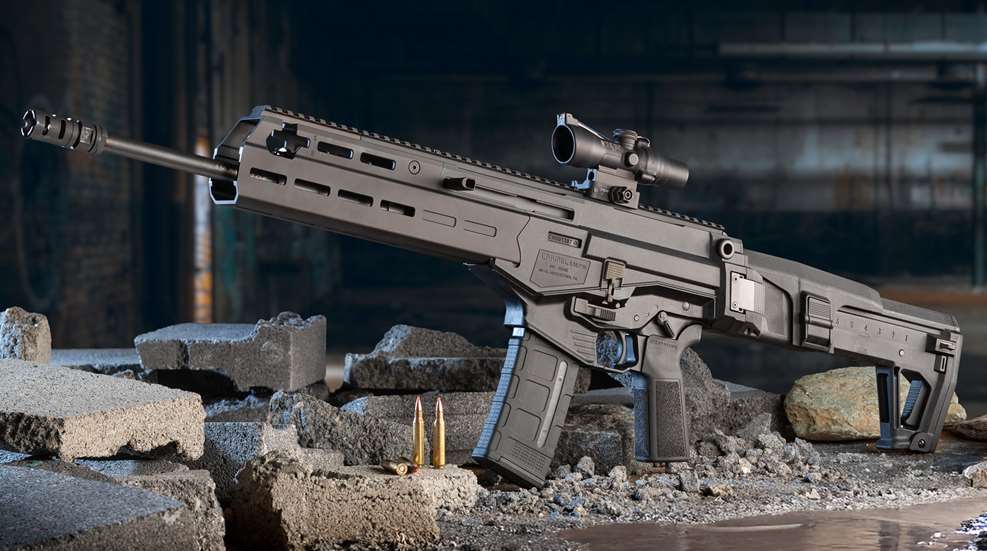
In 2013, IWI opened its own U.S. subsidiary. This allowed the company to import Israeli-made firearm components and assemble them into complete firearms with American-made parts. Such is the case with the Carmel, which was brought to the U.S. market as a semi-automatic rifle last year. At the rifle’s core is a polymer “upper,” the serialized receiver proper, which features steel inserts and that houses the aforementioned operating system. A spring-loaded dustcover closes the ejection port. A cold-hammer-forged barrel with a chrome-lined bore is free-floated within the removable fore-end. The gas system is also housed within the handguard, with a two-position, adjustable gas regulator that can be switched between “regular” and “suppressed” settings.
Fire-control components are housed within a polymer “lower” housing. Controls, including the safety, magazine release and bolt catch are placed on both sides of the rifle for full ambidexterity. The safety has a 45-degree arc to switch between fire and safe positions (indicated by pictogram “bullets” or “no bullets” markings). The charging handle is non-reciprocating and can be switched to the right or left side easily without disassembling the rifle. Making use of standard AR-15/STANAG magazines, the rifle is supplied with one 30-round Magpul PMAG.
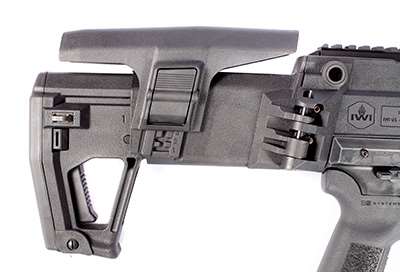
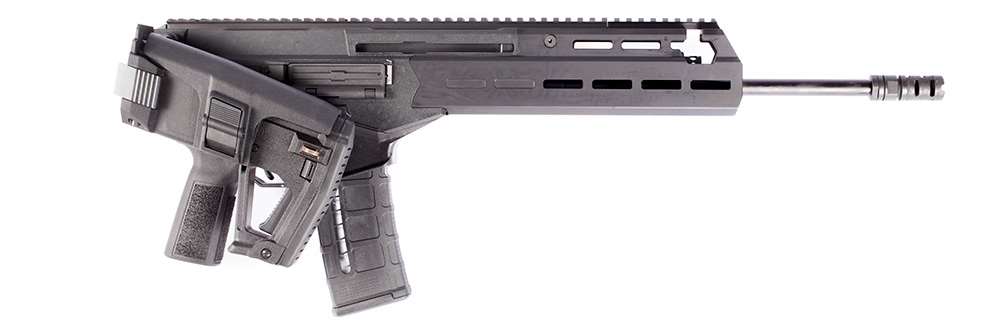
The Carmel’s buttstock telescopes to adjust length of pull at six different positions, and an adjustable cheekpiece allows the shooter to match his or her line of sight to the height of the optic being used. To make the rifle more compact for stowage, the stock folds to the right side of the rifle, but at an angle that doesn’t block the ejection port. The rifle can be fired with the stock folded, if its dustcover is already open.
Both QD swivel sockets and hook-type sling-attachment points are incorporated into the buttstock and receiver. The fore-end is aluminum with M-Lok slots for mounting accessories. No sights are supplied, but a Picatinny rail section runs the length of the upper receiver and handguard. The pistol grip is removable and is AR-15-compatible, and the rifle comes with a B5 Systems Type 23 P-Grip installed.
With the rifle fitted with a Leupold Patrol 6HD scope, we performed formal accuracy testing on the range. Accuracy averaged just under 2" for five-shot groups at 100 yards. A two-stage trigger that broke cleanly at just under 6 lbs. of pressure aided accurate shooting. The rifle’s 8-lb., 8-oz., weight and proprietary muzzle device (the muzzle has conventional 1/2x28 TPI threads) made 5.56 NATO particularly soft shooting, and the case deflector allowed for comfortable left-handed use. Reliability was 100 percent, and all testing was done unsuppressed with the gas regulator in the “regular” position. Our testing regime pales in comparison to the rigors that IWI put the Carmel through during development; the company YouTube channel has a series of videos showing the rifle passing its mud, sand, water and freezing-temperature tests with flying colors.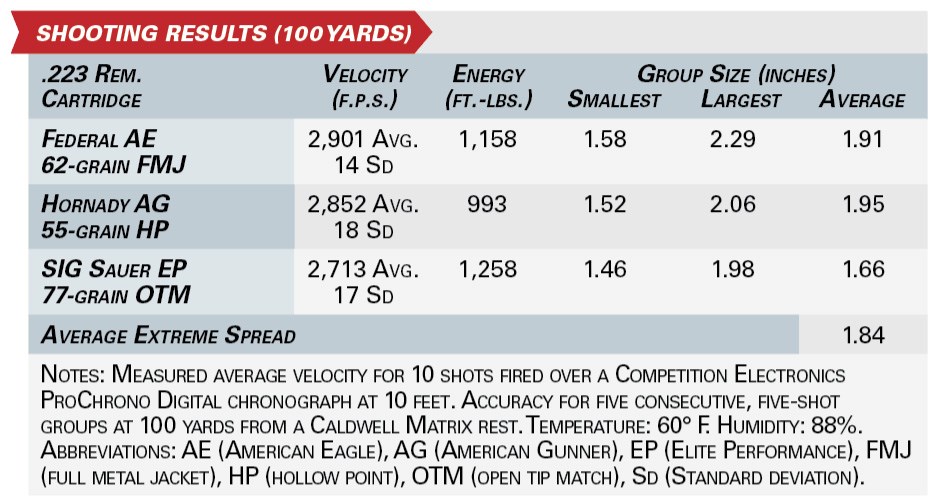
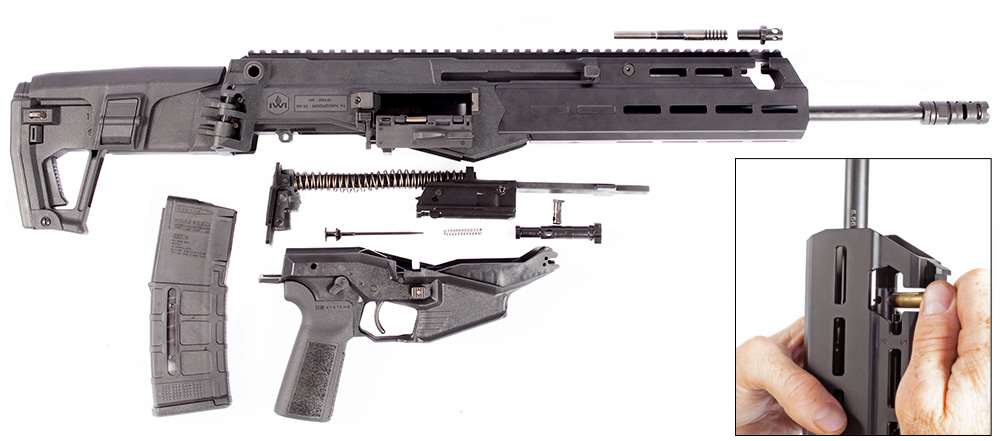
Designed to be low maintenance, the Carmel fieldstrips easily. With the stock folded, pulling the locking pins at the rear of the receiver allows the bolt carrier group to be removed. Removing another pin allows the lower housing to be removed from the receiver. The gas regulator and piston can be removed to the front with the handguard in place. All these actions, and stripping the bolt carrier group, can be accomplished without tools. The short-stroke gas system keeps the inside of the receiver clean, with the internals of the Carmel noticeably less dirty than a typical direct-impingement gas-operated firearm after our testing.
Priced at $1,799, the Carmel is more expensive than a run-of-the-mill modern sporting rifle, but its features and pedigree justify the extra expense. It is another example of IWI building on its heritage while also meeting the demands of today’s market.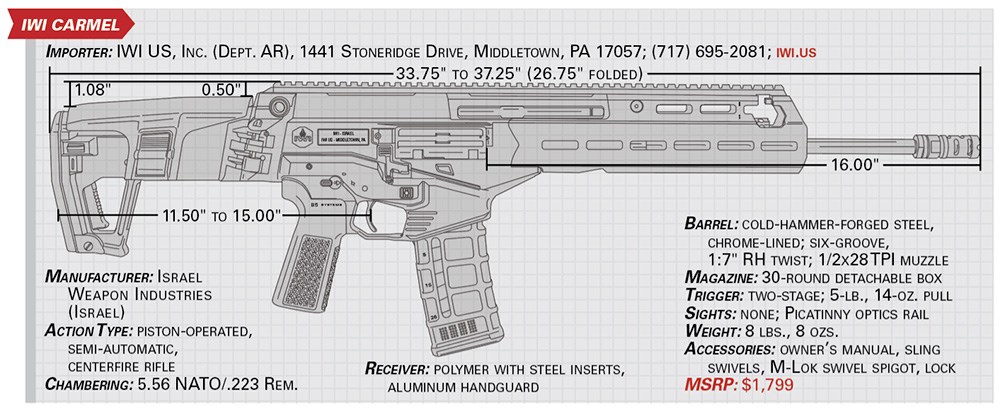
Most Popular