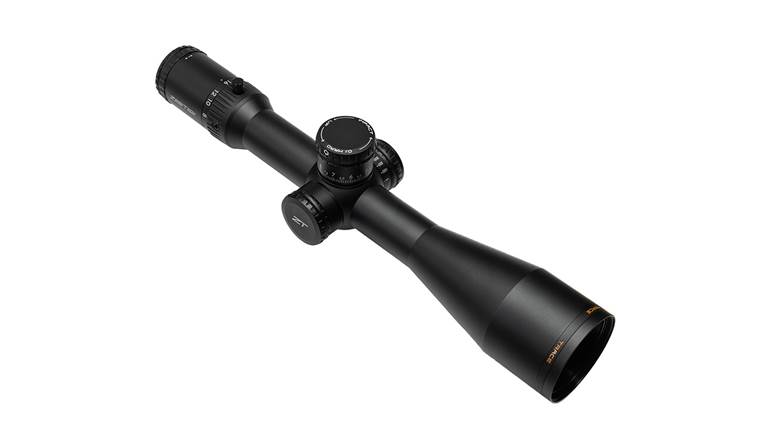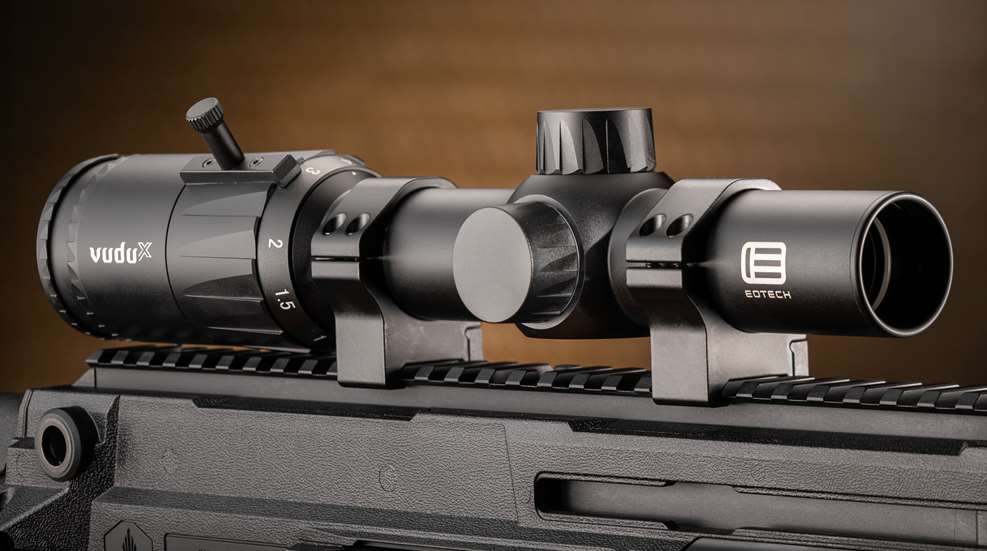
Optics manufacturer EOTech is known for its feature-rich products, but when a lower-priced line of riflescopes was proposed, the company had to give some serious thought to which features would stay and which would go. The result is the Vudu X family, a line of more affordably priced optics that delivers the utility expected from a Vudu, without any features that would be likely to go unused.
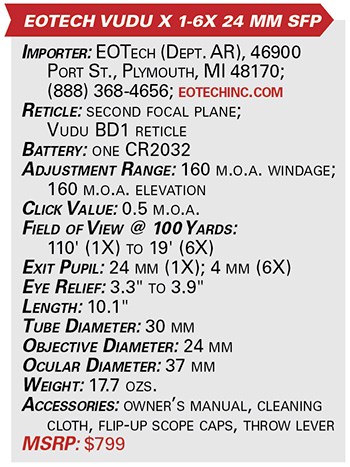
Initial offerings are a 2-12X 40 mm hunting scope and a 1-6X 24 mm low-power variable optic. As we’d previously reviewed the original 1-6X Vudu, we were interested in the latter in order to compare the differences. The Vudu X offers only two reticle options. Of the two, there is a utility-based duplex, dubbed the DP1, and a bullet drop compensator named the BD1. As a duplex doesn’t require much explanation, we decided to keep our evaluation limited to the BD1 model.
The unit was manufactured in the Philippines, which offers a savings compared to the Japanese sourcing of the original Vudu line while also providing a step up from most Chinese manufacturing. Peering through the glass while we cycled through the magnification range, we noticed the reticle is now located in the second focal plane, which also drops production costs a bit. At 6X, the ballistic dots were true to their prescribed values. Additionally, it was appreciated that they followed a linear scale of 2, 4, 6 and 8 m.o.a. as opposed to a logarithmic one that is intended to compensate for one specific cartridge—making it much more versatile.
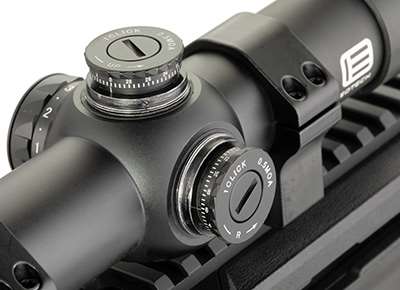
With the turret adjustments also being m.o.a., this makes for math-free corrections when zeroing or dealing with environmental factors. In evaluating the glass, we were excited by what we saw and, equally importantly, didn’t see. With a price tag of approximately half of the Japanese-made 1-6X Vudu, we expected some level of milkiness or chromatic aberration, but the optic was void of both.
We affixed our scope to a Smith & Wesson AR-15 with a carbine-length gas system using a Monstrum one-piece scope mount. Chambered in 5.56 NATO, we opted for a 55-grain load to represent the traditional use case of this rifle. Our testers began by zeroing the optic and recording the adjustment left over; after establishing a 100-yard zero, we still had an additional 74 m.o.a. available for any long-range dialing that needed to be had. This is more than enough to take a 5.56 beyond its effective range, so there arguably wasn’t a need for canted hardware.
 After removing the central screw on each turret, we were able to reset both drums to zero and move on. We confirmed tracking and repeatability by “shooting the square” and performing a tall target test; the Vudu X passed both. Before calling the experiment a success, we vigorously rotated both dials through their full range of motion more than a dozen times before returning them to zero and firing a confirmation group. No point-of-impact shift was detected.
Estimating one division of come-up per 100 yards, we were able to confirm the accuracy of the BDC subtensions and put repeatable hits on 12"x20" targets placed between 200 and 500 yards. Checking against a ballistic calculator confirmed that our guess of one hashmark per 100 yards was a good rule of thumb for targets of that size.
All testers appreciated the weight and forgiving eye box of the design, but most remarked that the turret clicks could have been more positive. However, as the rifle held zero and returned to this point after adjustments, all agreed it was more of a mental convenience rather than a requirement. We were happy to see that the illuminated reticle made the cut, but it could have been brighter.
In all, the new EoTech X models make for an excellent addition to the Vudu family as solid solutions for shooters who desire high-end glass without having to pay for the features they likely won’t ever use.
Most Popular