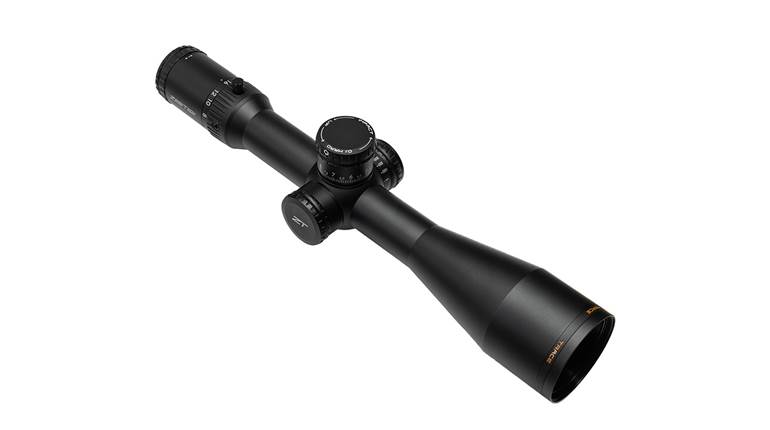
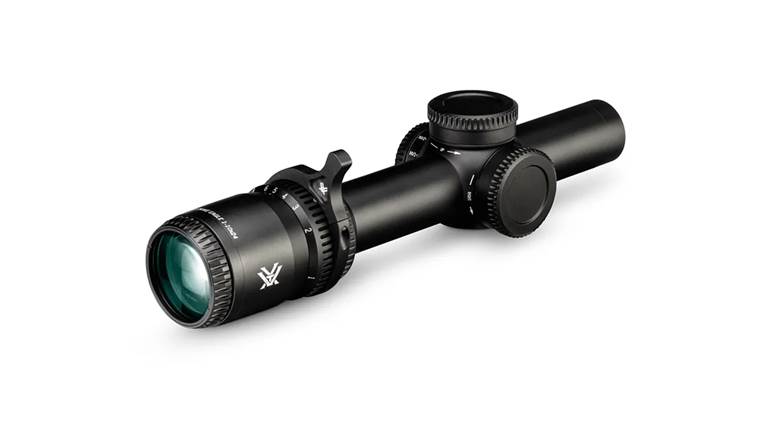
A division of the Sellmark corporation, Sightmark holds the reins as the company’s affordable-optics brand. Shooters turn to it for red dots, riflescopes and even thermal-imaging devices. But, through its international relationships, it is evident that it doesn’t have to be painted into the “budget” box, and launching products like the Pinnacle boldly demonstrates this fact. This optic features Japanese glass and tactile and effective adjustment turrets, and carries the prestigious National Tactical Officers Association (NTOA) recommendation after surviving that organization’s rigorous testing.
The Sightmark Pinnacle is a low-power variable optic, or LPVO. At the low side is a 1X magnification, useful in tight quarters and rapid engagements, while the high side allows the user to crank it up to 6X magnification, which is useful for moderate distances. To make use of each end of the spectrum, the scope houses the Tactical Mil-Dash (TMD) reticle set in the first focal plane. This allows it to scale with magnification, making the subtensions perpetually true regardless of the setting. It can also be illuminated in either red or green.
Unpacking the box, I found an additional turret included, and upon closer inspection, I saw that each had bullet-drop-compensation marks etched in; one for 5.56 NATO and the other for 7.62 NATO. Swapping them is as easy as loosening the trio of set screws holding them in place, which is also the method for indexing them after a zero is achieved.
I used a Sightmark Tactical Cantilever Mount to attach the Pinnacle to an 18-inch-barreled AR-15. This riflescope has an outstanding amount of eye relief, making it useful for heavy magnum applications as well.
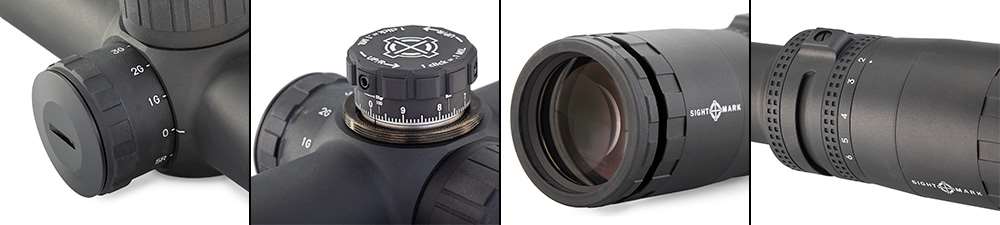
Zeroing is to be conducted at 200 yards for the TMD reticle, which ensures all of the BDC marks align. Doing so off a rest allowed me to inspect the glass, which was indeed clear and indicative of quality Japanese manufacture. Checking edges for distortion proved fruitless, and the optical system was free of chromatic aberration, which was confirmed by viewing white paper in bright sunlight.
Satisfied with the optical quality, I reset the turrets to zero and counted 19 mils of remaining elevation for dialing out to longer ranges. With everything set, I was now able to test some of the bullet-drop compensation features of the scope. To do so, I placed full-size Caldwell AR500 IPSC targets at 300, 400 and 500 yards. The turret is marked out to 800 yards, but getting there with 55-grain 5.56 isn’t quite realistic in my book. Without measuring velocity or confirming data in a ballistic calculator, I was pleased to score first-round impacts at all three distances.
Before knowing where to dial, shooters must know the target’s range. The Pinnacle offers two ways to do this. The first is to use the 1-mil subtensions. If you know the height or width of a target, you can use mild algebra to solve how far away it is. The other is through the oval reticle, which is sized to fit perfectly over head-size target situated at 50 yards. At 100 yards, it will fill it halfway, and at 200, one quarter. This process is cruder, but faster, and doesn’t involve any math.
I finished my day by dialing back and forth between all the targets before returning to my 200-yard zero. Through all the cranking and recoil, the zero did not shift, proving to me that this scope is repeatable and reliable. Throughout my test, I found it both comfortable and easy to use, and it met every promise made by the manufacturer. Like the NTOA, I, too, can enthusiastically recommend it.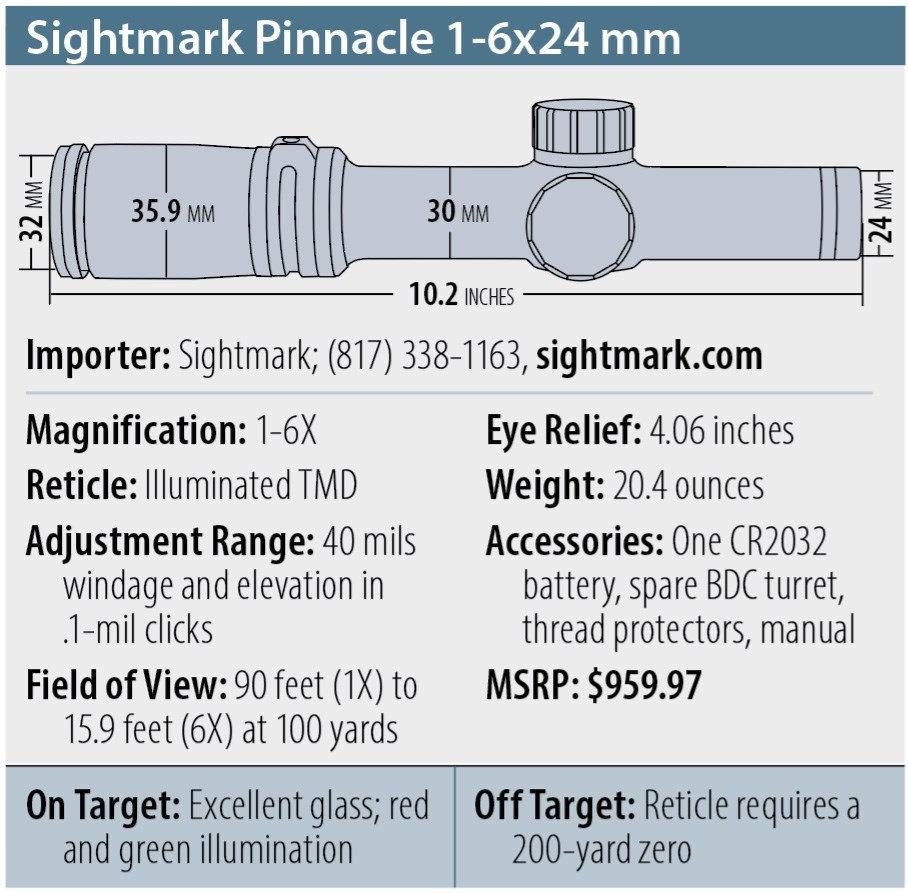
Most Popular