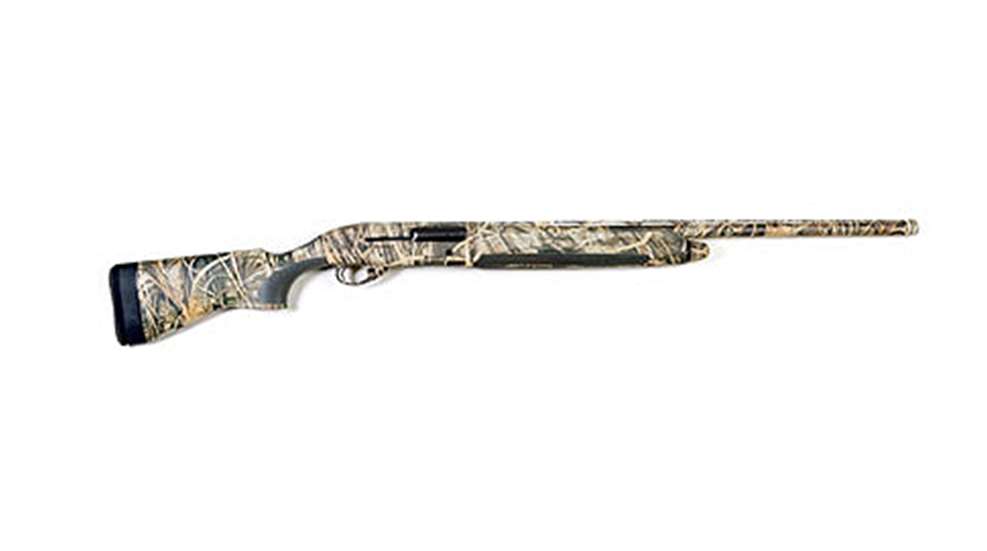
The last of the world’s major shotgun manufacturers to embrace the 12-ga., 3 1/2-inch shotshell, Beretta based its Xtrema on the successful A391 Urika. The gas-operated Beretta A391 Xtrema closely followed the lines of its progenitor, but borrows elements from other designs as well to better withstand the constant pounding of heavy 12-ga., 3 1/2-inch hunting loads. Beretta’s Xtrema2 includes a number of performance enhancements that focus on improved handling, reduced recoil and increased durability.
Although it will cycle some 1-oz. loads, that is not the gun’s intended role. It is a field gun, pure and simple, and Beretta recommends that only heavy shotshells be fired in it. With that in mind, the Xtrema2 is offered only with a synthetic stock, either in matte black or in Realtree Advantage Max4 or Hardwoods.
Efforts to reduce felt recoil start with the Xtrema2’s 4140 steel barrel, which is overbored to 0.742 inches. Hammer forged and fitted with the “Optima Plus” bore system, the barrel features lengthened forcing cones and choke tubes that are longer and thinner than Beretta’s other designs. The full vent rib is crosshatched to reduce glare and topped by a gold bead at its front. The barrel extension is a separate piece firmly screwed to the barrel and left in the white.
Extraction is via a hook on the bolt’s right side, and the ejector is pinned into the receiver’s left. The ejector is a tapered rectangular stud that rides in a channel in the wall of the barrel extension as it is pushed forward along with its guide under spring tension. Depending on the force of the recoiling shell, the extractor will travel rearward as much as is necessary to clear the ejection port before kicking the case free.
The Xtrema2 employs a gas system with two ports. Gas drives a piston rearward that drives the operating rod rearward. Excess gas is vented forward and out of vents at the bottom front of the fore-end. A steel ring with a toothed face reduces fouling around the piston and makes the system, to some extent, self-cleaning.
The bolt, operating rod and recoil spring are removed as a unit for cleaning. The two-piece bolt has a rotating head reminiscent of the Benelli Black Eagle. The recoil spring slides over the magazine tube and is surrounded by a polymer tube below the dual, white-metal action bars. This arrangement leaves room in the buttstock for the two hydraulic cylinders that make up Beretta’s Kick-Off recoil-reduction system, which is available as an accessory.
The bolt release is on the receiver’s right front. Depressing the smooth, rounded button frees the bolt to move forward. There is also a magazine cut-off on the left front of the receiver. On top of the receiver are two sets of recesses that allow for Weaver-style scope bases to be attached, which is welcome news to turkey hunters who prefer optics.
The buttstock incorporates Beretta’s Gel-Tek recoil pad system as standard equipment. Made of a soft gel-type material, the pads are interchangeable with different lengths offered. To detach the unit, simply withdraw the U-shaped wire bar at the stock’s toe and lift it off the stock. The stock and fore-end also have soft rubber panels over-molded on both sides that aid in gripping the gun, especially when it is wet.
The ejection system earned high marks by kicking out 2 3/4, 3 and 3 1/2-inch shells with aplomb. In fact, the big 3 1/2-inch shells were ejected more positively than the shorter ones thanks to the increased spring tension in the ejector. It cycles extremely fast for a gas-operated autoloader; and recoil, thanks to the overboring, weight and efficiency of the gas system and recoil pad, was more than manageable—even with heavy Federal goose loads.
Beretta has trimmed the wrist and fore-end to improve handling and response, and in recognition of the fact that this gun is intended for cold-weather shooting where hunters are forced to wear bulky clothing, it has shortened the length of pull. The end result of these efforts was not lost on staffers who had a chance to put the Xtrema2 through its paces on a Saskatchewan waterfowl hunt. The gun was admittedly something less than lively, but it was certainly not sluggish. Unlike some other 3 1/2-inch guns we've tested, we never struggled to keep the Xtrema2 in front of the target.
That said, the Xtrema2 is a special-purpose tool rather than an all-around shotgun. It worked well with higher velocity 1-oz. loads, but it proved to be balky with light target loads. The Xtrema2 was patterned with Federal field loads. Those looking for a fast-handling 3 1/2-inch autoloader to take to the field in search of waterfowl or turkey would be well advised to give the Xtrema2 a thorough look.
Manufacturer: Fabbrica D' Armi Pietro Beretta,
Importer: Beretta, USA Corp.; (800) 636-3420; Berettausa.com
Gauge: 12, 3 1/2"
Action Type: gas-operated, semi- automatic shotgun
Receiver: anodized aluminum
Barrel: 28" (tested), 30"
Chokes: five Optima-Bore choke tubes: full, improved-modified, modified, improved cylinder, cylinder
Trigger Pull: single-stage, 4 1/2 lbs.
Stock: synthetic: length of pull, 13 1/4" (14 1/4" with Kick-Off recoil system); drop at heel, 2 1/4"; drop at comb, 1 1/2"
Overall Length: 49 1/2"
Weight: 7 lbs., 2 ozs.
Accessories: lockable hard plastic case, choke-tube key, choke tubes
Suggested Retail Price: $1,098 (matte black); $1,198 (Realtree Advantage Max4 or Hardwoods)