Nothing quite beats the utility of a revolver chambered in .22 LR. Whether it is for training, plinking, pest control and even personal defense, the case for .22 is always there. One strength of the .22 is the sheer scale of handguns chambered for it. They range from inexpensive single actions that can live in a tackle box to safe queens.
Somewhere on the latter end of the spectrum are medium-size, all-steel revolvers that are made to be shot and shot indefinitely. These include the Smith & Wesson 617 and Ruger GP100. My personal choice is the all-stainless Colt King Cobra .22, mainly due to its slightly smaller size and a surprisingly light trigger for a rimfire handgun.
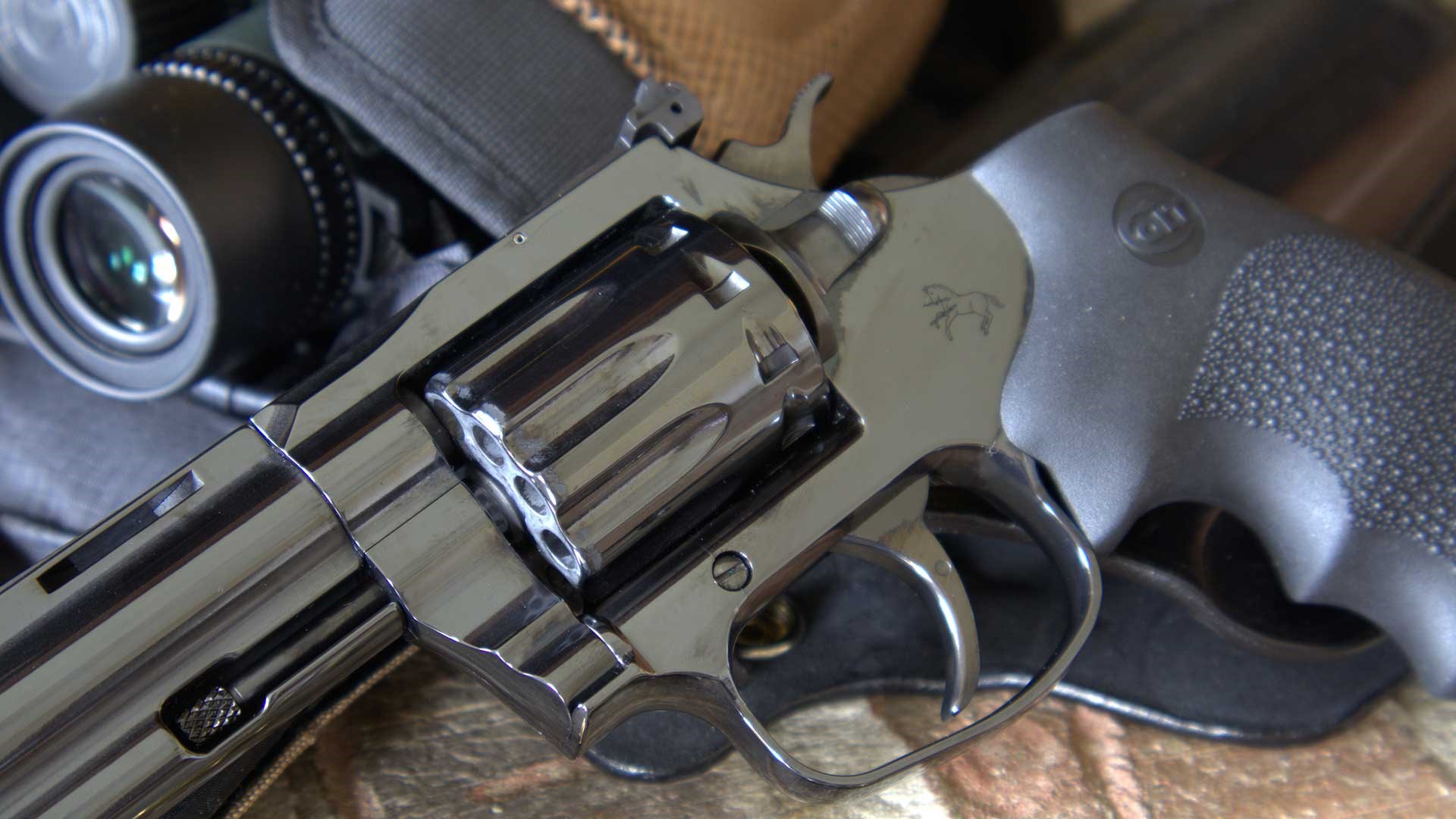
While stainless steel is attractive and easy to clean up, it is a relatively new addition from a brand known for its blued finishes. When Colt launched the blued version of the King Cobra .22, I was first in line to give it a try.
A New New King Cobra .22
Colt re-launched the King Cobra .357 Magnum as a small-frame carry revolver in 2019. The stainless-steel rimfire version complete with a distinctive vent rib barrel and adjustable sights followed in 2023. The features and barrel length options are transferred to the new model, save for the switch to carbon steel and a rich, hot-blued finish.
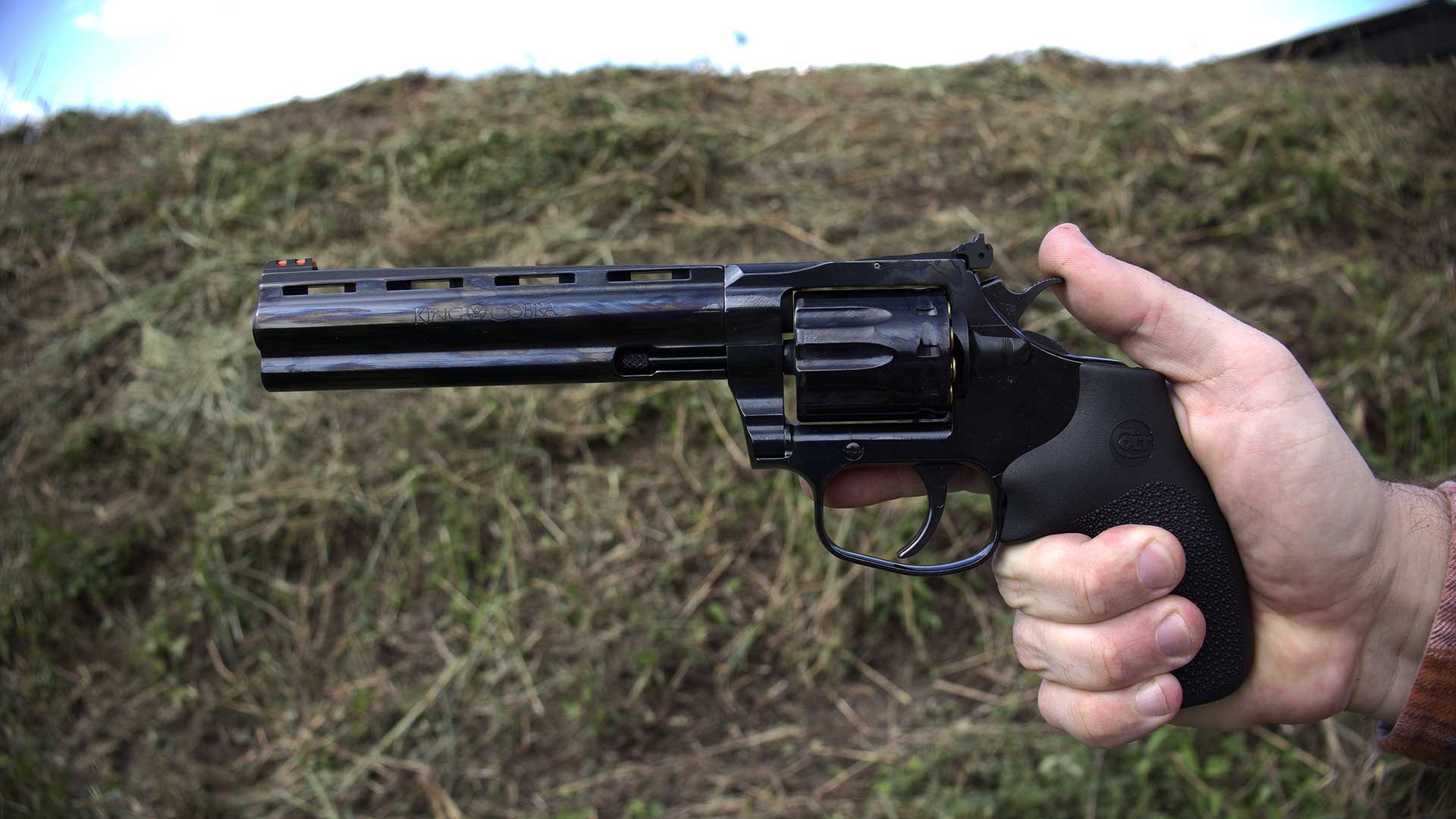
The blued King Cobra .22 is a conventional double-action/single-action revolver that features a traditional hammer spur and a swing-out, 10-shot cylinder actuated by Colt’s iconic clam-shell cylinder release. The trigger is smooth-faced and has a clean, single-action break of about 4½ pounds. My Lyman trigger scale puts the double-action trigger pull at just north of 8 pounds.
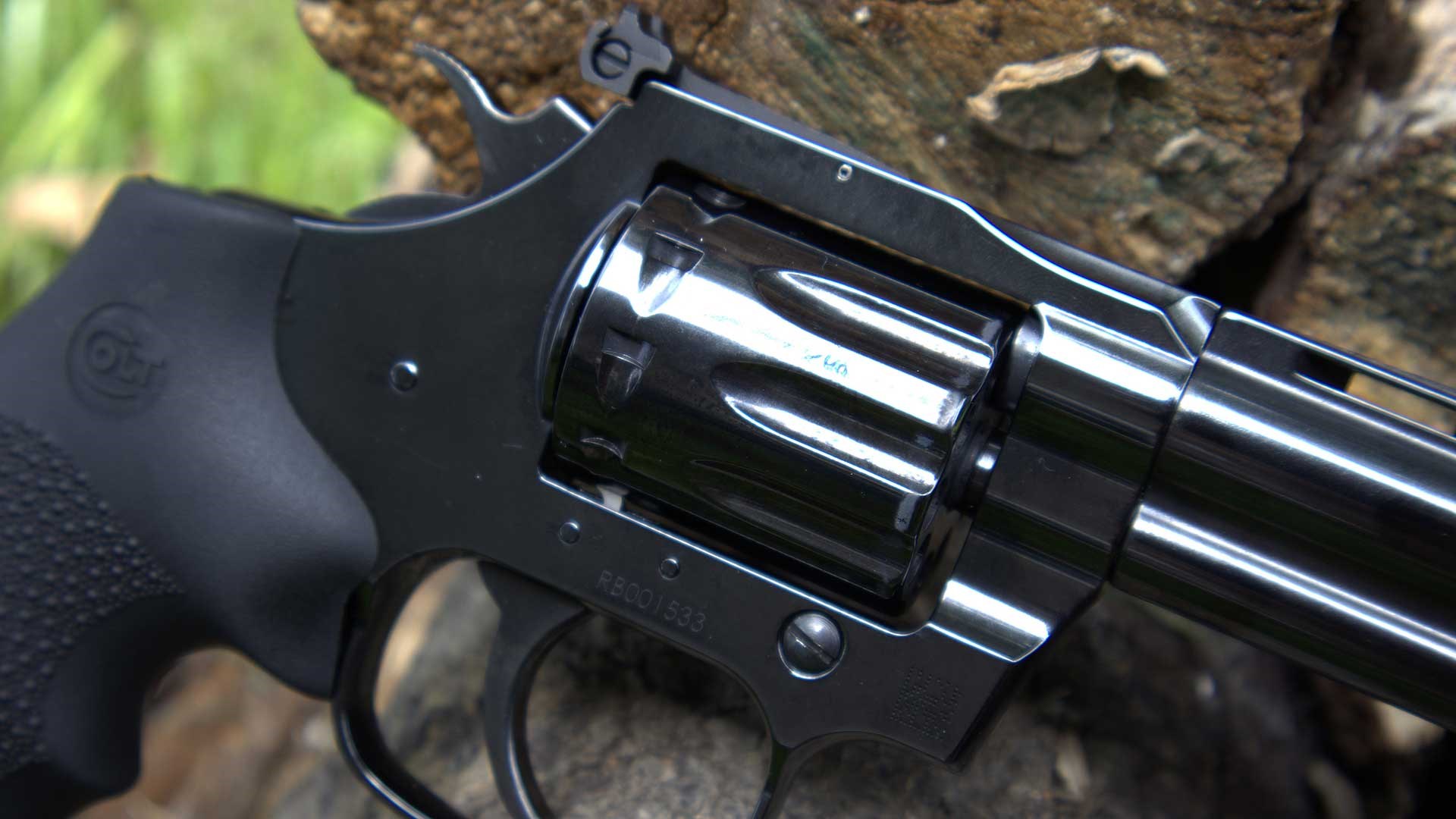
The revolver is available in barrel lengths from 2 inches to 8 inches. No matter the length, the barrel is a heavy profile with a smooth vent rib and full underlug that shrouds the ejector rod. Think of it as a mini Python, and you won’t be far off the mark. The model seen here is the 6-inch version.
The sights consist of a black, square-notch rear sight that is adjustable for windage and elevation and a pinned, orange, fiber-optic front post. Alternatively, the rear sight can be removed for an optic adapter plate–a favorite modification on my snub-nosed stainless model.
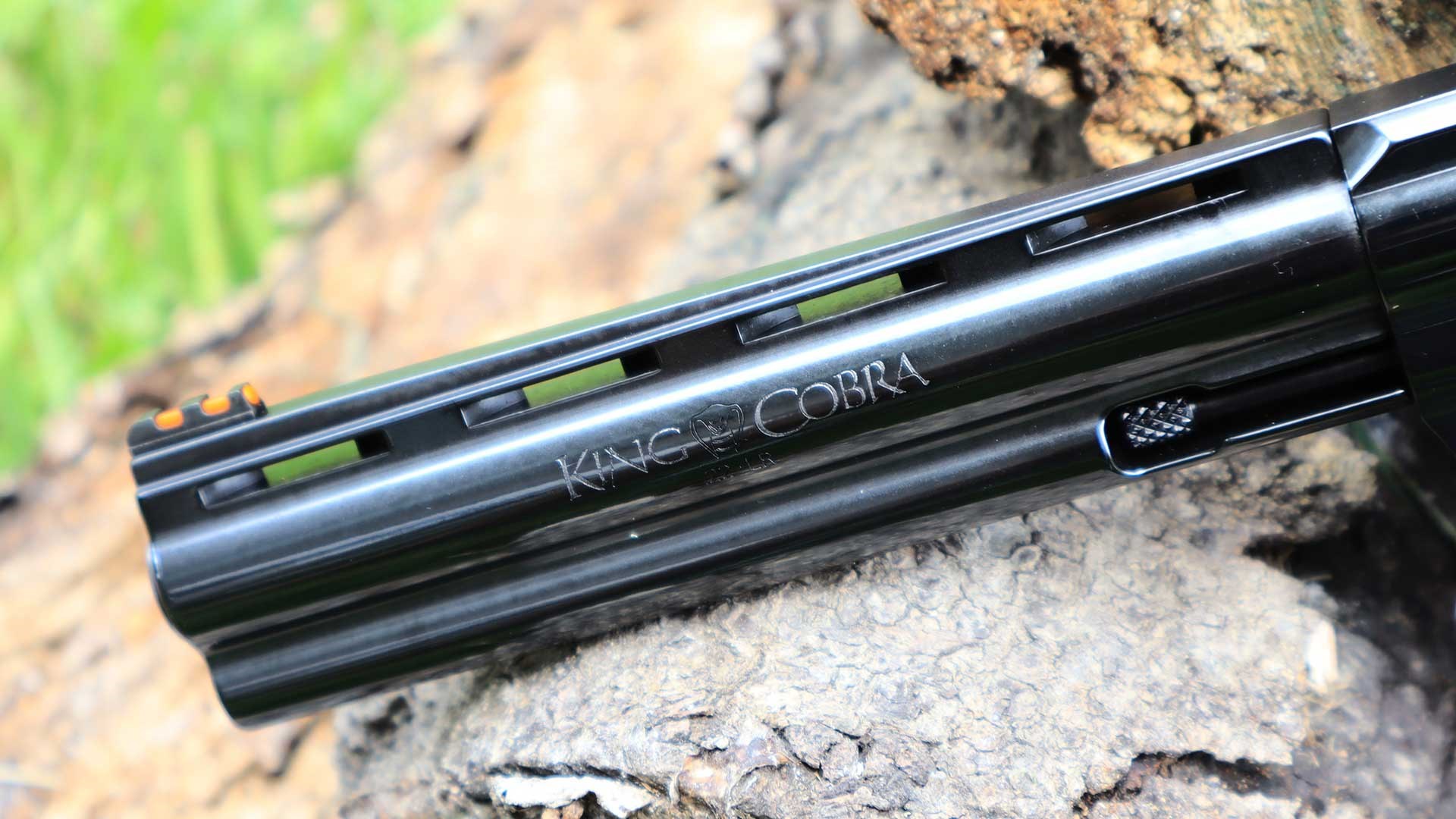
As with its stainless stablemates, the blued Colt King Cobra .22 ships with wraparound rubber grips, which are functional but do not match the blued aesthetic like a good pair of Altamonts.
Old Finishing Meets Modern Manufacturing
With the re-launch of blued versions of its Python and King Cobra line, Colt is attempting to go back to its roots while embracing modern manufacturing techniques that bring the product to the shelves.
The King Cobra .22 features an updated U-shaped hammer spring and metal-injection-molded steel parts throughout its lockwork. These updates are balanced by retaining Colt’s bank vault lockup, where the hand and locking bolt tightens the cylinder when the trigger is pulled.
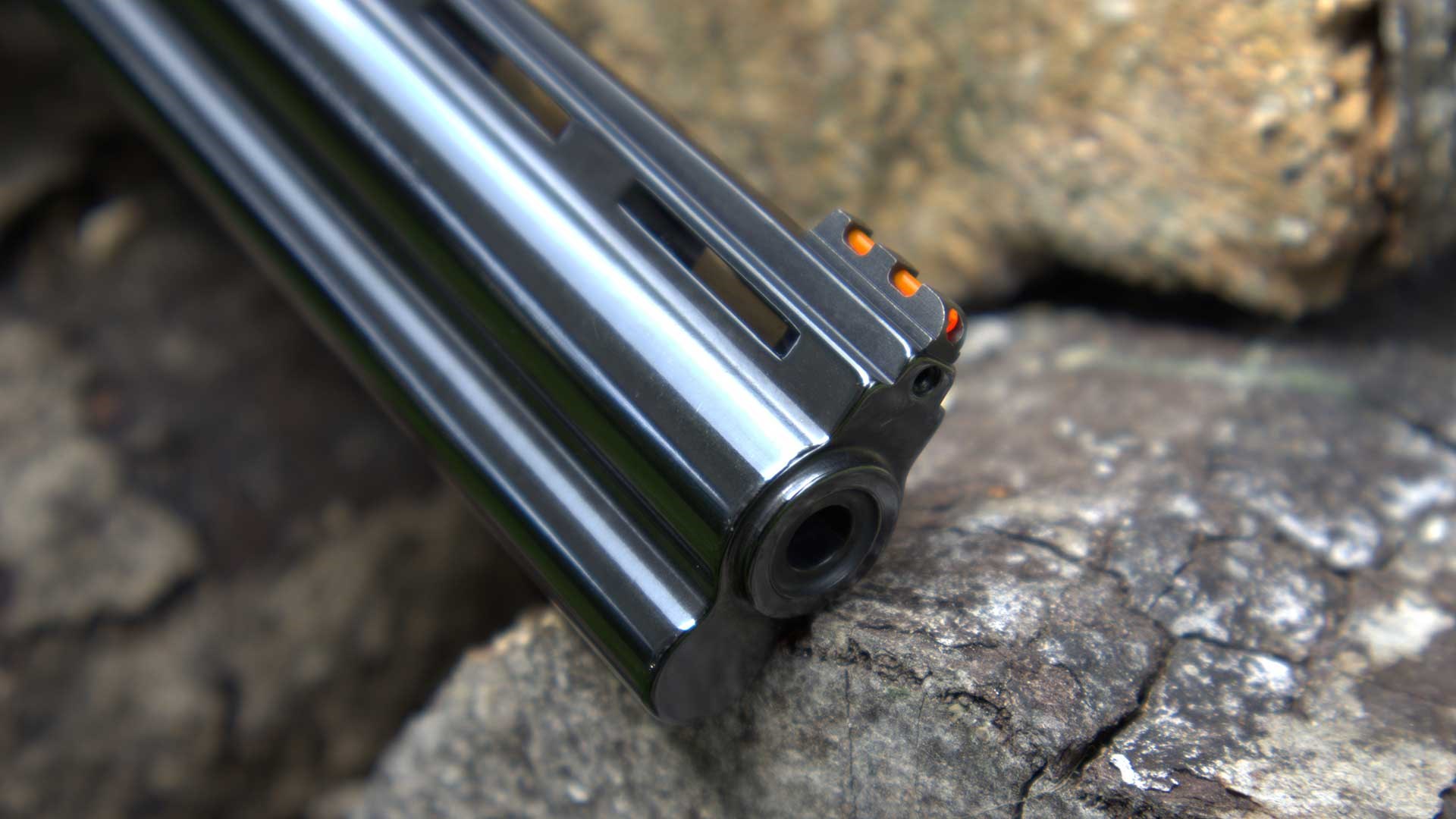
Like its lockup, Colt finishes were a cut above. In the late 19th century, Colt used special charcoal and bone mixtures to achieve a rich, durable blue when their competitors had gone to gas ovens and hot bluing. By the mid 20th century, charcoal bluing was out for most makers, but Colt prided itself on a deeper blue with a higher polish. Beyond its look, it was practical. In the era before stainless steel, high polishes guarded against rust and corrosion.
Since then, the revolver market has waxed and waned, and the finishes range from uncharacteristic matte to polished stainless. Going back to a good, blued finish is refreshing, and leave it to Colt to do it. The blued finish on the King Cobra is a conventional hot blue that lacks the depth of the old Colt Royal Blue finish, but the polish is unmistakable and effective. It looks good, catches attention, but it doesn’t glare in the sun like their stainless models.
Range Impressions
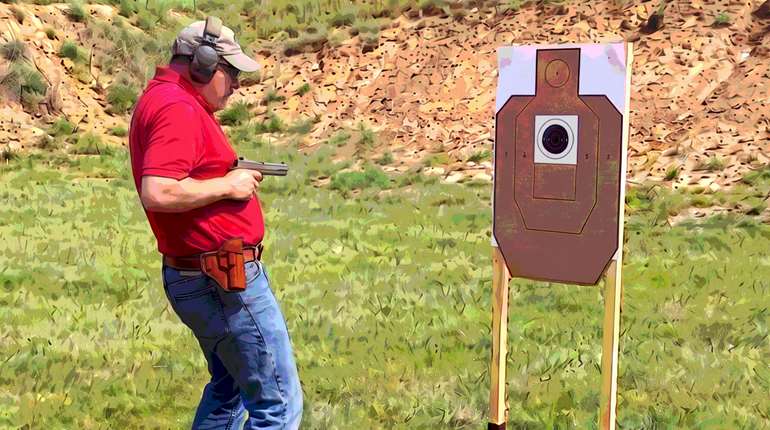
I put the Colt Blued King Cobra through a 300-round test. This included a 10-yard accuracy and velocity test, as well as offhand work on paper and steel to gauge the revolver’s ergonomics.
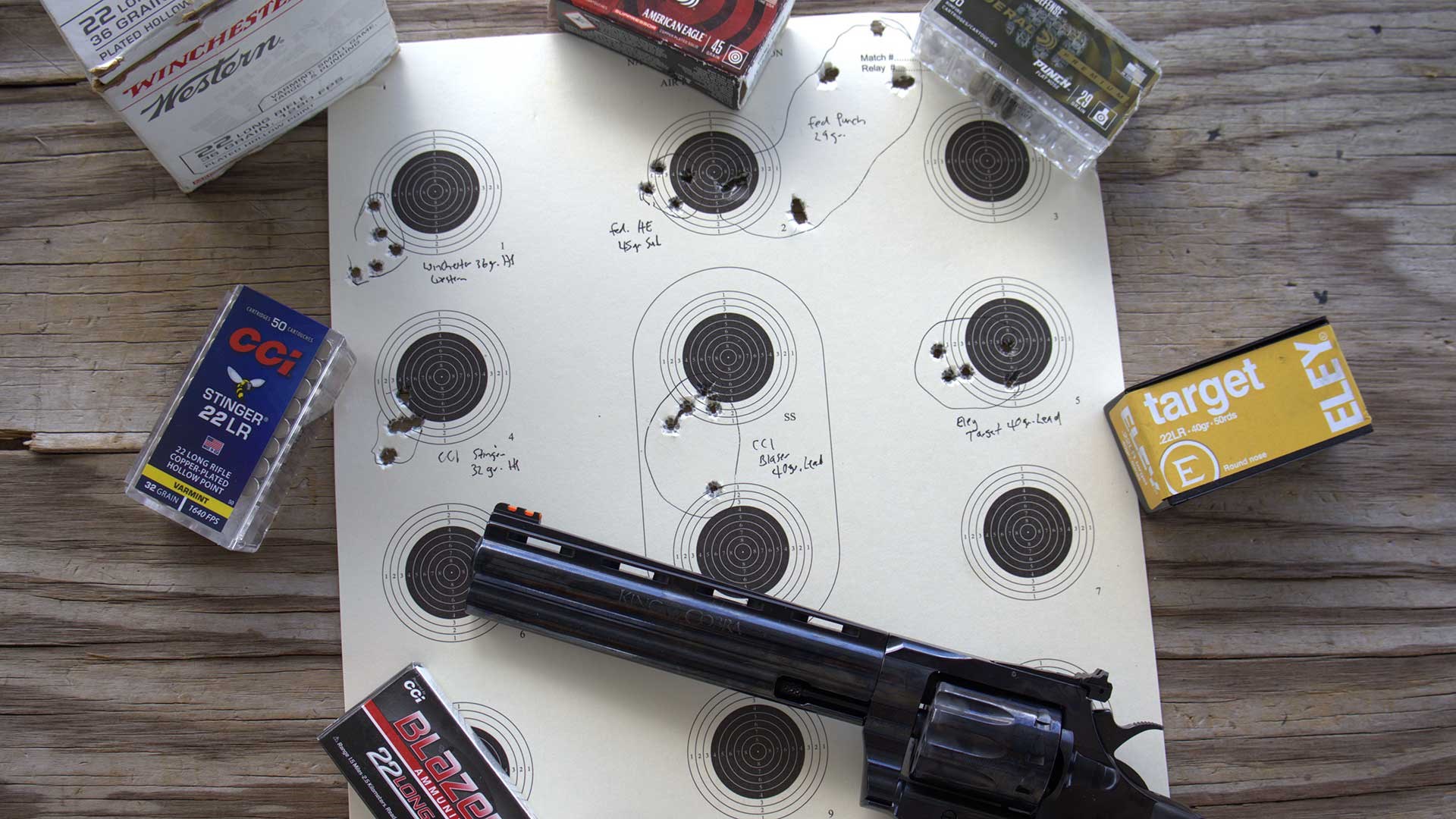
To get the King Cobra on paper, I posted paper at 10 yards and shot from the bench in single-action. As with other Colt revolvers I have tested, the rear sight was graduated too high. A few revolutions with a screwdriver, and I was hitting to the point of aim. The accuracy test ended as follows:
|
Brand (.22 Long Rifle) |
Muzzle Velocity (fps) |
Accuracy (inches) |
|
CCI Blazer 40-grain LRN |
1,127 |
.71 |
|
CCI Stinger 32-grain HP |
1,328 |
.80 |
|
Eley Target 40-grain LRN |
925 |
1.0 |
|
Federal Punch 29-grain NPFN |
1,289 |
3.5 |
|
Federal Subsonic 45-grain CPRN |
865 |
.58 |
|
Winchester 36-grain HP |
1,200 |
1.2 |
*Velocities taken as a five-shot average from a distance of 10 feet. Accuracy consists of an average five-shot group of three attempts at 10 yards. Abbreviations: LRN (Lead Round Nose), HP (Hollow Point), NPFN (Nickel Plated Flat Nose), CPRN (Copper Plated Round Nose).
The 6-inch King Cobra scoots out most loadings at velocities similar to that of a carbine, although there is some velocity loss with the CCI Stinger varmint load. Accuracy was consistent across all brands, save for the Federal Punch, which keyholed without fail. Report was low and accuracy consistent with the Eley Target and Federal Subsonic loads.
The single-action trigger on the King Cobra has a clean break but is somewhat heavy if you use an old Colt as a reference. The redesigned Colt sacrifices some of that lighter single-action pull for a smoother and lighter double-action pull. Although the double-action pull is heavier, it is predictable. Offhand at 25 yards, it was not difficult to get 10 for 10 inside a 4-inch group. The trigger, the hand-filling grip and the slightly muzzle-heavy character of this particular revolver helps with the hits.
At 50 yards, the fiber-optic front sight presents brilliantly on a half-sized silhouette even in the brightness of the Louisiana summer sun. With most rounds tested, 10 for 10 is almost a guarantee, although the slower subsonic rounds required a 12-o’clock hold.
The King Cobra .22’s controls are oversized for a rimfire and friendly to use. Although I would prefer a pair of wood stocks, the rubber grips afford a commanding hold without compromising an easy trigger reach for my above-average-sized hands. The cylinder release is easy to hit with the shooting thumb, and the cylinder can be rolled out without changing the grip. The ejector rod offers enough length for a longer cartridge, and it expels short .22 LR brass with gusto.
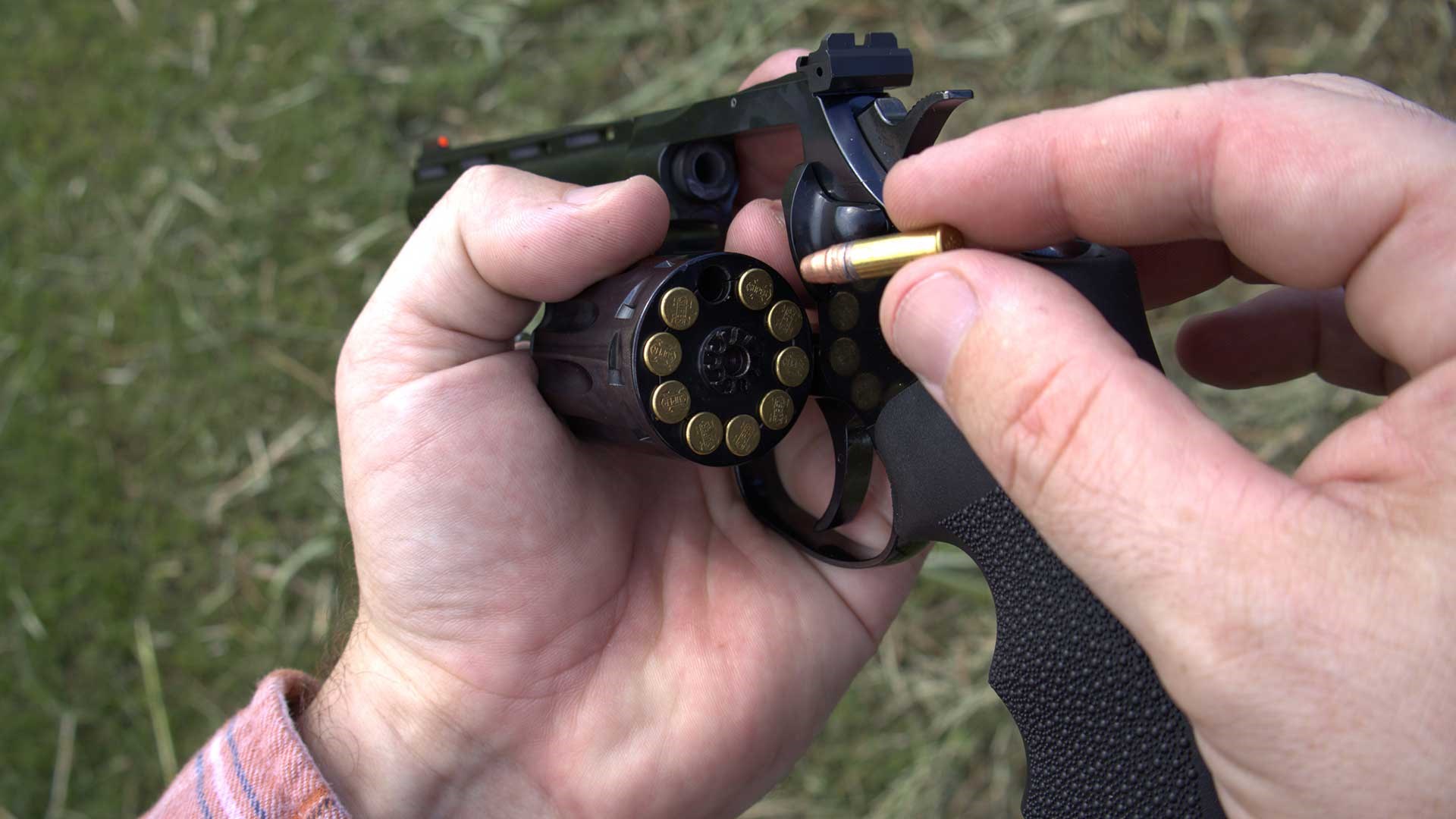
The 10-shot capacity is a must-have for a fun plinker in this caliber, but loading takes a minute. I sped up the process with a pair of .22-caliber Tuff Strips, which operate like Bianchi Speed Strips. Speed Beez offers a quick speedloader option that works well for the range but tends to lose rounds when carrying in a pocket.
The Bottom Line
The Colt King Cobra .22 got through my 300- round test with near flying colors. I could never understand the dismal performance of the Federal Punch and was forced to leave it up to the Rimfire Gods. In terms of reliability, I had a single dud CCI Stinger to blemish a pistol that otherwise fired every time I pressed the trigger. On the whole, the Colt Blued King Cobra .22 is an easy, light-recoiling shooter that is dressed just enough to impress.
Most Popular