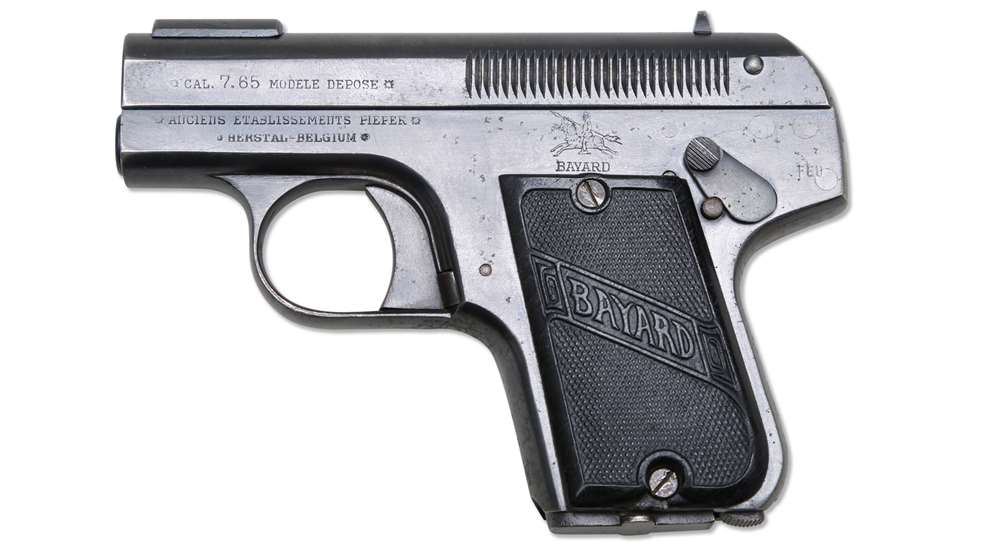
The Herstal, Belgium, firm of Anciens Etablissements Pieper was apparently expecting big things when, in 1908, it named its new semi-automatic pocket pistol “Bayard.” First mentioned in a 12th century French manuscript, Bayard was described as a highly intelligent magical bay horse that could change his size to accommodate up to four riders, was able to understand human speech and was capable of extraordinary feats of strength.
Anciens Etablissements Pieper was the later name of a company originally founded by Henri Pieper in 1866, producing rifles, handguns and shotguns. One of the company’s more distinctive arms was a nine-shot, 8 mm, double-action revolving carbine that was adopted in limited numbers by the Mexican Rurales (rural government constabulary) in the 1890s.
Semi-automatic pistols became a particular specialty for the company, which eventually produced several popular models. The Bayard, unlike most of Pieper’s offerings, was not based on a proprietary patent but on a design devised by an employee, Bernard Clarus.
Similar to some other arms of the period, such as the 1900 Browning, the Bayard was an under-barrel design that afforded space for the top-mounted recoil spring and guide. It was a simple blowback-operated, hammer-fired gun, the firing pin located in an integral housing machined within the breechblock.
The gun’s system possessed no disconnector. Its sliding trigger arrangement was not particularly robust and was liable to go out of order when some of its parts became worse for wear. Takedown was interesting, the key part to the procedure being a curious sliding front sight, which was pushed to the rear to permit the removal of the recoil spring and spring guide. This, in turn, allowed the slide to be tilted upward and removed from the receiver.
The magazine catch was a small, spring-loaded affair on the heel of the grip. It was a bit on the stout side, and this, coupled with the fact the magazine had to be physically withdrawn from its channel via a fiddly eared baseplate, did not allow for fast removal or replacement. Bayards had no magazine safety, relying solely upon a rotating catch sited on the left, rear of the frame.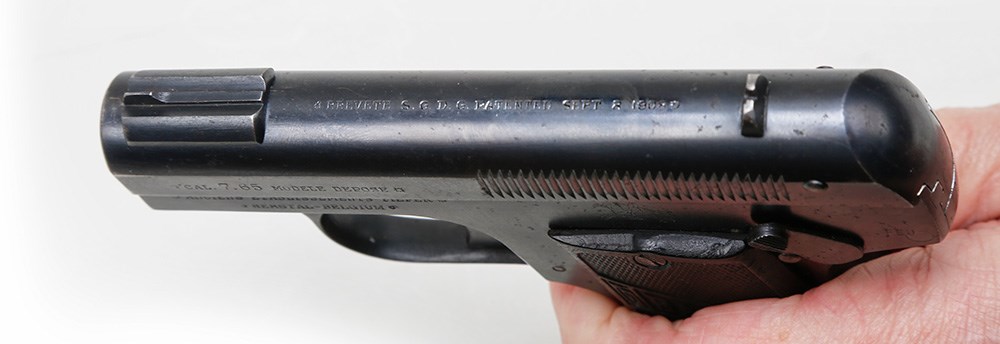
As well as the company’s address and patent details, the pistol’s markings involved a horse with a lance-wielding knight, the style of which looked as though it was lifted from a medieval illumination.
Initially offered in 7.65 mm Browning (.32 ACP), eventually it was also produced in 9x17 mm (.380 ACP) and, in an altered form, in 6.35 mm Browning (.25 ACP). Measuring in the neighborhood (depending upon the variant) of 5" in length and 3¼" high, for a considerable period of time it was the smallest semi-automatic pistol chambered in .380 ACP.
Manufactured from 1908 to 1940, two versions ultimately evolved. While the mechanism remained basically the same, nuanced changes involved such things as size differences, molding patterns in the hard rubber stocks, magazine releases, safety shapes and slide serrations.
In 1914, the Germans took over Pieper and began producing pistols for their own use. While retaining all the original factory markings, instead of the usual Liège proofmarks, the occupation Bayard’s slides and frames are marked with imperial eagles. All guns made during this period were chambered in .32 ACP.
Despite some flaws—and the fact that, by the time of their demise, they were certainly not the best option should one wish to purchase a pocket pistol—Bayards continued to enjoy a modicum of popularity throughout their production life. Today they are not unpopular collector pieces, with Belgian-proofed .32 ACP and .380 ACP examples bringing in the $550-$600 range and .25 ACPs a tad more. Because the pistol shown here has German eagles and is in excellent condition, it enjoys a premium, selling for $825.
Gun: Model 1908 Bayard
Manufacturer: Anciens Etablissements Pieper (German occupation)
Chambering: 7.65 mm Browning (.32 ACP)
Manufactured: c. 1915
Condition: NRA Excellent (Modern Gun Standards)
Value: $825
Most Popular