Gun: Standard Arms Model G
Manufacturer: Standard Arms Co. (Wilmington, Del.)
Chambering: .30 Rem.
Manufactured: 1910
Condition: Very Good (NRA Modern Gun Standards)
Value: $1,500
There is an adage that goes something to the effect of, “just because one can do something doesn’t mean it necessarily should be done.” This thought may aptly be applied to the short-lived Standard Arms Model G rifle, which employed a redundant, selective, gas-operated semi-automatic action and pump mechanism.
Philadelphian Morris F. Smith thought the public needed a self-loading arm that could easily be swapped over to pump-action at the shooter’s whim. Thus, in 1906, he received patent number 314,243 for a distinctive “automatic gas-operated” rifle.
In 1909, Smith’s Standard Arms Co. of Wilmington, Del., unveiled its “Model H,” the “H” likely signifying the gun’s hammerless mechanism. Its look was streamlined and modern. Likely realizing the rifle’s salient feature was its gas-operation system, not its hammerless design, its name was changed to the more appropriately alliterative “Model G.”
Gas-operated it was, but by turning a small valve on the gas inlet, it was possible to shut off the semi-automatic operation and turn the gun into a pump, referred to by the company as “hand-action.”
Rather than chambering his rifle for proprietary cartridges, Smith astutely decided to offer it in already familiar .25, .30, .32 and .35 Rem. chamberings. Early on, the .32 was excised from the lineup, as it was felt its performance was too close to that of the .30, and if one desired a more powerful round, the .35 Rem. would more than fit the bill.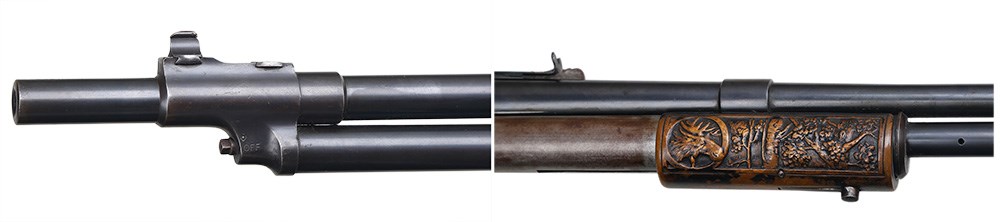
The Model G functioned like most other gas-operated guns. When fired, gas was tapped off from the barrel to operate the action by means of a piston and connecting rods, which unlocked the bolt to chamber a round and eject cases. Cartridges were dropped into the magazine (holding five rounds for the .25 and .30 calibers or four for .35) from beneath by opening a pivoting cover with attached follower that was released by a small button just in front of the trigger guard. The cover was then closed and the first round chambered by pulling the slide handle to the rear and allowing it to move forward. From this point, the gun could be fired semi-automatically.
If manual shooting was desired, one simply rotated the small valve on the front of the inlet (by means of a supplied combination tool) to shut off the gas. Other controls involved a checkered slide-lock button on the right side of the frame and a small safety lever in front of the trigger.
Model Gs were available in several grades from a basic model through five tiers offering increased decoration and cost ($35 to $200), culminating in the “Rocky Mountain,” which displayed full-coverage engraving and fancy stockwork as good as that seen on any American sporting rifle then on the market. Standard Model Gs were blued and un-embellished, except for their buttplates and slide grips, which were made of cast brass presenting elaborate arabesques, floral designs and game figures.
One must remember, in the early 20th century, the Model G’s semi-automatic rivals consisted of such products as Remington’s superb Model 8 and Winchester’s Model 1907 and Model 1910—both rugged, reliable rifles. It was a tough market to crack. As a result, unfortunately, the Model G’s mechanism, clever at it was, just could not hold its own.
Compounding the market issue was the fact that the mechanism was beset with problems right from the beginning, the most troublesome involving an easy-to-break pin that connected the piston to the bolt extension. Other small parts were also found to be fragile, and the gas system easily clogged up. The action was mostly pinned together and generally defeated the efforts of the average user to disassemble and repair it.
Once the initial novelty of the Model G wore off, sales plummeted, and despite an active advertising campaign, the rifle’s manifest weaknesses quickly caused the company to file for bankruptcy a scant three years after its inception. Model Gs received a slight resurgence in 1914, when some were assembled by the Standard Arms Manufacturing Company using existing parts, but eventually that entity, too, admitted defeat and sold its leftovers to the New York surplus arms dealer Francis Bannerman. It is estimated that a total of some 12,000 Model Gs were manufactured.
Despite its limited production, today, they seem to turn up regularly for sale at auction and on the internet. Prices are moderate to middling, depending upon grade and serviceability. The example we’re looking at here is a good-condition, standard model in working (for the time being, at least) order. As such, this particular rifle is worth $1,500.
Most Popular