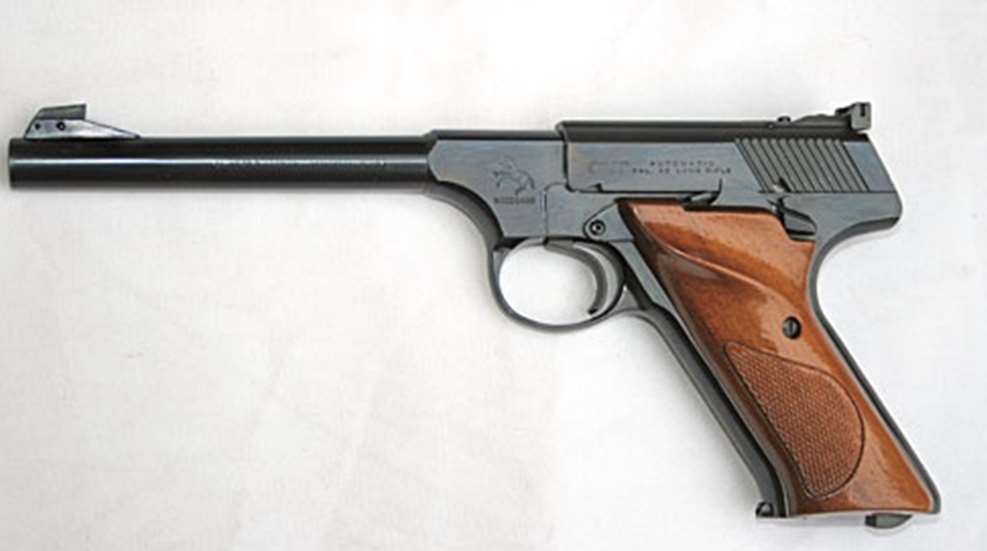
Could there be a more fitting name than “Woodsman” for a .22 Long Rifle, semi-automatic handgun that evokes images of bouncing tin cans or dropping rabbits on the run? This is yet another classic firearm from John M. Browning, assisted by Colt employees George H. Tansley and F.C. Chadwick. When introduced in 1915, it was named the “Colt Automatic Pistol, caliber .22 Target Model”—hardly indicative of what would become a 62-year reign of a gun that started many a boy on a lifetime of shooting. In all, more than 690,000 were made.
Initially sporting a 6 5⁄8-inch barrel, adjustable sights, blued finish, checkered walnut stocks and a profile reminiscent of the Luger (and later, the Ruger Mark I), this pistol was renamed the Woodsman in 1927. Retaining its adjustable sights, it came with a two-tone, 10-round-capacity magazine retained by a European-style heel release. In 1933 Colt introduced a Sport Model with 4½-inch barrel, and from 1938 until 1944 the company made a heavier-barreled Match Target with a “Bull’s Eye” target logo on the frame. These guns constitute the First Series, which ran until 1947.
From 1947 to 1955, the Second Series featured Sport and Target Models, with Target barrels shortened to 6 inches, and saw a side-mounted magazine release. Designers and engineers at Colt re-proportioned the grip (with Coltwood or brown plastic stocks) with a higher arch, for better controllability, and they added a weighted-barrel Match Target Model to the line.
The Third Series, from 1955 to the end of production in 1977, had the magazine release relocated to the frame’s bottom. It introduced the economical, fixed-sight Challenger and Huntsman Models, along with other variations. Stocks were black plastic, but beginning in 1960 Colt offered thumbrest walnut stocks at no extra cost. The price back then for a Woodsman Target was $84.50. Two years ago a 1938-era, 95-percent Woodsman Target with original magazine, box, and sales receipt sold for $850 at Wally Beinfield’s Las Vegas Antique Arms show.
This pristine Third Series Target Model was shipped on June 21, 1974. If I hadn’t known it had previously been shot, I would have rated it NRA New, as virtually 100 percent of the finish is present. As the saying goes, the only thing missing is the box. Even so, at 99 percent, to a collector it is easily worth $800 or possibly more.
Gun: Colt Woodsman Target Model—Third Series
Serial Number: 052XXXS
Caliber: .22 Long Rifle
Condition: 99 Percent (NRA Perfect—Modern Gun Condition)
Manufactured: 1974
Value: $800
Most Popular