As our country was celebrating its centennial 150 years ago, Oliver Winchester dominated the lever-action market with his Models 1866 and 1873 and was just introducing the Model 1876. But there were problems. The Winchesters 1866 and 1873 were only chambered for, respectively, .44 rimfire and .44-40 centerfire cartridges— mid-range, medium-game loadings at best—while the new Model 1876 still couldn’t handle some of the popular big-game chamberings of the day, most notably the coveted .45-70 Govt.
To add to Oliver Winchester’s issues, in 1881, his neighbor in New Haven, Conn., the nascent Marlin Firearms Company—which previously made only rimfire derringers, small-frame revolvers and single-shot Ballard rifles—took a giant leap and vaulted directly into Winchester’s arena by coming out with its first lever-action. The Marlin Model 1881 Repeating Rifle was not only chambered for the company’s proprietary .40-60 Marlin, but also for the .45-70 Govt., with other chamberings to follow. Clearly, something had to be done to maintain Winchester’s lead in what was sure to turn into a highly competitive arms race.
In the past, two gunsmith-inventor brothers from Ogden, Utah—Matthew and John Browning—had come to Winchester’s rescue with their design of the Model 1878 single-shot, which became the Winchester Model 1885. Now, as if by fate, the Browning brothers presented their new concept for a repeating rifle to the same individual who had purchased the patent for their single-shot: T.G. Bennett, Oliver Winchester’s son-in-law, who was also vice president of the company. Bennett bought the rights to the new rifle immediately, thus beginning an 11-year string of lever-action successes between the Brownings and Winchester.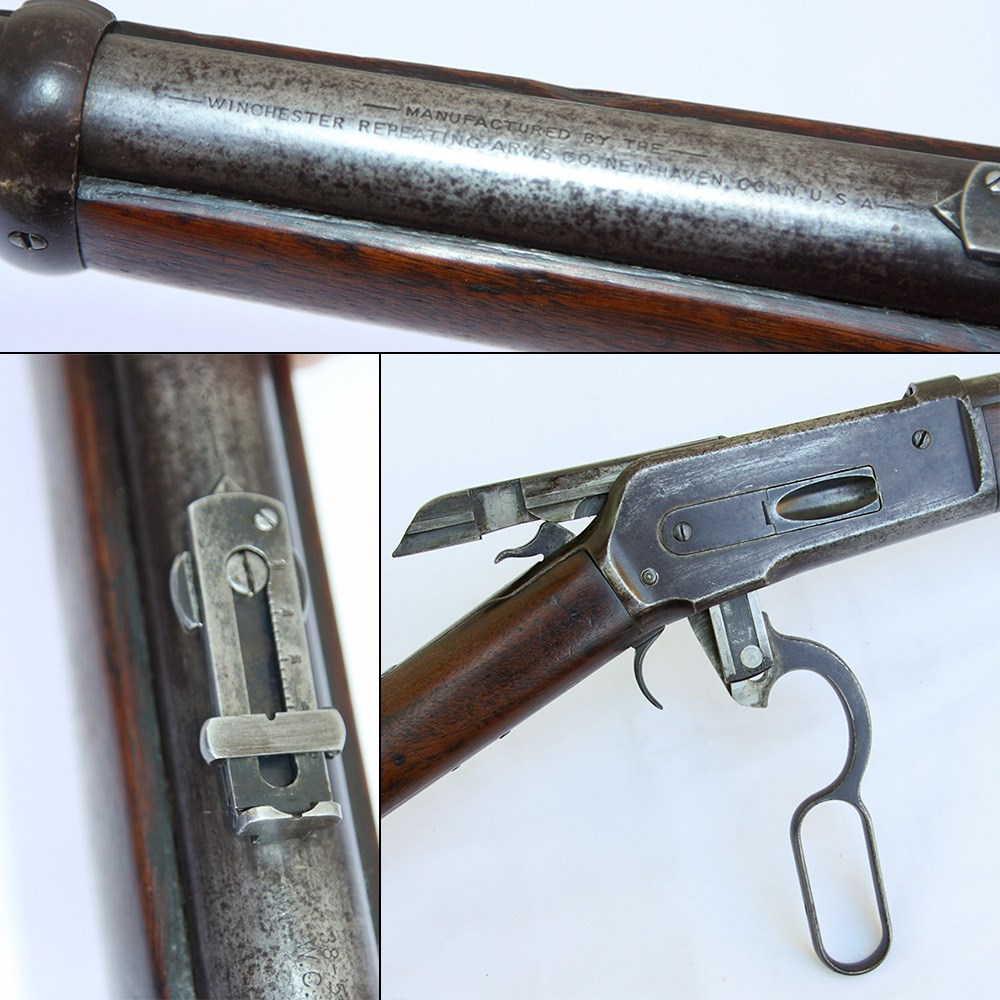
Taking inspiration from his single-shot rifle’s falling breechblock, John Browning developed what many still consider the ultimate big-game lever-action rifle: the Winchester Model 1886. The falling breechblock was transformed into twin vertical locking bars that slid up along opposite inside walls of a dramatically beefed-up receiver, anchoring the bolt closed, then lowering as the action was opened, aided by a muscular feeding mechanism that was perfected by Winchester’s William Mason. The result was a solid lockup, combined with a smooth action. A 26-inch barreled Sporting Rifle, pistol-gripped Fancy Sporting Rifle and a 22-inch barreled Carbine (along with a briefly catalogued 30-inch Musket) were introduced, with prices ranging from $36 for the Fancy Sporting Rifle to $19 for the Carbine.
The Model 1886, and particularly the Sporting Rifle model, met with immediate success. Calibers eventually ran the gamut from .33 WCF to the .50-110 Express, with the popular .45-70 Govt. taking the lead. However, unlike Winchester’s previous lever-actions and those to follow, the 1886 Carbine lagged far behind the rifles in sales. Perhaps it was the ’86 Carbine’s 7.5-pound weight and 22-inch barrel (compared with the 6.5 pounds and 20-inch barrels of Winchester’s other carbines), but the hefty saddle gun did not share the popularity of the 1886 rifles, despite the carbine’s lower price. By the time the Winchester 1886 was discontinued in 1935, with a total of 159,994 guns produced, only 6,223 of those had been manufactured as carbines.
But time—and collector demand—have a way of altering things. Today, the Winchester 1886 Carbine is one of the most sought-after versions of this model. As George Madis stated in The Winchester Book: “One of the rarest carbines in the Winchester line is the Model ’86.” This saddle-ring carbine was made in 1893 and is in 50-percent condition, having developed an age-worthy patina while retaining sharp rifling and worn but legible markings. As such, it is worth $6,500 to $7,000.
Gun: Model 1886 Saddle-Ring Carbine
Manufacturer: Winchester Repeating Arms
Chambering: .38-56 WCF
Manufactured: c. 1893
Condition: NRA Very Good (Antique Firearm Condition Standards)
Value: $6,500 to $7,000
Most Popular