Probably no other 20th-century military arm has been as successful as the AK-47, which was developed by renowned Soviet firearm designer Mikhail Kalashnikov and adopted by the Soviet Union in 1947. Simple to produce and maintain, and extremely rugged and reliable, the selective-fire AK (or Avtomat Kalashnikova) was widely supplied to Warsaw Pact and Third World nations (as well as many revolutionary movements) by the People’s Republic of China and the Soviet Union during the Cold War era.
Coincidentally, the rifle so often used against American forces during the past six decades utilizes the same basic operating principles as the M1 Garand. Propellant gas bled from the barrel impinges on a gas piston attached to the bolt carrier, which terminates in an angled cam track that engages a lug on the bolt head. As the bolt carrier moves to the rear, the bolt is cammed counterclockwise, turning its two locking lugs out of engagement with the receiver. With further rearward travel of the carrier and bolt, the case is extracted and ejected, the hammer is cocked, and the recoil spring is compressed. Finally, propelled by the recoil spring, the bolt and bolt carrier return forward, stripping a fresh round from the magazine, chambering the cartridge and camming the bolt back into lockup.
Introduced in January 2010, the Centurion 39 is a new semi-automatic version of the AK-47 design, and it retains all the signature AK features, such as the curved 30-round magazine, 7.62x39 mm chambering, and an oversize, right-side safety lever. Unlike other AKs sold in this country, which are usually assembled using foreign-made parts kits, the Centurion is made completely in the United States.
The Centurion 39 conveys an impression of extreme sturdiness, with robust and simple internal components, and a receiver machined from an 11-pound block of 4140 steel. Century Arms states that the rifle is also made to tighter tolerances than the original.
The Centurion, however, incorporates a number of changes to the original design. For example, its 16 1/2-inch barrel terminates in Century’s proprietary three-port Chevron Compensator. Created expressly for the Centurion, this removable unit more effectively directs propellant gas upward to reduce muzzle jump.
Also departing from the original pattern are the Centurion’s sights. On standard AK variants, windage adjustments are performed by moving the front sight. On the Centurion, the square-notch rear sight has been redesigned to allow windage changes by loosening a set screw and moving the rear sight blade laterally. Elevation is adjusted by a slider on the rear tangent sight or by rotating the red-colored front sight post.
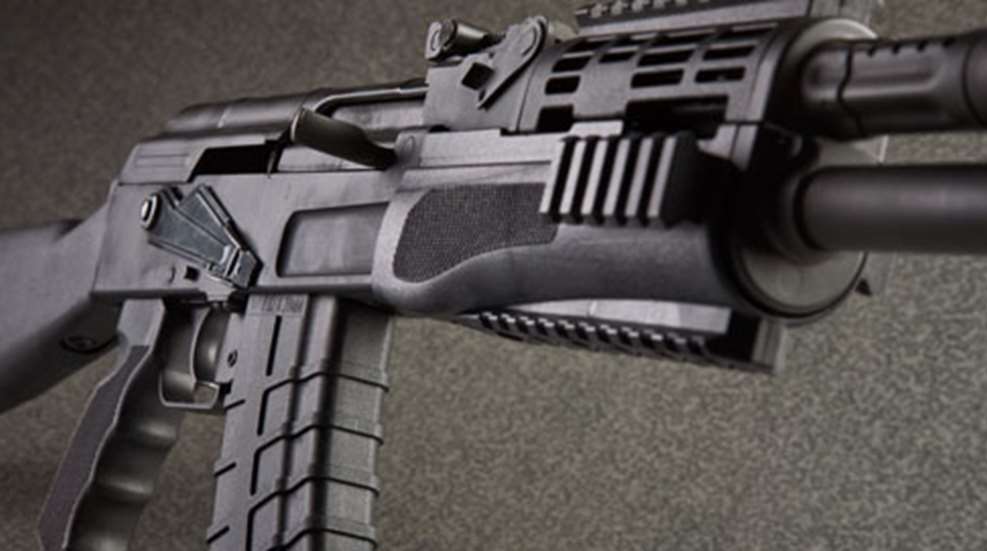
The Centurion’s most visually distinguishing features are its polymer buttstock and two-piece polymer handguard. The buttstock has a 1-inch longer length of pull than the original wood stock—better fitting American shooters—and terminates in a ribbed, plastic buttpad. The handguard features four Picatinny rail segments spaced 90 degrees apart for the mounting of optics, lights and other accessories. Molded-in checkered panels on the lower handguard aid grip, while numerous ventilation slots in the upper handguard help cool the enclosed gas tube assembly.
Two TAPCO 30-round polymer magazines come with each rifle. Century Int’l states that the Centurion accepts standard AK accessories, including the company’s own MTL-225 Tactical Fore-end Weapon Light, which combines a 225-lumen light with a vertical fore-grip and mounts on the rifle’s bottom Picatinny rail. Disassembly follows standard AK-47 procedures, as is thoroughly explained in the rifle’s owner’s manual.
We tested the Centurion 39 with three 7.62x39 mm loads, from American Eagle, Winchester and Wolf. Aiming was by way of an EOTech holographic sight mounted on the top Picatinny rail. A Harris bipod, attached to the bottom rail, and Protektor sandbag promoted steady holding.
The rifle created a favorable first impression, with an attractive matte-black finish and no external machining marks. Our test shooter gave the Centurion high marks for ergonomics and particularly appreciated its longer buttstock.
Accuracy was typical for AK-47 rifles, with groups averaging about 2½ to 3 inches at 100 yards. In fairness, the long 30-round magazine required full extension of the bipod’s legs—not the most stable firing position—and an intermittent crosswind bedeviled our tests, as shown by the fact that every group exhibited more horizontal than vertical dispersion. Finally, the EOTech did not afford the magnification advantage of a telescopic sight. With a 4X scope, a tripod front rest and less wind, we’d expect the Centurion to produce groups closer to 2 inches.
During our test-fire session, we had no failures to feed, fire or eject. Nonetheless, reliable ejection of live cartridges was best achieved by pulling the bolt back sharply rather than slowly. As with the original AK-47, the Centurion’s bolt does not lock open after the last round in the magazine is fired.
The Chevron Compensator was highly effective in reducing muzzle jump, allowing the rifle to return to almost the same point of aim with each shot. Also, the Centurion’s 6-pound, 12-ounce, two-stage TAPCO trigger was surprisingly shootable, with a 4-pound, 8-ounce, first-stage pull that left a light second-stage break having only a small amount of creep.
All in all, we consider the Centurion 39 to be a well-thought-out and well-executed semi-automatic-only version of the venerable Avtomat Kalashnikova, with features that make it stand out in the crowded AK-47 market. With a suggested retail price of nearly $1,100, the Centurion is costlier than some of its competitors (though comparable to many higher-end AKs with milled receivers). For many Americans, however, the Centurion’s performance and “Made in U.S.A.” label will make it worth the price.
Manufacturer: Century Int’l Arms, Inc.; (800) 527-1252; www.centuryarms.com
Caliber: 7.62x39 mm
Action Type: gas-operated, semi-automatic center-fire rifle
Receiver: 4140 steel
Barrel Length: 161⁄2"
Rifling: four-groove, 1:10" RH twist
Magazine: 30-round polymer box magazine
Sights: front post adjustable for elevation, rear adjustable for windage and elevation
Trigger: two-stage, 6-lb., 12-oz. pull
Stock: polymer: length of pull, 14"; drop at heel, 2"; drop at comb, 111⁄16"
Overall Length: 371⁄4"
Weight: 8 lbs.
Accessories: two magazines, owner’s manual
Suggested Retail Price: $1,090
Most Popular