3/5/2013
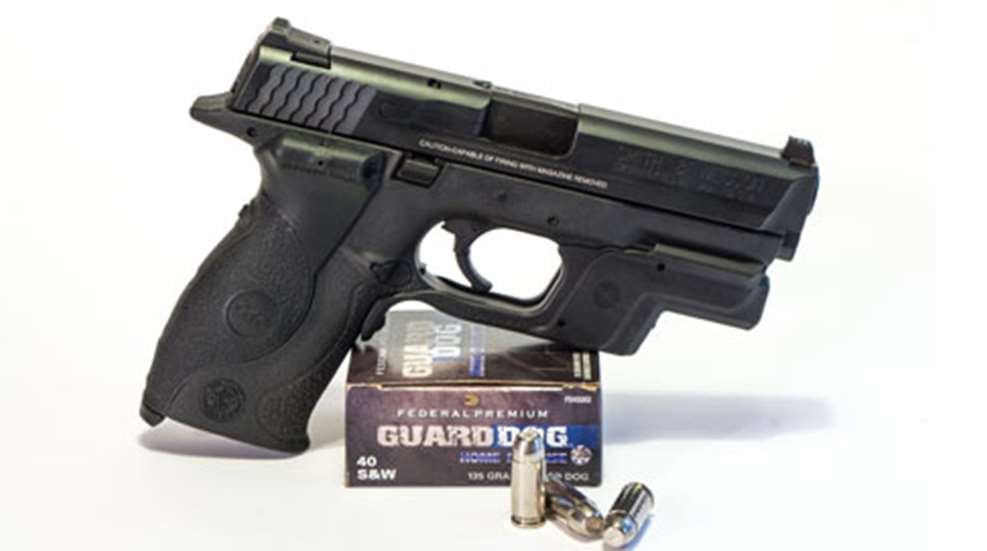
Due to the reputation of the agency and its vested interest and research on the subject, the Federal Bureau of Investigation (FBI) has had a great deal of influence on defensive handgun ammunition. When the FBI speaks, cops and civilians listen. Right or wrong, the FBI’s field experience and testing protocol has set the standard for modern defensive handgun ammunition. The FBI is also the reason we have the .40 S&W.
In April of 1986, two bank robbers donated their lives to further the development of defensive handgun ammunition. During this shootout, which occurred in Miami, two FBI agents were also killed and five others wounded. In the wake of this incident the FBI developed a series of tests using 10 percent ordnance gelatin to evaluate a bullet's ability to penetrate and expand; primarily after passing through various intermediate barriers. Barriers commonly encountered by police when shooting at bad guys.
Afterward the FBI asked Federal Ammunition to develop a 10 mm load using a 180-grain bullet that would not recoil more than common .45 Auto loads. The result was a 180-grain Sierra JHP bullet at 950 fps. When subjected to its established test protocol, this 10 mm load performed very well and the FBI placed an order with Smith & Wesson (S&W) for pistols to shoot it.
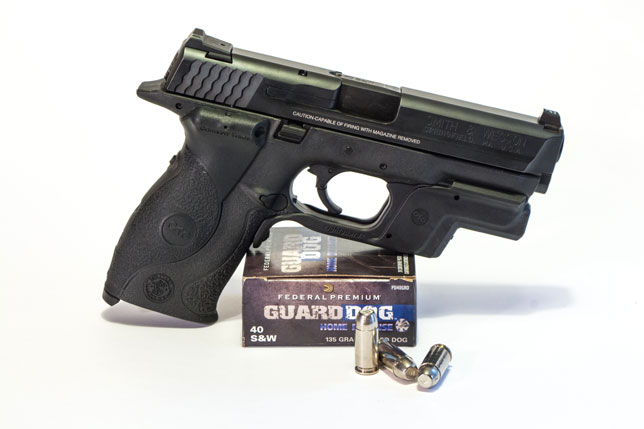
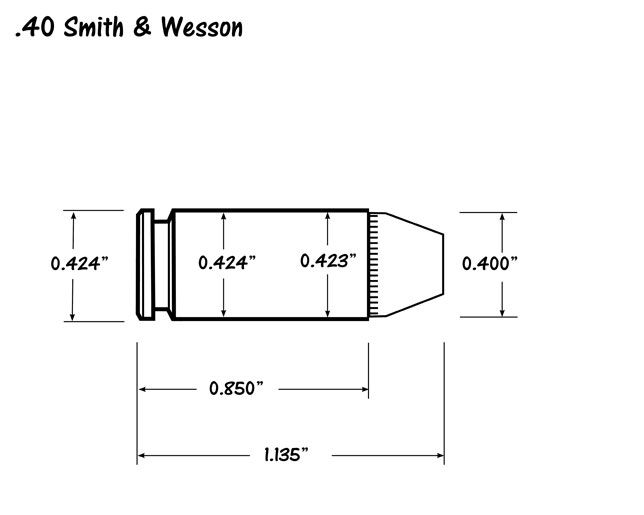
S&W also agreed to develop a smaller 10 mm cartridge case that would ballistically match the 10 mm. In 1990, the .40 S&W was unveiled as an effort between S&W and Winchester Ammunition. It could best be described as a shortened 10 mm, loaded to the same pressure as the 9 mm Luger. For those who could not decide between the faster 9 mm and the lumbering .45, there was finally a compromise.
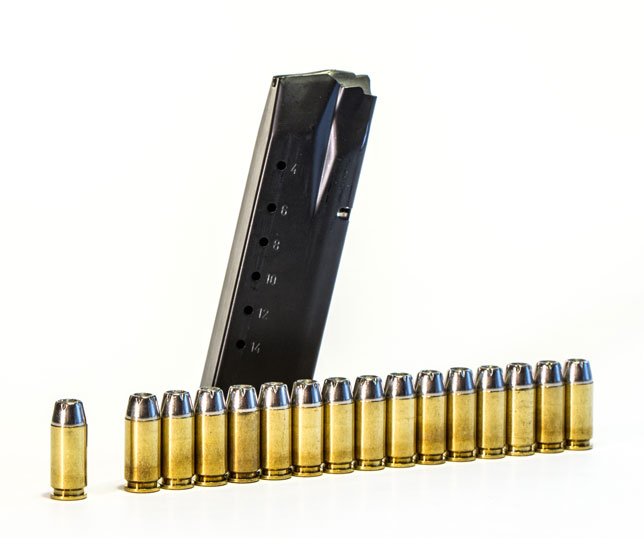
When pistols of the same size are compared a .40 S&W will hold more ammunition than a .45 ACP. It can also handle heavier bullets than a 9 mm. For American law enforcement this combination seemed perfect, and with some savvy marketing help from Glock, the .40 S&W became the first choice of cops nationwide. And, as always, civilian shooters were quick to follow in the footsteps of the police.
There were some stumbling blocks. Case head separations started occurring; particularly in Glock pistols due to the area of the case left unsupported above the feed ramp. Some guns even blew up. The exploding guns were caused by another problem pretty much exclusive to law enforcement; bullet set back.
Many cops unload their duty guns at shift's end and insert the cartridge from the chamber into the top of the magazine. Chambering the same cartridge day after day can cause the bullet to set-back in the case. With the .40 S&W this had the potential of doubling chamber pressures. When an officer reported for qualification and fired his duty ammo, the first shot—which was the cartridge with the bullet set back—could be very exciting. These problems have since been addressed with stronger cases and a more robust bullet crimp. Still, it's not a bad idea to cycle any cartridge you unload from the chamber of your handgun to the bottom of the magazine.
Is the .40 S&W the best defensive or law enforcement handgun cartridge? That's difficult to answer because the definition of "best" seems to be a moving target. I've tested hundreds of defensive handgun loads in 10 percent ordnance gelatin and I remain somewhat unconvinced the .40 S&W is a better mouse trap, and still consider it mostly an option for those who cannot decide between a light, fast-moving bullet or a slow, heavy bullet.
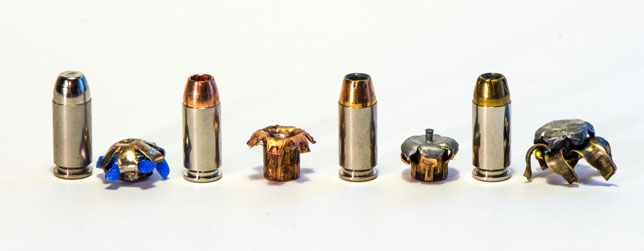
The .40 S&W seems to shine the brightest when paired with 140- to 155-grain projectiles. Consider the 140-grain Barnes TAC-XP bullet loaded by Black Hills and Buffalo Bore or the 155-grain Speer Gold Dot. The .40 caliber, 140-grain TAC-XP bullet will expand to about .70 caliber and penetrate to what many consider an optimal 13 inches. The .40 caliber, 155-grain Gold Dot performs almost identically. Since .40 S&W bullet diameter (0.400) is smack in the middle of the 9 mm (0.355) and the .45 (0.451), it seems logical that something between heavy 9 mm and a light .45 bullets would be optimal in this cartridge.
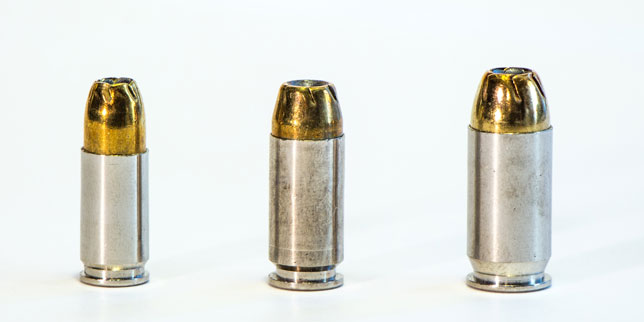
Anyway you look at it, the .40 S&W is a compromise cartridge offering terminal ballistics similar to the 9 mm and the .45 ACP, but with an ammo capacity right in the middle. Early on, the .40 S&W benefited from the engineering directed at the bullets it fired, but that same technology has been applied to the bullets loaded in almost every defensive handgun cartridge. Though it's likely the 23-year-old .40 S&W will continue to be the police cartridge of choice, civilians still gravitate to the 100-year-old 9 mm and the .45.
I'm no different. I carried an issued Glock in .40 S&W for 13 years when I worked the street, but since I no longer have to compromise, nines and forty-fives are all you'll find me carrying. Maybe I'm just old-fashioned.
Gallery