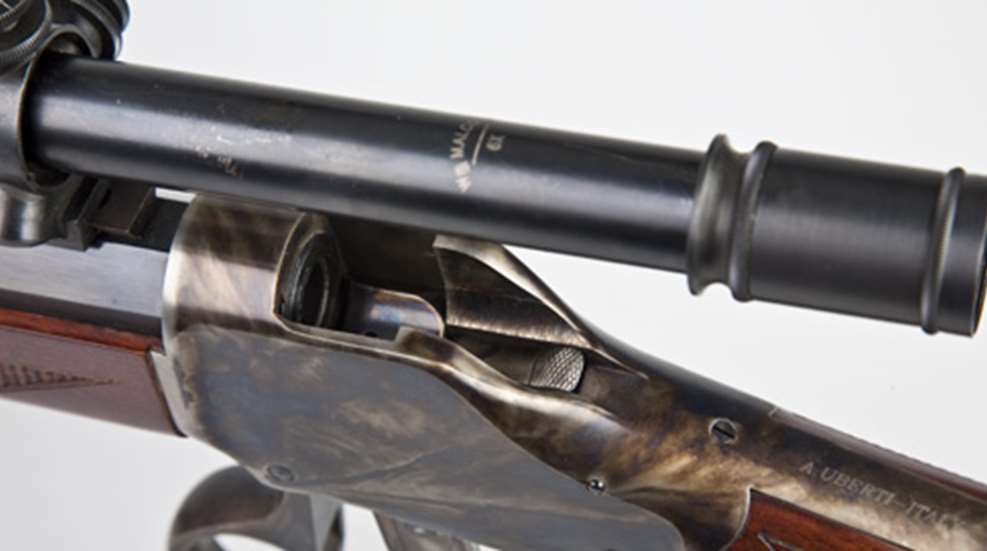
William Malcolm was one of the first names in American riflescopes, and he opened for business in Syracuse, N.Y., in 1855 with both 1/2- and 3/4-inch-diameter tubed riflescopes 24 to 30 inches in length. According to Nick Strobel in “Old Rifle Scopes,” they were initially available from 2X to 20X in magnification, but eventually most ended up in 14 to 30 inches in length and in 4X to 8X magnification. In their day, Malcolm scopes were considered the best of the American-made riflescopes, and they were pricey as one might expect. In 1910, the simple Malcolm “Rough Rider” 3X was priced at $14 with the “A” mount—a mere $2 less than an octagonal-barreled Winchester Single Shot (1885 High Wall) with a shotgun buttplate. In addition to the scopes, Malcolm was also “Inventor of the celebrated Elevating screw Movement and also Screw Wind Gauge Movement for Telescopes. William Malcolm died in 1890, but the company remained in business until 1940, by which time other American scopes surpassed the Malcolms. Just as a market developed for replica firearms, so too was there demand for a replica scope. While it’s hard to improve on a Single Action Army or an 1885 High Wall, improvements in lens coatings, nitrogen-filled tubes and other advances could be incorporated into a replica riflescope without changing the external lines. Look through an original riflescope of the 19th century then go back to even an inexpensive modern scope, and there is literally a world of difference.
Jim Leatherwood (inventor of the Auto-Range Telescopic Sight or ART) was fascinated with vintage riflescopes and wanted to offer a unit as period-correct as possible. It took him about 14 years of research before he brought out the first of the modern William Malcolm steel 3/4-inch diameter tube scopes. In 2006, Leatherwood went into mass production of short, steel-tubed scopes 18 inches length (extended sun shades allowed mounting the scopes on a variety of rifles). The scopes, marked “Wm Malcolm” just forward of the ocular lens housing, are produced at the Leatherwood factory in China. Run by a member of the Leatherwood family (Jim Leatherwood died in 2007), the facility has high quality-control standards, and all the components are fabricated in-house. In 2008, a 6X was introduced, and it is now the firm’s most popular scope.
Although they look period, the scopes are filled with nitrogen, and there are six lenses on the inside, fully multi-coated on every air surface. Leatherwood reports 96.7 percent light transmission with its proprietary coatings. Inside a modern riflescope, typically a spring or springs press on the erector tube opposite of the adjustment turrets. When you turn the dial, it increases or decreases tension, moving the reticle. Obviously, there are no adjustment turrets on the Malcolm scopes so that function, as in days past, is done with the mount.
At the front, the mount is fixed, but at the rear the unit is patterned after those made in the past by Lyman, and it is called a “rabbit ear rear mount” by Leatherwood. The front base is fixed, and I added a recoil clamp to the front ring to prevent movement under recoil. Only the rear ring has provision for adjustment, and unlike a conventional riflescope, you can see the tube move. There are no clicks and each dial has a lock ring that must be loosened before adjustments can be made. A spring at the five o’clock position presses upward on the tube. The windage and elevation screws push the tube against that spring, and you can actually move the tube inside the mount, but spring tension returns it to zero.
External scope mounts, just so you know, don’t work like modern scope adjustments, and they take some getting used to. In practice they are a bit like iron sights, you move the rear of the scope in the opposite direction you want to move the group.
For target work there is a Precision rear mount fine elevation adjustments that are not period correct, but allow more precise adjustments. Under recoil of standard Sporting Arms and Ammunition Manufacturers’ Institute (SAAMI) compliant ammunition (designed to be safe in Trapdoor Springfields), I had no difficulties holding zero, although heavier hunting loads created for the stronger 1885 resulted in shifts in point of impact until the scope was pressed against the spring firmly and allowed to reset against the adjustment screws.
My scope came from MidwayUSA, and cost $299 for the scope itself, but the rings, bases and locking clamp were an additional $170 or so.
Most Popular