Although German Precision Optics may be a relative newcomer to the outdoor optics market, the principle partners—Mike Jensen and Richard Schmidt—are seasoned hands, both having experience at the helms of renowned European sporting glass companies. Now, the duo is using their expertise and international connections to design and engineer binoculars and riflescopes in Germany, manufacture those optics to exceedingly high standards in Japanese and Asian facilities, and bring the final product, at a fair price, to the American sporting market. The combination of premium German optical engineering and affordable Asian manufacture—a burgeoning market that, in the past decade, has grown by leaps and bounds in terms of quality and reliability—allows GPO to bring feature-filled optics and excellent glass to the American consumer at competitive price points previously passed over by European interests. Jensen told American Rifleman, “We make sure GPO products are built to our specs and that the factories we work with adhere to the tough quality control we’re used to from our experience with other top brands. We use high-transmission glass and other prime components—the same as our competitors. What it all adds up to is this: We build higher-quality products with better features at similar prices, or similar-quality products at better prices.”
 A testament to the company’s experience and expertise, right from the jump GPO’s catalog offered 11 models of binoculars and 17 riflescopes. The impressive lineup ranges in price from a few hundred dollars to just under $2,000 for premium-grade glass, and includes well-appointed entry-level offerings—such as the Passion ED 8X 32 mm binocular—up to the feature-filled, expert-grade optics like the GPOTAC 1-8X24i, the subject of this review.
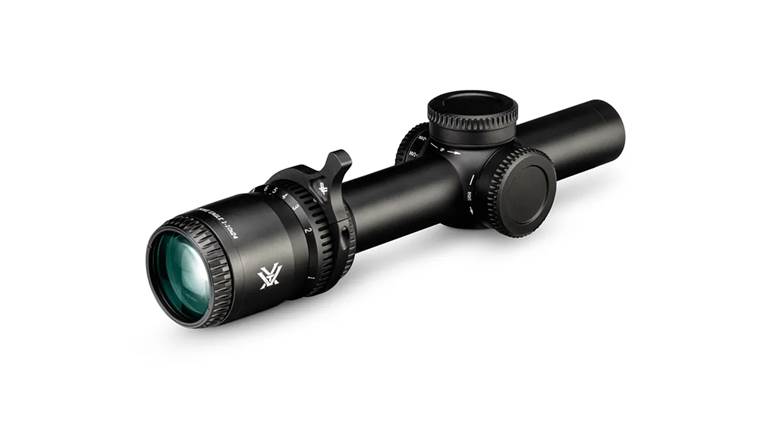
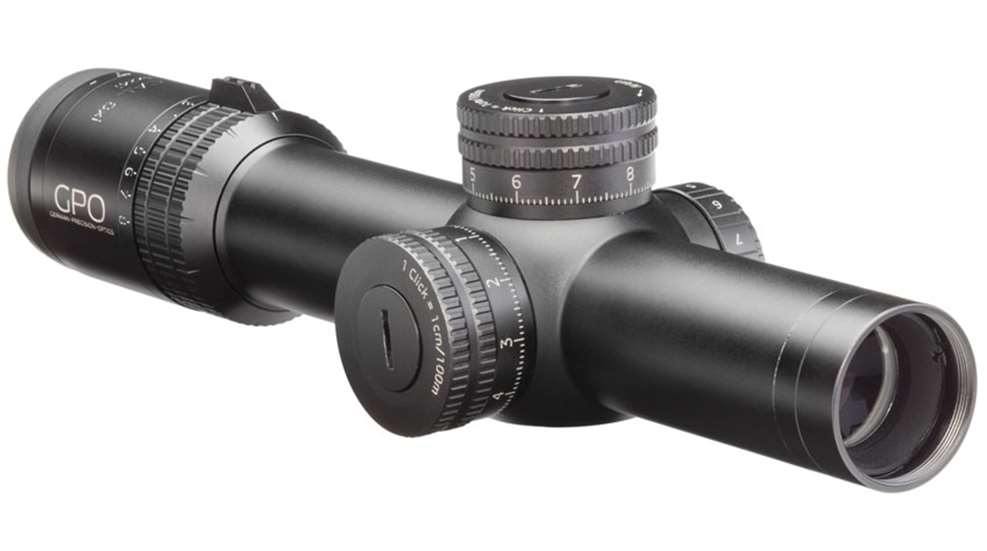
A departure from more traditional, European-inspired sporting glass, the GPOTAC 1-8X24i is designed, instead, along the lines of tactical- and target-style riflescopes intended for use on AR-15-type platforms, and even advances that category. The scope’s model designation reveals several of its salient features, specifically the 1-8X magnification range, which is notably larger than many scopes designed with 24-mm objective lenses—1-6X is probably the most common magnification range for this class. Also, the “i” denotes GPO’s iControl illuminated reticle system, a feature we will discuss shortly. Not included in the model name is the fact that the 1-8X GPOTAC is built on a 34-mm main tube, which is an upgrade over the more common 30-mm tubes seen in similar riflescopes. It makes for a pretty substantial package, but 34-mm tubes are becoming more prevalent in high-end precision scopes, in part because they allow for a wider range of windage and elevation adjustments—291 cm at 100 meters, each, for the 1-8X GPOTAC, or about 29 mils of vertical and horizontal adjustment.
To make those adjustments, the GPOTAC has two oversized turrets at the midpoint of the main tube, about 3" back from the front of the scope. As expected, the top turret is for elevation adjustments and the right-side turret is for windage. Both adjust at a rate of 1 cm at 100 meters per click, and clockwise turns result in “UP” and “R” adjustments, respectively. Rather than protective caps as on hunting scopes, or fully “free” turrets as on some competition optics, the GPOTAC turrets feature a lift-to-unlock mechanism, whereby the user must grasp the knurled turret top and lift up (or pull out) before rotating. Once an adjustment is made, the turret can be pushed back into the locked position. Further, for shooters who like to “dial up,” once the scope is zeroed to a firearm, each turret has a slotted central cap that can be removed, allowing the turret body to be removed, rotated to show “0” and replaced. Throughout testing, including zeroing to a rifle and subsequently shooting the square, adjustments remained crisp with audible and tactile clicks, and the values remained consistent.
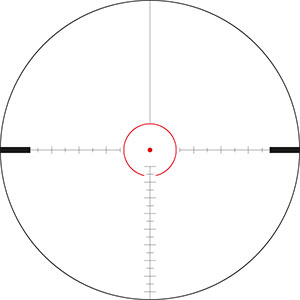
A third turret, on the left side of the tube, controls the GPOTAC’s illuminated reticle and houses the single CR2032 battery. There are eight brightness settings, and GPO’s iControl system alerts users when the battery is getting low and automatically shuts off after three hours of inactivity. The reticle itself is in the first focal plane, and is the company’s horseshoe design. As such, at 1X the reticle appears to be a basic plex arrangement with an illuminated center point. As the magnification increases, the reticle reveals itself to have an illuminated CQB-style horseshoe-and-dot, and the non-illuminated plex lines possess windage and elevation holdover hashes.
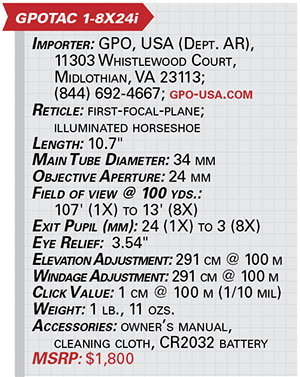 At the rear of the scope is a rather robust eyepiece, a profile common to tactical scopes. Its forward edge, just behind the main tube, is the magnification adjustment ring. Three bands of knurling make the ring easy to grasp, even for gloved hands, and there is also a raised fin to aid quick adjustments. The ring rotates in a 180-degree arc from “1”—for 1X—at the far left to “8” on the right. Finally, surrounding the ocular lens is a rubberized ring that can be rotated to adjust focus. Speaking of the ocular lens, and the scope’s glass as a whole, the lenses are coated with the company’s GPObright formula, and, though small, the 24-mm objective lens is rated as Double HD glass. In practice, we found the optical brightness and clarity to be very good, delivering crisp images, even in lower-light conditions.
Overall, we found the GPOTAC 1-8X24i to be a very stoutly built riflescope with an excellent magnification range, reliable adjustments and very good glass. It is a feature-filled design manufactured to a very high quality standard. As if to reinforce Jensen’s quote, several evaluators and fellow range-goers ballparked the price for the GPOTAC to be in the $2,500-$3,000 range, and the scope certainly delivers that level of performance. However, with an $1,800 suggested retail price, German Precision Optics has brought a quality product to market that exceeds expectations when it comes to perhaps the most important feature of all—value.
Most Popular