When it comes to handgun operation, there seems to remain a nearly constant misinterpretation. One that occasionally pops up like fingernails on a blackboard to any gunner worth his or her salt is the semi-automatic revolver.
Some time ago an acquaintance wanted to show me his 1911 and produced a Smith & Wesson Model 645, thinking that .45 ACP was synonymous with 1911. His faux pas was not intentional, and after some diplomatic correction he now knows the difference. So let’s see if we can set the record straight on basic handgun operation.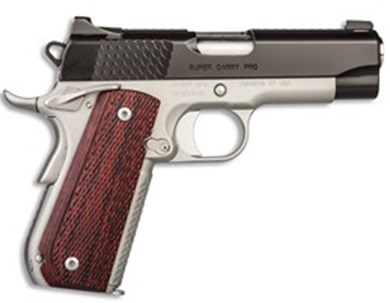
Single Action
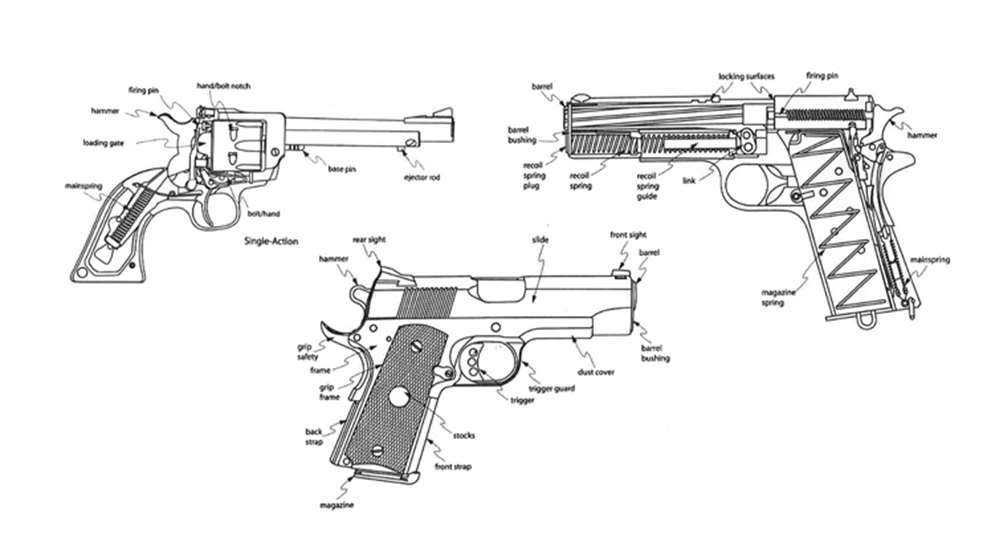
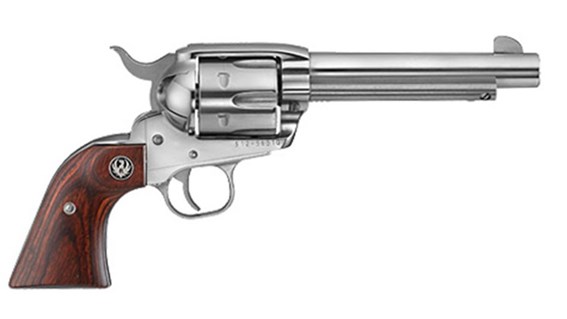
Single-action handguns are generally the simplest in terms of operation. A single-action revolver must be manually cocked before it can fire. Usually this is done with the thumb—hence the colloquialism “thumb buster.” The hammer is cocked until the sear of the trigger engages a notch in the hammer, and simultaneously the mainspring is either compressed if it is a coil spring like a Ruger, or it is loaded if it is a leaf-type like a Colt. Cocking a single-action revolver also rotates the cylinder and sets up a fresh cartridge. A locking bolt in the bottom of the frame engages a notch in the cylinder aligning the cylinder with the barrel and locking it in place. Single-action revolvers have no manual safety; once the hammer is cocked, the gun can be fired by pulling the trigger, thus making it unsafe to carry with the hammer cocked. Examples of single-action revolvers are the Colt Single Action Army and the Ruger Blackhawk and Vaquero series of revolvers. Some refer to single actions as “cowboy guns.”
There are also single-action semi-automatic pistols. Like the revolver, the hammer must be cocked before the pistol can fire. With semi-automatics, the hammer is cocked when the slide is fully retracted and then released. The slide makes contact with the hammer, cocking it until a notch much like the one in the revolver’s hammer engages the sear. Additionally, with semi-automatics, the sear is a separate part and not integral with the trigger. Single-action semi-automatics do have a separate manually-operated safety that prevents the sear from moving when engaged. Some single-action semi-automatics also have a grip safety that must be depressed in order for the pistol to fire. Single-action semi-automatic pistols can be carried safely with the hammer cocked and a round in the chamber with the manual safety engaged, provided the user fully understands the operation of the pistol. Examples of single-action semi-automatic pistols are the 1911 and Browning P-35.
Double Action
Like the single action, there are double-action revolvers and semi-automatics. Double actions are a step up in complexity, both in mechanics as well as categorizing. Let me see if I can sort it out.
Double-action revolvers can use the trigger to cock the hammer as well as fire the gun. On the double-action revolver’s trigger is a sear that engages a rotating fly mounted on the hammer. Pulling the trigger, the sear engages the fly, thus retracting the hammer. When the hammer reaches maximum compression of the mainspring, the fly disengages the sear, allowing the hammer to move forward and strike the primer of the cartridge. Like the single-action revolver, the trigger does double duty. A pawl mounted on the trigger engages a ratchet on the cylinder via a window in the recoil shield to rotate the cylinder into battery, and a bolt in the bottom of the frame engages a notch in the cylinder to align and lock it up.
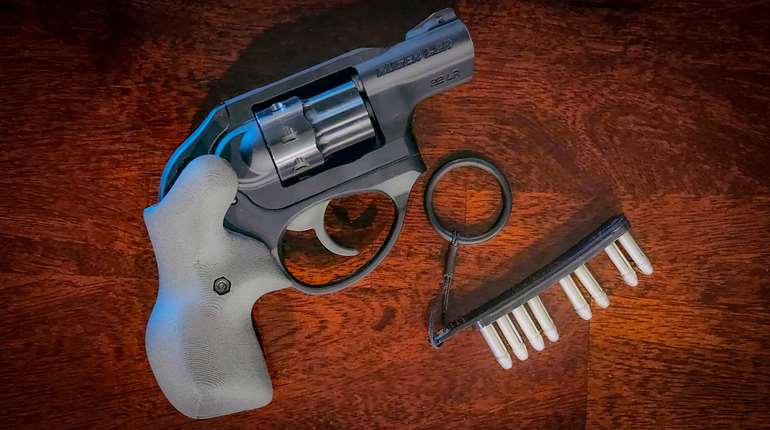
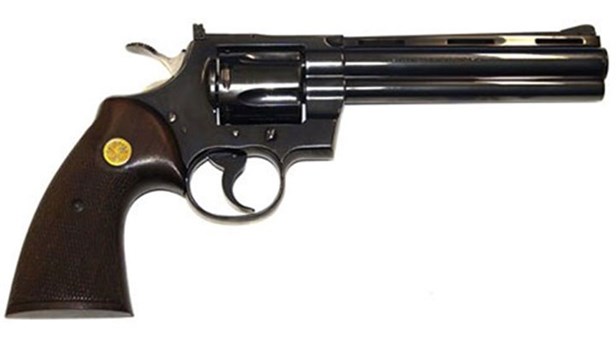
Most double-action revolvers have a notch on the bottom of the hammer that can engage the sear on the trigger so that the revolver may be fired single action. A few do not have this single-action feature and are labeled as “double-action-only” or DAO. Again, like the single-action revolver there is no manual safety; the force necessary to overcome mainspring tension is the built-in safety allowing the double-action revolver to be carried safely with the hammer down. Modern double-action revolvers have a hammer block or transfer bar that prevents the firing pin from touching a primer under the hammer at rest and the trigger not pulled, thus making it safe to carry all six chambers loaded with the hammer down. Very few double-action revolvers were made with grip safeties; garnering the name of “lemon squeezer.” Most double-action revolvers also feature a swing-out cylinder allowing all of the cases in the cylinder to be extracted simultaneously via an ejector rod and a star at the rear of the cylinder. Examples are the Smith & Wesson Hand Ejector series (J,K, L, N and X frames), and Colt Model 1878 Double Action, New Service, Police Positive, Python and Anaconda revolvers.
Double-action semi-automatic pistols also use the trigger to cock the hammer and fire the pistol in one relatively smooth motion for the first shot. Subsequent shots are fired as a single-action pistol, often giving such pistols the double-action/single-action (DA/SA) nomenclature. Instead of directly engaging a double-action fly to the trigger sear, a drawbar connects the trigger to a lever and then to the sear which is connected to the hammer. Operation is similar to the revolver except that when the pistol is initially fired, its operation then becomes single action.
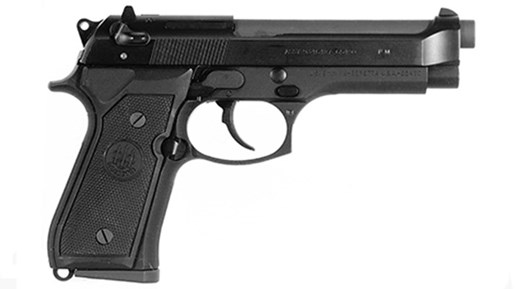
Some double-action semi-automatics have a manual safety, usually combined with a decocking lever that can drop the hammer to its resting position without firing the pistol. On some models, what looks like a manual safety is a decocker only. These features are model specific and the shooter should consult with the user’s manual to fully understand his particular pistol. Examples of double-action semi-automatic pistols are the Smith & Wesson models 39, 59 and 645, as well as the Beretta Model 92 and H&K P30.
Striker Fired 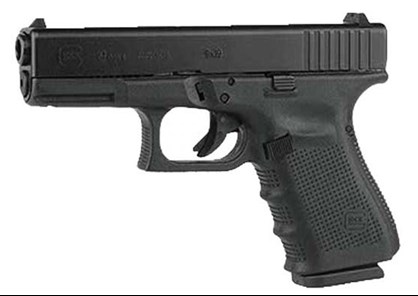
Moving up the complexity scale are the striker-fired pistols. The most popular by far is the Glock. Other models nibble away at replicating the Glock mechanism—which is akin to a kid’s erector set crammed into a pistol—but we’ll stick with the original here. There are no external or manual safeties on a Glock—though some other striker-fired pistols do have them—it relies on three internal passive safeties that have to be defeated before the pistol can fire.
Starting with a round in the chamber and the slide in battery, the striker assembly which includes a firing pin, spacer sleeve, firing pin spring and a pair of retainer clips is under partial spring tension, restrained by a spring-loaded firing pin safety. When the trigger is properly pulled, the first safety, a spring-loaded trigger locking lever, disengages, allowing the trigger to move freely. The trigger now engages the trigger bar that presses on a connector which has a kick-up that engages a recess at the rear of the firing pin, pushing it rearward and further compressing the firing pin spring. As the trigger continues to be pulled, the firing pin is moved rearward and out of the way of the firing pin safety. A ramped integral lever on the trigger bar pushes the firing pin safety upward, disengaging it. At full firing pin compression, the connector disengages from the firing pin freeing it to move forward and strike the cartridge’s primer. The pistol fires, and cycles via the Browning-designed recoil system. 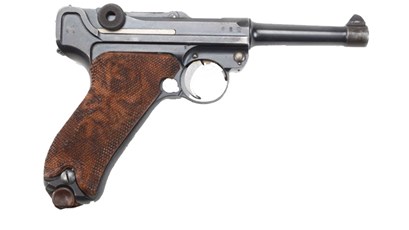
There are other, less-known methods of handgun operation. The P08 Luger is actually a melding of single-action and striker-fired design, for example. But these three are the means by which the vast majority of handguns operate. A clear understanding of each of them will help you in terms of your gun-handling skills.
Most Popular