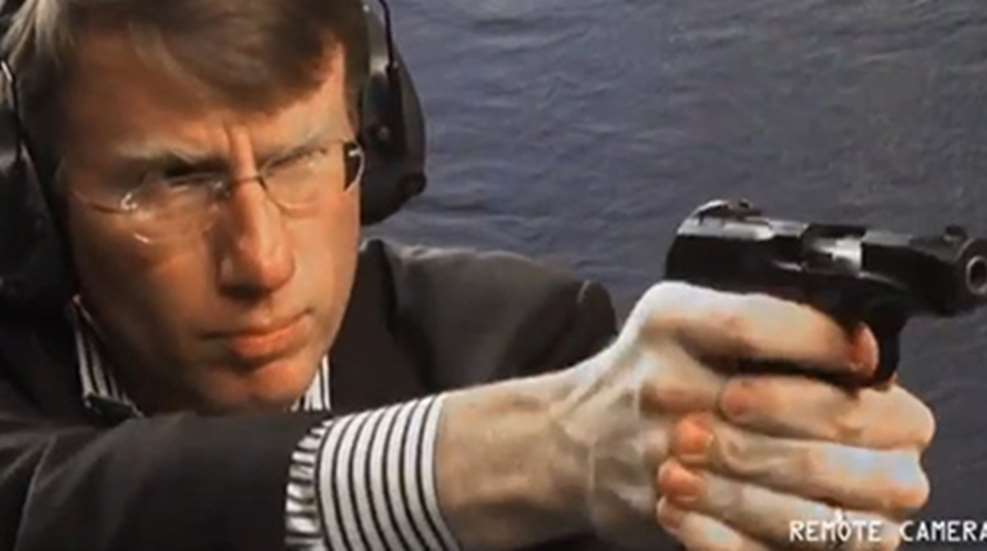
While I knew it was coming and had the chance to handle prototypes, nothing compares to taking a gun to the range. In this case, I am referring to the new Remington R51 pistol. My expectations were high, and the gun did not disappoint.
This is the 198-year-old company's first attempt at a compact personal protection gun since the John Pedersen designed Model 51 was discontinued in about 1926. The .32 or .380 ACP Model 51 was an advanced design for its day, having excellent ergonomics and slim, streamlined lines. As a matter of fact, it was a favorite of no less a personage than General George S. Patton.
The new R51 is a compact carry gun built on an aluminum frame that measures a mere 6" long by 4½" high, and is less than an inch across. It uses a form of delayed-blowback operation called the Pedersen lock or an impingement lock. What that means is that there is no familiar Browning-style tilting barrel, and the recoil spring surrounds the barrel. When firing the 20-oz. gun, it did not behave in the hand like the small gun that it is. Recoil was extremely manageable and straight back, with minimal muzzle rise. By going with the Pedersen lock, Remington’s engineers were able to keep the bore axis low. Combine that with the high grip in the back, allowing the shooter to really get into the gun, and you will find it easy to get back on target quickly.
The gun has and internal hammer and a crisp trigger-without a safety built into the trigger blade-that delivered a consistent pull weight. There is enough grip frame there to hold onto, and Remington will offer oversize grip panels that will bulk the gun up for trips to the range.
There is no manual mechanical safety, but rather a very positive grip safety in the backstrap must be depressed as part of a firm grip. This may take some getting used to by experienced shooters as it is somewhat unfamiliar. But so long as the shooter maintains a firm grip on the backstrap-much like fans of the H&K P7 must maintain a firm traps on the frontstrap-there should be no issues.
One of the biggest issues facing those without a of strength in their hands and upper bodies when it comes to semi-automatic pistols is the cocking effort required to fully retract the slide. Remington addressed this with the Pedersen lock. According to Remington, the R51 only requires 16.78-lbs of cocking effort, and even slight women I handed the pistol to were able to properly and confidently work the slide. Running the gun and its controls are crucial in a personal protection pistol, and I believe this to be one of the most significant pluses of the R51.
The accompanying video was done on fly on our test range, and I'll admit my mouth got ahead of my brain. I said “Model 1951” instead of 51 at one point. For the record, the Model 1951 is a post-war open-topped, single-action semi-automatic pistol design from Beretta. Its slide design is familiar because it was carried over to the Model 92 series of pistols.
Look for a feature article in the pages of American Rifleman on R51 by Field Editor Wiley Clapp later in the year. Wiley was part of an elite group of gun writers that wrung the R51 out at the Gunsite Training Center in Paulden, Ariz. R51s are in the final stages of production at Remington's handgun facility in Pineville, N.C., and I am told the first batch should be shipping at the end of this month.
Most Popular