Colt’s of Hartford, Conn., has been in the solid-frame, swing-out-cylinder, double-action 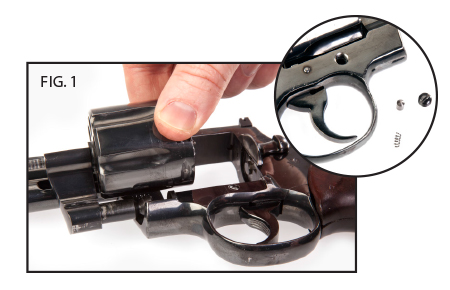 revolver business since the introduction of the Model 1889 Navy .38 DA. There were many subsequent models, the Official Police, Police Positive and Detective Special to name but a few, but to many the epitome of Colt’s double-action revolver line was the Python. Introduced initially as a “deluxe Magnum” target revolver, the Python in .357 Mag. made its debut in 1955. It was a big, beefy six-shot revolver with an integrally machined vent-rib, fully lugged barrel and a shrouded ejector rod. Typical sights included a Patridge-style front and a fully adjustable square-notch rear. Barrel lengths included 2½ inches, 3 inches, 4 inches, 6 inches and 8 inches. How beefy? The 21/2-inch barreled .357 Mag. reviewed in these pages in February 1964 was 7¾-inches long and weighed in at 33½ ounces. Not inexpensive, it sold for $125 a half-century ago. Finishes were blue, royal blue, nickel and stainless at various times during production.
According to the Blue Book of Gun Values, there were four separate eras for the Python: 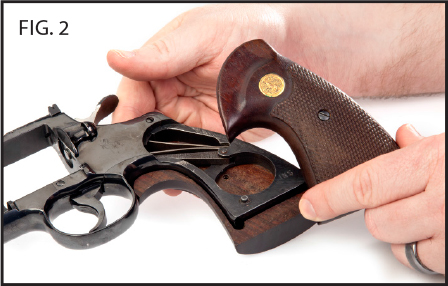 the early guns were offered in blue or royal blue with full checkered stocks from the early 1950s; the pre-suffix serial number guns up until roughly 1969; production from 1970 to 1990; and then the post-1990 production. Colt’s Custom Shop offered the Python Elite through special-order-only in 1997, discontinuing it a year later, and reintroducing it a year after that. Finally, Pythons were reintroduced from the Custom Shop from 2002 to 2006. Among other variations, there was a Python Elite Stainless made from 1997 to 1999, then again from 2002 to 2006.
The end of the production Python was caused, oddly enough, by its quality. It was a difficult gun to make, requiring skilled labor and a lot of hand-work. Pythons were all hand-fitted-an expensive and time-consuming process-and Colt could no longer afford to produce them, even through the Custom Shop. Once special-order production ended, it ended-no new Pythons. As they have been unavailable from the factory for years, values have risen dramatically. The already popular Python, in stainless 6-inch form, has been in high demand due to its use in the zombie apocalypse television series “The Walking Dead.”
Disassembly and Assembly Procedure
Remove the crane lock screw (8) and crane lock assembly (7 and 9). Swing out the 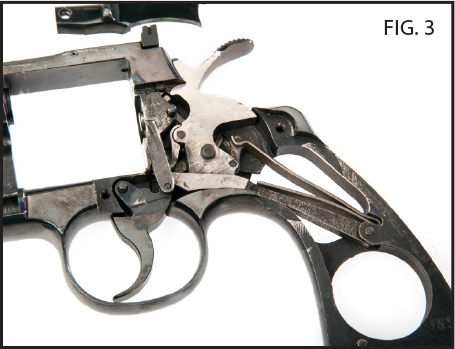
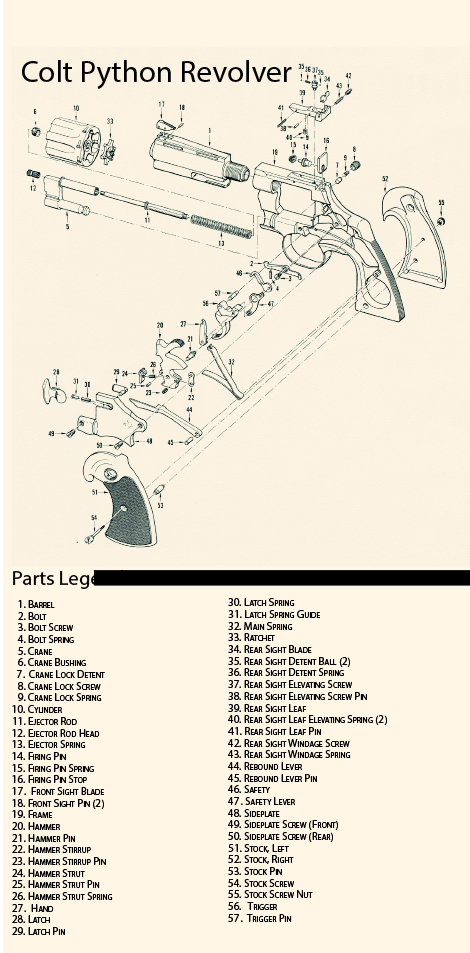 cylinder and remove cylinder and crane assembly by pushing them to the front (Fig. 1). Disassembly of the cylinder and crane assembly should be undertaken only by a competent gunsmith. Remove the stock screw (54) and stocks (51, 52), then remove the sideplate screws (49 and 50) (Fig. 2). Do not attempt to pry out the sideplate (48); instead, tap the frame and sideplate with the wooden handle of a tool until the plate loosens and it may be lifted out. Remove the latch (28) and latch spring and guide (30 and 31) from the sideplate (Fig. 3).
To remove the mainspring (32), lay the revolver flat and push the hammer back about 1/4 inches with the left forefinger. Holding a screwdriver in the right hand, press down on the mainspring near the stirrup (22) with the flat tip of the screwdriver. Push the hammer forward to disengage the stirrup from the mainspring, and then lift out the mainspring with the fingers.
Remove hand (27) from trigger (56). Drive out the rebound lever pin (45) with a punch or drift pin and remove the rebound lever (44). Remove the trigger by lifting it up off the trigger pin (57). Draw the hammer (20) to its rearmost position, and lift it up off the hammer pin (21). Drive out the strut pin (25) from the hammer with a small punch and remove the strut (24) and strut spring (26). Drive out the hammer stirrup pin (23) and remove the hammer stirrup (22).
Remove the safety lever (47) from its pivot around the base of the hammer pin (21) and remove the safety (46) from its slot in the frame. Remove the bolt screw (3) and remove the bolt (2), using care not to lose the bolt spring (4). The latch pin (29) can then be dropped out of its hole in the frame. Removal of the barrel, firing pin, recoil plate, stock pin, trigger pin, or hammer pin should be attempted only by an experienced, competent gunsmith.
The revolver is reassembled in the reverse order. The safety lever (47) should be placed back on its pivot with the slot in its short end engaging the stud on the safety (46). Replace the trigger so that the stud on the right side of the trigger engages the slot on the longer end of the safety lever. This assembly should be tested by moving the trigger back and forth to determine if the safety and safety lever are operating smoothly with the safety in its full “up” position when the trigger is all the way forward.
To replace the mainspring (32), grasp the spring between thumb and forefinger of the right hand and slide the slotted end of the spring into position with the hammer stirrup (22), guiding the stirrup into position by moving the hammer on its pin with the forefinger of the left hand. When the stirrup and mainspring have been engaged, lift the bottom of the spring onto the rebound lever (44) with thumb of right hand. Replace hand (27) in its hole in the trigger and press upward on the rebound lever (44) to allow the hand to be fully seated. Replace the latch spring and guide (30 and 31) in the sideplate (48) and place the sideplate in position on frame, but do not seat it fully. Place the latch (28) in its slot in the sideplate so that the stud on the latch pin (29) engages the hole in the latch. Seat the sideplate tightly and replace the screws (49 and 50). Replacing the cylinder and crane assembly and the stocks completes the reassembly.
Most Popular