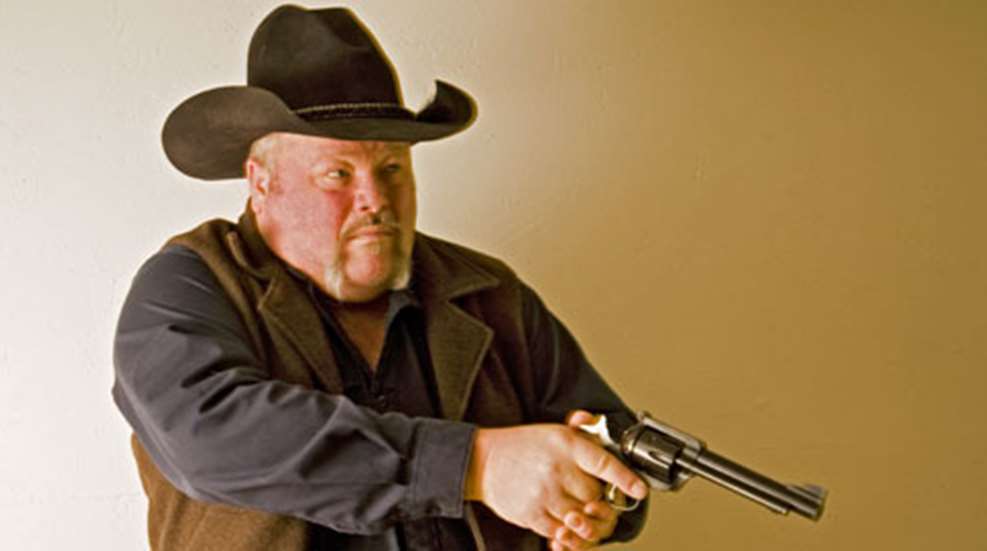
One afternoon some 30-plus years ago I let myself in the back door of the jail in Afton, Wyo. In my arms was a week’s worth of laundry and some detergent. The jail had a washer and dryer, and being the cheap sort of fella that I am, I used it for that weekly chore and saved myself a few cents. I dressed then much as I do today—jeans, cowboy boots, a flannel shirt and a felt cowboy hat. I had just got my first load in the washer when the chief burst through the door and said, “C’mon, we’ve got an arrest warrant to carry out.” I mentioned that I wasn’t in uniform, but he wouldn’t have any of that. “You got your badge?” I nodded. “Gun?” I alluded that I had a Ruger single-action in my truck. “Get it and let’s go!”
I was in my mid-20s—bulletproof and in shape, or so I thought. The chief and the dayshift officer were both in their late 50s, and, like I do today, carried some extra pounds around their midsection. We had three flights of stairs to climb to get where the miscreant was located. I flew up the stairs and waited for the other two officers to join me. When they did, both were winded, heaving for oxygen. The chief—gun in hand—waved it forward and wheezed, “Take the door!”
With an overload of testosterone and an equally vacuous quantity in brains, I squared off at the door of the room—which was ajar. I cocked the Ruger .45 Colt and slammed my right boot into the middle of the door. Our bad guy was sitting on the floor with his back against the bed, smoking a cigarette. My boot came down right where his legs came together, and I stuck the muzzle of the revolver on the end of his nose. He was most cooperative, and we quickly handcuffed him and took him into the town’s criminal justice system.
There was a lot that could have gone wrong that afternoon, but I was young and dumb, and I got away with it. As stupid as some of the things I did that day, I do not regret my choice of gun. The single-action revolver is as good a self-defense pistol today as it was when it first came on the scene nearly a century and a half ago.
It is undeniable that the semi-auto pistol dominates the self-defense market today and justifiably so. Technological and tactical improvements have produced a product that is well-suited to serving its owner as a primary reactive tool. But does that mean that the single-action revolver should be relegated solely to plinkers and cowboy action shooters? I would argue against that notion.
First is power: The solid, heavy frame of a single-action revolver can restrain and control more power than almost any semi-auto pistol. In many urban environs that can be problematical since over penetration in an apartment can be dangerous to innocents. But out in the sticks that power can be effectively used to overcome barriers and longer ranges. In a handgun I am a staunch supporter of large chunks of lead launched at as high a velocity as I can handle. A 250- to 300-grain semi-wadcutter at 1,100 fps or so has measurably more range and punch than a 120- to 180-grain JHP at 950 to 1,000 fps.
Second is simplicity: A single-action revolver is simpler and easier to operate than a semi-auto. There are no safety levers—passive or active—to manipulate. Simply cock the hammer and pull the trigger. It could be successfully argued that a double-action revolver is even simpler—all that is necessary is to pull the trigger—but that doesn’t take anything from the simplicity of the thumb-buster.
I am not presenting a case toward the superiority of the single-action revolver over the semi-auto. For multiple threats, go-fast guns are unarguably better. Most semi-autos are easier to conceal than single actions, too. But those of us with an affinity toward the single action are far from under armed when we choose our otherwise antiquated design. Let’s look at a few ways to make this revolver a bit more efficient as a self-defense pistol.
It all begins with presentation. You will, of course, be shooting two-handed. A major difference between what you may already be doing with a semi-auto or double-action revolver and a single-action revolver is that your support hand takes on a more active role. The thumb of the support hand will have the additional duty of cocking the single-action revolver. If you have been shooting single actions for some time, this may seem a bit foreign. But a few minutes with an empty gun on the range will demonstrate clearly that when you use the strong-side thumb to cock the revolver it becomes a more complicated operation. Unless you have hands the size of an outfielder’s glove, you will have to move the grip of the revolver in your hand to reach the hammer spur. By using your strong-side hand to firmly control the revolver, the support hand will be in a more natural position to simply raise a thumb and cock the hammer.
Using the support hand to operate the hammer means that you can get follow-up shots off quicker. If you don’t believe me, watch a cowboy action shooter sometime. Well-practiced shooters can get five aimed shots off in less than three seconds using this two-handed method.
Reloading—both emergency and tactical—techniques will obviously be different with a single-action revolver. If you’re shooting a post-’73 Ruger or one altered to utilize a transfer bar, it is safe to charge all six chambers. Get into the habit of loading a chamber right after you eject a spent case, instead of dumping all of the cases and then reloading. It’s a lot faster, and it keeps you in the fight. Colt and it clones require more attention since they are not safe to carry with all the chambers charged. In the middle of a fight this is a moot point, but at some point you will holster the revolver and then you must ensure the hammer is not resting on a live primer. Those of us who have been shooting single-action Colt-style revolvers for some time have learned to load one chamber, skip one and load the remaining four. Bring the hammer back to full cock, and you will always lower it on an empty chamber.
Also consider how and where you keep your spare ammo. Traditional belt loops look cool but are very inefficient. Putting a half box of ammunition on your belt is a great way to ensure it falls off your rear. I know this from personal experience, and it isn’t a pretty sight, especially when the gun belt takes your pants along for the ride. Carry no more than two cylinders-full of cartridges on your belt, and a box that dumps six into your hand from the bottom is quicker and more efficient than loops.
Forward-thinking pistol-packers will understand that many confrontations occur in low light. I have yet to see a single-action revolver made with a Picatinny accessory rail, so the prudent shooter will learn and develop a chosen method to handle an auxiliary light. There are several methods—offset, cigar and crossed wrists are the most popular—and no one technique is perfect. Some employ all of these depending on the situation. But here’s the important caveat to remember: All revolvers have a gap between the cylinder and the rear of the barrel, and all will eject fire, hot gasses and some burning particles from that gap during firing. If your hand is in that pathway, expect a painful distraction to occur—anything from a stinging concussion to a nasty laceration, depending upon the ferocity of the cartridge. Should you allow your light source to interfere with that path, it’s possible that ricocheting ejecta could end up in an unfortunate location, such as your eyes. Practice and train accordingly.
Make no mistake, I am not advocating that we all give up our semi-autos and replace them with the old guns. But I will say this: A Ruger Flat Top Blackhawk in .44 Spl. has a more-or-less permanent home in my truck. And when I’m on my four-wheeler on the back of my property or aboard a horse playing trail bum on some lonely piece of desert, most of the time there is another .44 or a .45 Colt single action dangling from my belt. My intent may be for some simple backcountry loafing, but it would be a mistake to “tread on me.”
Most Popular