4/15/2013
A concerned citizen who contemplates buying and using a handgun faces an intimidating task, which is true regardless of the shooter’s reason for starting a handgunning career. Shooting a handgun is a rather simple physical skill akin to playing golf or tennis. But using a handgun is a practice loaded with legal and moral implications.
By design, all firearms are deadly and every shot that issues forth from them is a potential death. You must accept the grave nature of your actions as you go about learning and using your new firearm. I certainly don’t want to discourage a healthy interest in using guns or even deprecate the need for one when the circumstances of your life might justify it. But I do want you to accept that you can seriously injure or even kill someone with your new hobby.
In times past, most shooters learned their shooting skills at their father’s knee, developing a sense of responsibility about firing a shot. As the years roll on and the population tends to cluster together in major urban centers, the need for learning gun skills and the opportunity to do so seem to lessen. True enough, but it can also be argued that life in an urban center simply exposes you to more people, some of which might be willing to victimize their fellow man.
The problem then becomes an educational one. You have to find an instructor who is up-to-date on all applicable Federal and state regulations, as well as being well versed in the teaching of gunhandling and marksmanship techniques. I believe that this is the biggest mistake that beginners make-they fail to seek qualified instructors. Having recently witnessed some pretty incompetent teaching in progress, I can attest to the truth of this statement. My suggestion here is to seek competent instruction from NRA-certified instructors. Believe me, they spent a good bit of time and effort achieving that distinction. Many local NRA-affiliated gun clubs have excellent teaching programs in place and responsible gun dealers are delighted to send you to them.
You also need to decide what kind of shooting you want to learn from an instructor. In these troubled times, I have often asked beginners this question and got some pretty vague answers. Usually, I hear things like “I want to know how to handle a handgun” or “I just need to know how to load and fire it.” What they are trying to say, without sounding like Rambo, is “I want to know how to defend myself.”
Skillfully used, the handgun is certainly capable of that. Notice that we are now focused on the handgun, because that is what the greater number of people are interested in learning. Instructors hear this all the time, but the good ones make it clear that basic skills of sight alignment and trigger control are the basis for all handgun shooting. Don’t give up on an instructor because he wants you to learn the basics before he progresses to advanced combat skills. I believe that a great many new handgunners are unrealistic about their training, specifically in what they expect to happen and how fast it will happen. Be patient-take your time and learn.
Then, people show up for their first class in a handgun training course with an amazing array of pistols and revolvers. Your equipment needs to be chosen with great care. Don’t worry about getting the latest or best in the way of powerful handguns and exotic equipment. All you need as a beginner is a handgun that may be fired comfortably and economically. There is nothing better in this regard than a plain .22 rimfire pistol or revolver. The lack of recoil and muzzle blast, added to the low cost of the ammunition, make these modest guns great choices for training. I would like to point out that Smith & Wesson offers a .22 semi-automatic pistol built on the same frame it uses for 9 mm and .40 S&W pistols. Ruger does exactly the same thing. Ruger also offers its steel frame SP101 in .22 and .38 Spl. versions. And believe it or not, S&W does the same thing in both small- and medium-sized revolvers. My point is simply that you can choose a handgun that flattens out the learning curve-a .22 rimfire-and provides an easy transition to a more effective caliber.
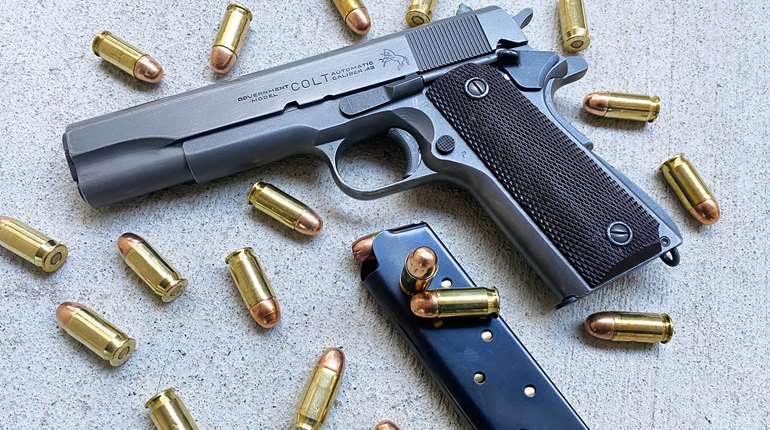
I steadfastly cling to the belief that a .22 Long Rifle is not an effective defense cartridge-not enough bullet, not enough speed. But the concept of training with one and transitioning to a .38 or 9 mm is very appealing. If you think that I am telling you that you must have a .22 and a .38 or 9 mm, I am not. It is completely possible to begin training with your choice of caliber and use it to the end of your days. The .22 route just makes it easier. In this regard, choose a primary defensive gun that has the greatest power you can manage. Believe it or not, that is usually a .45 ACP. Yes, I know that this is the caliber associated with SWAT cops and SPECOPs soldiers, but I recently finished a class at Gunsite with half-and-half men and women. Several women had .45s and used them well. Make that very well.
The majority of new handgunners make errors on at least some of these things. They don’t get responsible and professional training, and then get impatient with their instructor. They don’t choose their gun sensibly and expect to become seasoned gunfighters overnight. Seek help, choose well, and be patient.
Most Popular