When Oliver Winchester’s son-in-law and Winchester Repeating Arms Co. President Thomas G. Bennett was looking for a new lever-action rifle that could withstand the higher pressures found in military cartridges used for single-shot rifles in the mid-1880s, he turned to John M. Browning. In one of his earliest firearms developed for Winchester, the Model 1886, Browning designed the first repeating rifle to incorporate dual sliding vertical breech locks. This strong design feature, in addition to the massive frame and parts, proved effective in bearing the pressures of the .45-70 Gov’t, .45-90 Win. and .50-110 Win., among many others cartridges.
Having a rifle capable of cartridge interchangeability with handguns had long been a desirable feature for consumers, as was proven with the success of the Winchester Model 1873. Winchester carried over that feature, along with the vertical breech locks of the Model 1886, to the Model 1892. Known for its light weight and compact, smooth lever-action design, the ’92 has long been hailed as one of the premier Winchester rifles of the 19th century.
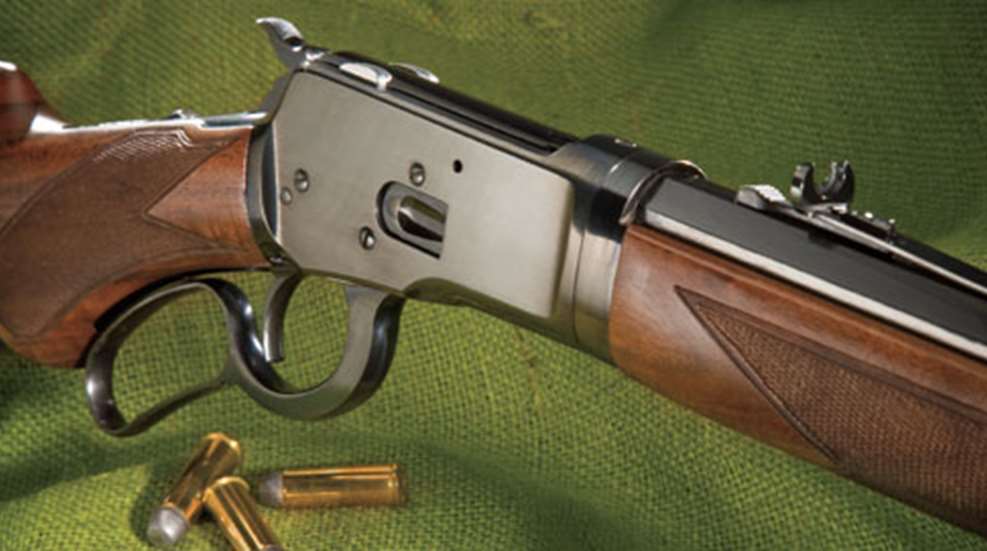
It was originally chambered in .44-40 Win., .38-40 Win. and .32-20 Win., then later in .25-20 Win. and .218 Bee. Today, Browning and Winchester Repeating Arms have joined Davidson’s in providing the new Winchester 1892 Limited Series Deluxe Takedown, manufactured by Japan’s Miroku, in either .44-40 Win. or .45 Colt. This rifle is modeled primarily from the Fancy Sporting Rifle, Takedown Model 1892, which was introduced in October 1893 and produced until 1932. Of the new Limited series, Winchester made only 251 of each caliber with the 20-inch barrels in 2008, and just 251 of each caliber with 24-inch barrels. A 16-inch-barrel Deluxe Trapper Takedown version should be available for 2010.
Although the parts are generally not interchangeable with original ’92s, Rossi rifles or other replicas, this 1892 Limited is virtually identical to the original ’92 takedown model in function and appearance. Standard design features include a side-loading port, vertical case ejection, a tubular magazine and a lever- or thumb-activated hammer.
Downward movement of the lever pulls the vertical breech blocks from their slots in the receiver and breech bolt while simultaneously pulling the bolt to the rear, ejecting a case or cartridge, and cocking the hammer. Returning the lever upward loads the next round from the magazine and re-inserts the vertical locks into their slots, locking the breech bolt in place.
Of course, the original ’92 was never chambered in .45 Colt, but the cartridge is popular with today’s Cowboy Action shooters. These shooters, like Western frontiersmen of the 19th century, often prefer rifle/handgun cartridge interchangeability, so Winchester made sure to offer the 1892 Limited in that caliber.
Also, Winchester incorporated a tang-mounted, hammer-blocking slide safety and a rebounding hammer, which work together for added safety. When engaged, the slide safety prevents the hammer from striking the firing pin. If the rifle is on “safe” and the trigger is pulled, the hammer still falls. In that case, instead of striking the firing pin the hammer is blocked, falling only to the rebound position.
After the safety is disengaged and the trigger is pulled, the hammer momentarily strikes the firing pin then automatically moves to the rebound position, where it cannot move forward. One can ease the hammer down with the thumb to the rebound position by pulling the trigger without fear of an accidental discharge, even with the safety disengaged. With the new gun’s design the only way for it to fire is for the safety to be off, the hammer to be completely to the rear and the trigger to be pulled.
The classic and convenient takedown feature is especially useful for cleaning, storage and transportation, just as it was in days of the Old West. One needs simply to open the action, pull the takedown lever at the end of the magazine tube outward, rotate the lever counterclockwise at least five times, then grasp the fore-end/barrel and rotate it 90 degrees to disengage it from the receiver.
This newest ’92 rendition is well-made and well-balanced, and the fit and finish appear excellent. The crescent-style steel buttplate extends over the heel of the walnut stock, and the pistol grip and fore-end feature fine, machine-cut diamond checkering and borders touched up by hand. The blued-steel receiver and barrel are well-polished, and the gun feels solid.
Both the buckhorn rear sight, with stepped elevator, and front brass bead sight are dovetailed into the octagonal barrel. As is typical with buckhorn sights, accuracy may suffer with some shooters, but the generously open sight picture is a significant advantage over some other open sights. Fortunately, if better accuracy is desired Brownells offers an Improved Peep Tang Sight from Marble Arms that fits a Winchester ’92 with a tang safety.
The smooth action and light recoil helped us continuously keep the rifle on the shoulder during rapid fire and send fairly accurate shots downrange. A number of different loads were fired through the gun, and all cycled with no problems.
The new Winchester 1892 Deluxe Takedown incorporates high quality, classic design and modern safety features that are sure to please Winchester enthusiasts, collectors, hunters and Cowboy Action shooters.
Manufacturer: Miroku Firearms Mfg. Co., Kochu Pref., Japan
Distributor: Davidson’s, Inc.; (928) 776-8055; Galleryofguns.com
Caliber: .44-40 Win. (tested), .45 Colt
Action Type: Lever-action, center-fire rifle
Receiver: Blued steel
Barrel: 20" (tested), 24"
Rifling: Six-groove, 1:36" RH twist
Magazine Capacity: Nine
Sights: Dovetailed front post, dovetailed buckhorn rear with elevator
Trigger Pull: Single-stage; 5 lbs., 4 ozs.
Stock: Satin walnut: length of pull, 13"; drop at heel, 2½"; drop at comb, 1½"
Overall Length: 38"
Weight: 6 lbs., 8 ozs.
Accessories: Owner’s manual, lock
Suggested Retail Price: $1,875
Most Popular