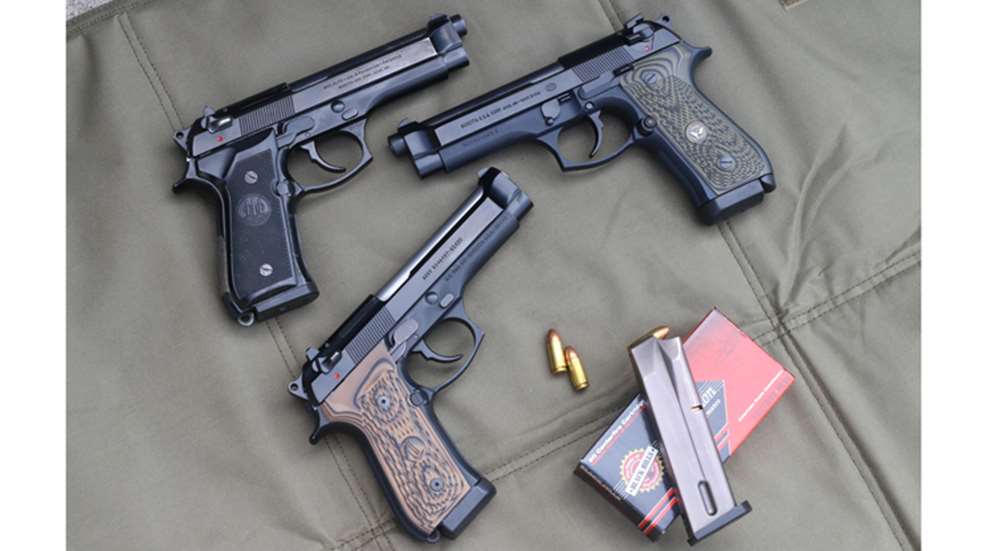
The Beretta 92 is currently enjoying a strong resurgence in interest even as its service as our military’s sidearm enters its last lap. The Model 92FS/M9 was red hot at its adoption, featured in the hands of nearly every action movie hero through the late ’80s and early ’90s, and soon filling many law enforcement holsters as well.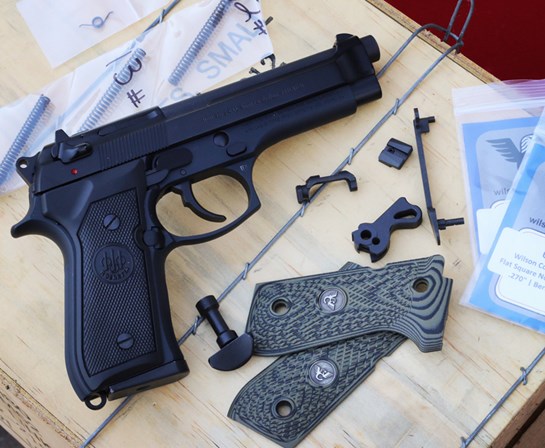
Then there was a cooling off as the shooting world embraced polymer-framed, striker-fired semi-automatics, and the Beretta came in for much maligning due to its double-action first shot. The charges of “hard to shoot” were somewhat overstated, as I was in a special unit at that time that prided itself on pistol skill and every Marine in the outfit could run a stock M9 at an impressive level.
However, this is not to say that the Beretta 92 series was perfect—there were pretty obvious points of improvement that the aftermarket largely ignored for years. This has, thankfully, been corrected, and there are now very solid options that can turn that old 92 in the back of the safe into an even better shooter with very little effort.
If You Only Do One Thing to Your Beretta 92, Do This …
The Beretta 92 has been equipped for 30-plus years with a hammer spring that is too heavy. I’ve heard that Beretta was simply building to the M9 requirement to function with all NATO spec ammunition and some allies’ 9 mm submachine gun ammo had seriously hard primers. Maybe, but it is telling that the Double-Action-Only (DAO) 92D pistols Beretta sold to law enforcement had a lighter hammer spring than the standard M9 and Model 92FS double-action/single-action (DA/SA) guns. If a 92D can be 100-percent reliable with the pistol firing every shot double-action with a lighter spring then the standard, heavier spring on the 92FS is overkill.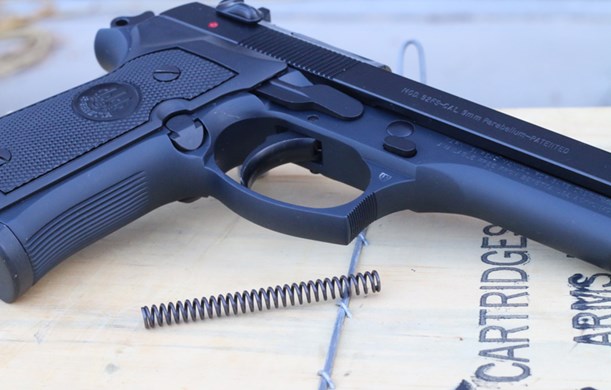
An improved hammer spring is the one thing that every Beretta shooter should try, making a huge difference at negligible cost and effort.
One of the reasons shooters sometimes complain about the heavy double-action pull on a Beretta is because they are compressing a needlessly heavy hammer spring with that trigger pull. Luckily, this needn’t be the case. The hammer spring is user replaceable and a best quality replacement is about six bucks. The Wilson Combat chrome silicon springs are the gold standard. Pulling the trigger on a Beretta with either a 13- or 14-pound Wilson spring is life changing. If you are a dedicated Beretta hater, you may not want to for fear of having to change your mind.
Simply swapping out the hammer spring drops the double action pull by 3 to 4 lbs. in most pistols. It is as easy as removing the grip panels, driving out a retaining pin, and swapping the spring. A friend who carried an M9 in Somalia, Kosovo and Iraq, after consistent encouragement (read haranguing) on my part, installed the Wilson Combat spring. He was amazed. The Marine vet insisted, “It is literally a completely different gun!”
In all of the shooting world there is probably nothing so easy to swap and so inexpensive that makes the same degree of difference in how a service pistol performs. Using American-made ammunition and primers, I’ve not heard of any ignition problems with the 13- or 14-lb. springs. If my pistol was often exposed to heavy dust or dirty conditions, I might hedge to the 14 pounder, but most will be extremely happy with the 13.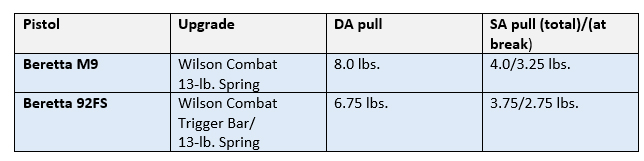
For those wanting an even lighter DA pull, Wilson Combat offers an improved trigger bar with slightly different geometry. This part changes the feel of the DA stroke while lowering weight and giving a little extra leverage to the hammer, ensuring ignition with the lightest possible springs.
The table shows the kind of improvement I measured compared to the nominal 12-plus pound factory double-action. With either upgrade in place a shooter that may have struggled with the stock double-action is able to hit easily in no time. It is really no struggle to roll the double-action and hit targets that a shooter might have sweated before or considered cocking the hammer for. There is also a very positive effect on the single action pull, taking the usually good 92 break to “great.”
While You’re in There
Right behind the heavy double-action pull, the next common gripe on the M9 is the grip size. The stock 92 panels are hand-filling--or downright fat if you have average or smaller hands. Since the stocks are already off of the pistol you may as well upgrade that as well. Replacing the OEM panels with ultra-thin G10 panels dramatically changes the feel of the pistol. It still feels like a 92—just better. The non-bear paw crowd can actually reach the controls and feel like they have good purchase and control of the pistol.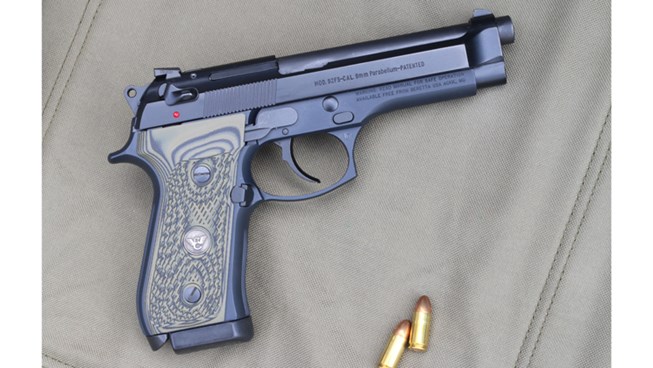
92 FS: This 92 has a Wilson Combat trigger bar and hammer spring, along with WC's Ultra Thin grips, mag guide and rear sight.
I like and use both the Langdon Tactical thin grips and the Wilson Combat Ultra Thins. The Langdon’s have more aggressive checkering but both are similar in overall shape and feel. The panels have a unique “hourglass”’ profile that comes out as minimally as possible to accommodate the grips screws and then curves in at the middle.
My wife and daughters have extra small hands and struggle with a stock 92. With either the Langdon or Wilson grips they can capably work the Beretta and actually like the way it feels. Simply measuring with a string around the circumference of the grip at the base of the trigger guard showed the 92 with the G10 panels to actually be smaller around by a couple of tick marks than a 3rd Generation Glock 17.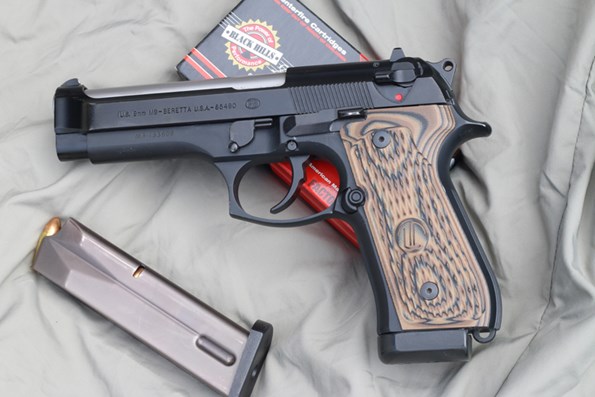
This commercial M9 has been upgraded with a 13 lb. Wilson Combat hammer spring, Langdon Tactical thin grips, Beretta Elite match barrel, steel trigger and guide rod.
A Part for Every Gripe
Once a shooter is beyond the hammer spring and grips there are other upgrades available to address specific shortfalls. When you get to this area of the menu, it is hard to prioritize as a generalization. This is where the shooter’s specific personal gripe with the stock gun drives the selection. For example, if a shooter still struggles to release the magazine after going to thin grips, both Beretta USA and Wilson Combat offer several extended options.
Several years ago Beretta subbed in a number of plastic parts on the 92 series to try and keep prices down. Many shooters prefer the metal parts and the OEM-style steel bits are available from Beretta USA, while Wilson offers some aftermarket versions of triggers, safety levers, and guide rods.
The Beretta’s lanyard loop is seldom used outside of military circles, so Wilson Combat offers a magazine guide that secures in its spot. It is less obtrusive than a full magazine well but helps to redirect magazines that are slightly off course during a hasty reload. It works quite well.
Many shooters prefer a decocker (“G” model in Beretta parlance) to the hammer dropping safety (or "F" as in 92FS), so a “G” conversion kit is readily available. The front sight on most of the 92 series is part of the slide and not easily modified or replaced, but options exist for the rear.
It took decades for the aftermarket to truly catch up to the Beretta. There are now great options to address nearly every personal “harrumph” one might have had on the 92. These upgrades are helping to fuel a mini-revival in interest for the pistol and rightfully so.
Additional Reading:
U.S. Pistol, M9 Beretta Model 92FS
The Beretta M9: 25 Years of Service
Most Popular