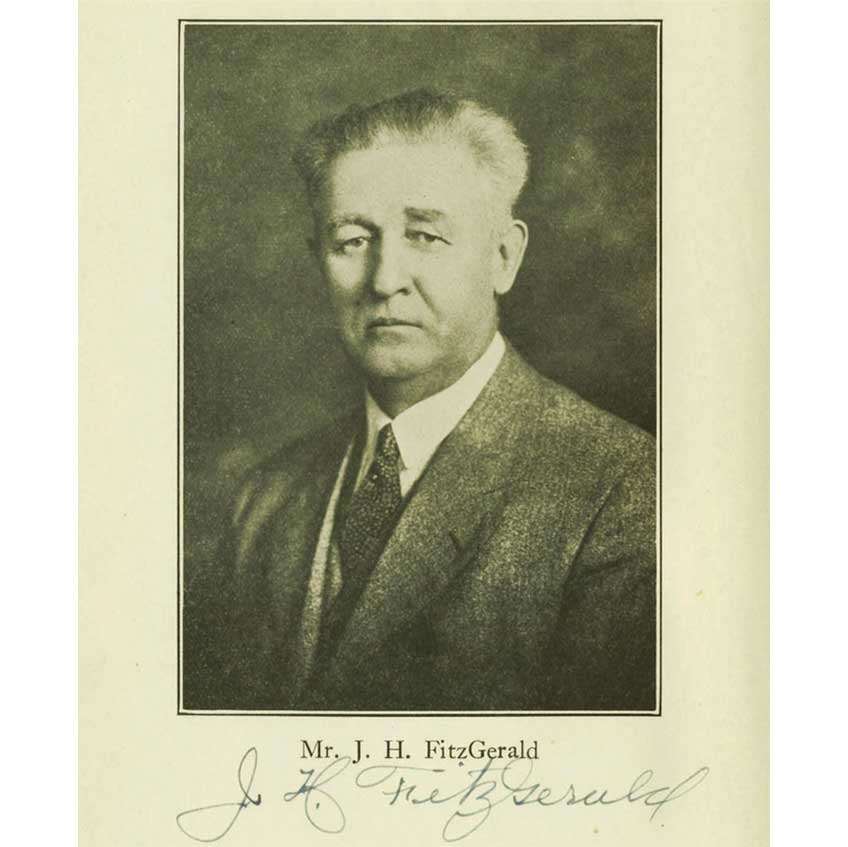
Published in 1930, the book carries the single-word title of Shooting. On page 363 is a photograph of the author, one J. H. FitzGerald, shooting a large Colt revolver—with two hands.
Fitz was a famous handgunner of the '20s and '30s. A great deal of the book is about the shooters of the day and their techniques. This was a time when bullseye shooting was nearly universal. Every other picture shows a shooter with his pistol in one hand, since the rules of bullseye games required it. Therefore, the book is actually up-to-date and accurate—for 1930.
But Fitz was a lifetime cop and instructor. He wanted to include some material for working pistoleros of the between-the-wars era and it's there, along with some draw-from-the holster and hand-to-hand stuff that was right on point. Chapter 50, “Shooting Two-handed” had the mentioned picture and two paragraphs of advice.
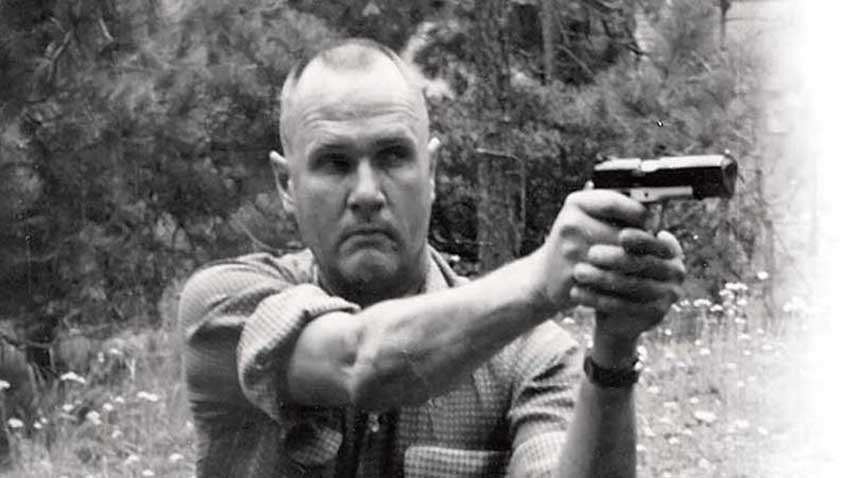
Fitz advised the reader that chasing a fleeing felon might get a policeman breathing hard and a two-handed hold would increase his stability if a pistol shot became necessary. He is in that picture—back straight, head up, gun arm (right) straight, support arm (left) bent at the elbow.
He has a high grip on the gun in his right hand and the left-hand fingers are wrapped around the right. Even more important, his right foot is well behind his left. In other words, he's in the Weaver stance, though it wasn't called that at the time, of course.
He's in the Weaver stance because it is the most natural and logical way to shoot a handgun when the one-hand stuff is not mandatory. Shooters just fall into this position when they are allowed to use the other arm and hand, rather than stick it in a left side pocket or in the waistband.
As far as requiring a one-hand grip, it's a cultural matter. I have long believed that using a single hand is an outgrowth of Civil War tactics, where the repeating revolver was a decisive weapon but couldn't be helped by a left hand. That hand was working the reins of a horse.
Out of habit and possibly a sense of propriety, we stayed with one hand for nearly everything having to do with a handgun. That's no indictment of any shooting sport that requires it, as there is much to be learned from the pure marksmanship of the bullseye game. But—since the handgun could be fired with a single hand—it was improperly concluded that it should be.
In the period immediately after WWII, more realistic combat shooting training came into being. There were many variations of a sort of combat-crouch position. Police service training evolved into the PPC course. This system grew popular, because multiple shooters could run the course together, and it did not demand a lot of space.
Although it was most commonly fired from a crouch and one-handed, the rules were loose enough to permit the shooter to vary his stance and use two hands. At the same time, Jeff Cooper and a growing band of common-sense pistoleros in southern California began to experiment with completely unrestricted combat shooting.
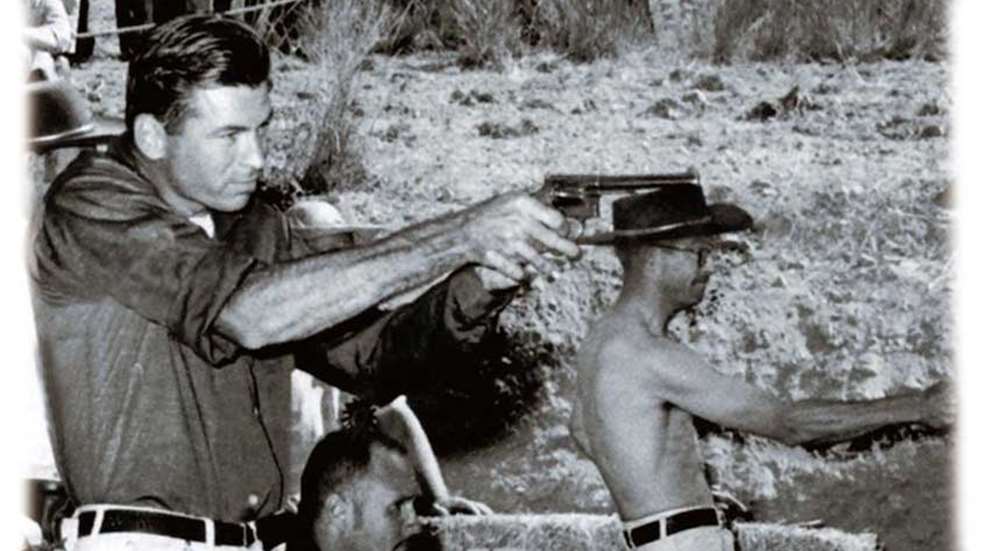
Much of it was close-range stuff and the trend was to draw fast and shoot quick—with one hand. Jack Weaver, a Los Angeles County deputy sheriff, started drawing his S&W revolver, raising it to eye level and shooting with two hands. Almost immediately, he started beating the daylights out of just about everybody else. They all started using it, and the rest is history.
Because it was so successful and so identified with the first guy to use it in these first competitions, the technique was acclaimed as the "Weaver Stance." It was the evolved doctrine when Cooper opened the first combat shooting school at Gunsite Ranch in the late '70s. Hundreds of thousands of civilian, military and police handgunners have been trained in the technique.
But combat shooting has evolved to the point where there are now several kinds of shooting competitions that purport to be combat-oriented. There is nothing at all wrong with making a competition out of a fighting skill. Indeed, it has happened for centuries—boxing, wrestling, fencing, judo, etc.
There, we began to see some variations on stances used in two-handed shooting. Usually, it was some form of Isosceles and often returned to a sort of semi-crouch. There are many top-tier action shooters using some variation of this. I cannot criticize these stances, because those competitors are shooting very well indeed.
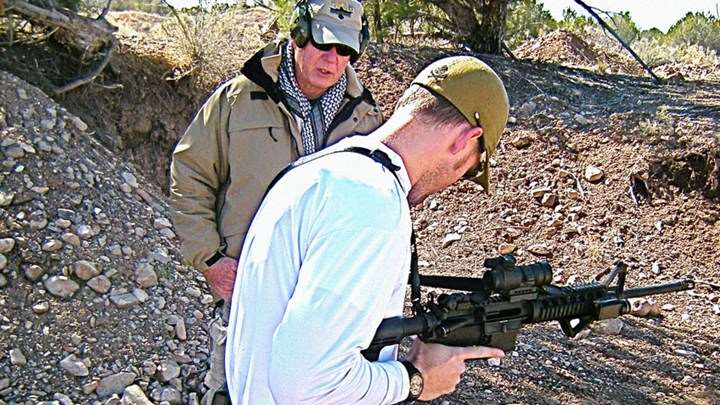
I went to Gunsite Academy for the first time in 1993 and got the Modern Technique in its purest form from legendary rangemaster Ed Stock. He is a forceful instructor, and I had years of shooting experience behind me. But I learned more about handgun work in that week than I had ever previously known. A great deal of it was the utility of the Weaver Stance.
It is a sound platform from which to deliver accurate shots at any range—long or short. With practice, it is also quick to assume, as well as to turn from when targets appear at different angles. Even more, it is great when the handgun of choice is an arm of more than adequate power—and therefore, recoil. All of these virtues remain as constant today as when Cooper and his crew developed the doctrine years past.
The Weaver still works.
Most Popular