New small arms with groundbreaking designs are rare in an industry where most companies chase consumer trends, new products tend to be evolutionary rather than revolutionary, and me-too designs quickly emerge once a market trend starts. Today, it’s stylish to make micro-size, polymer-frame pistols with 10- or 12-round magazines. Before that, it was copies of Mossberg’s Shockwave “firearm,” and before that, it was popular to produce .380-caliber pistols patterned on the Colt Mustang. Fortunately, some companies like Freedom Ordnance march to the beat of a different drum and invest their creative energy into innovative, unique products like the FM-9D.
The FM-9D is a 9 mm-chambered, blowback-operated, semi-automatic fed by a detachable Glock-pattern magazine or disintegrating steel links, and you can switch between the two feed methods seamlessly without changing parts. And it isn’t a prototype gun you read about with a release date sometime in the future, but a production piece that was released in late 2025 and can be ordered today.
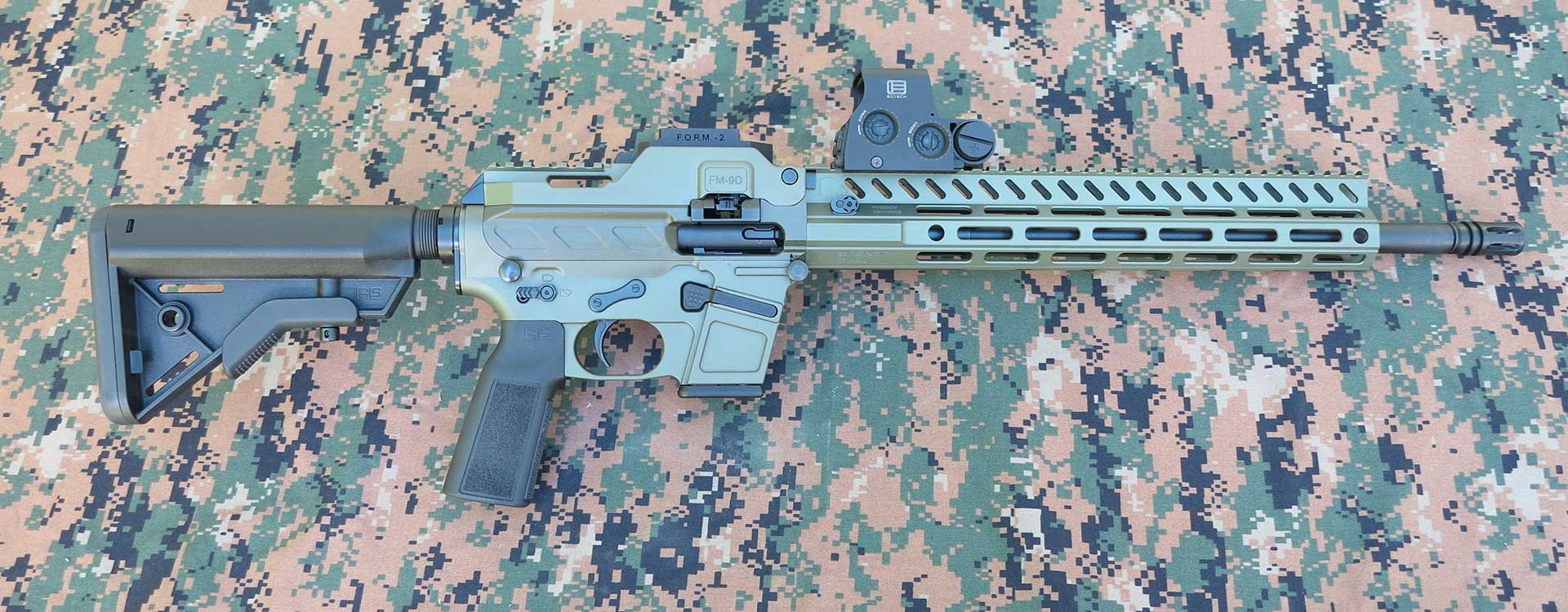
The FM-9D is the successor to Freedom Ordnance’s belt fed FM-9 upper receiver that fit AR-15/M16 lower receivers and was made from late 2015-2018. The new version shares a few features with the original, but it’s unquestionably a new design with six patents pending. It’s also the result of two years of intensive design and testing intended to deliver functional reliability across more types of ammo than its predecessor, a goal my evaluation shows was achieved.
Pistol, Rifle, SBR or Upper Receiver
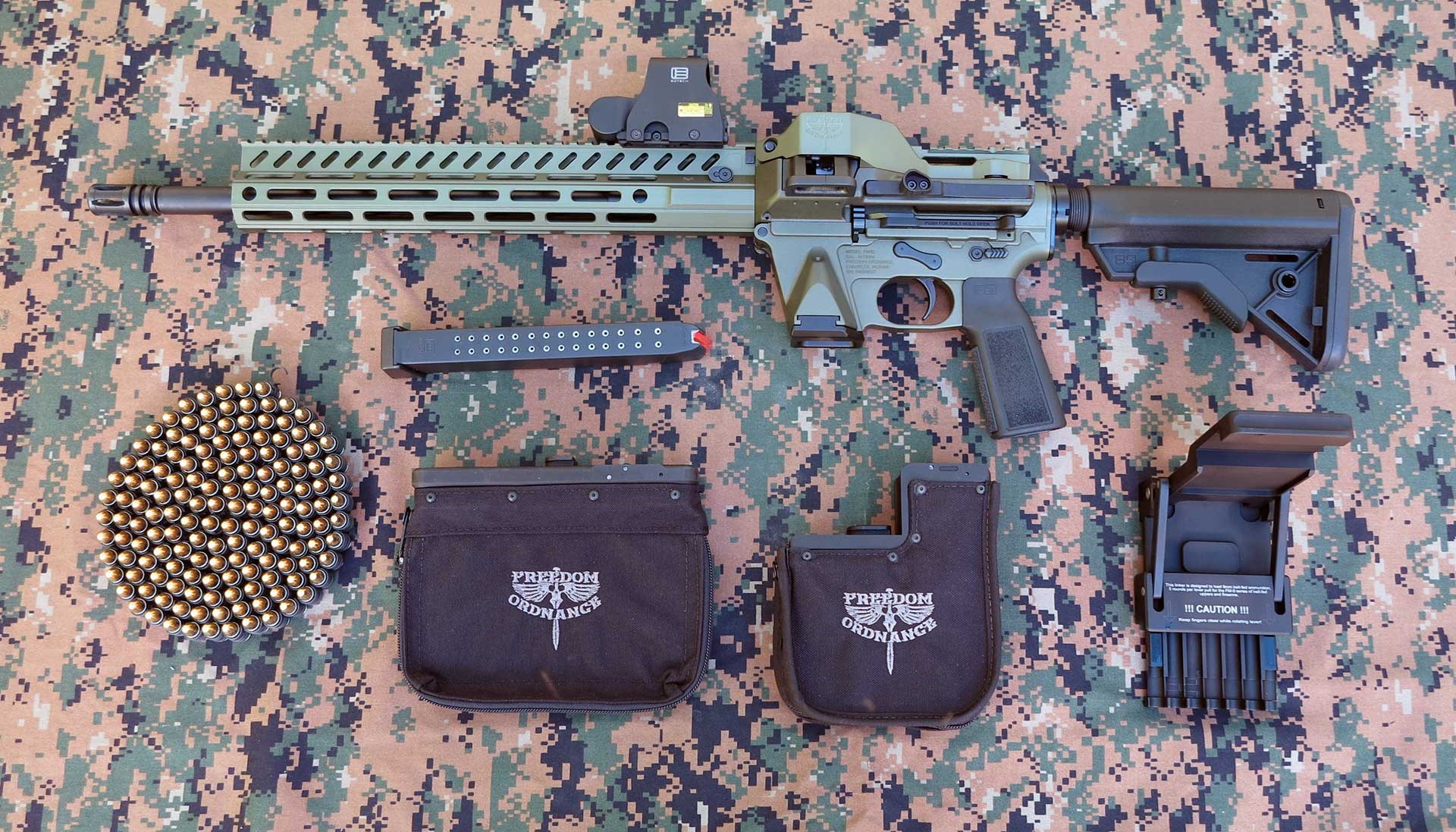
The D Model is sold as a pistol, rifle, SBR or an upper receiver alone. When bought as a complete firearm, it comes with a high-quality Savior Equipment American Classic Double Rifle soft case, 33-round factory Glock mag, 100-round capacity detachable belt bag and 150 reusable metal links.
The upper receiver won’t work with another company’s 9 mm lower, but it will attach to a mil-spec AR-15 or select-fire M16 lower for belt-fed capability only. If you go that route, Freedom Ordnance recommends you change the hammer in your lower to a bobbed tail hammer (sometimes called a 9 mm or speed hammer) to lessen stress on the hammer and trigger pins when using hot ammo.
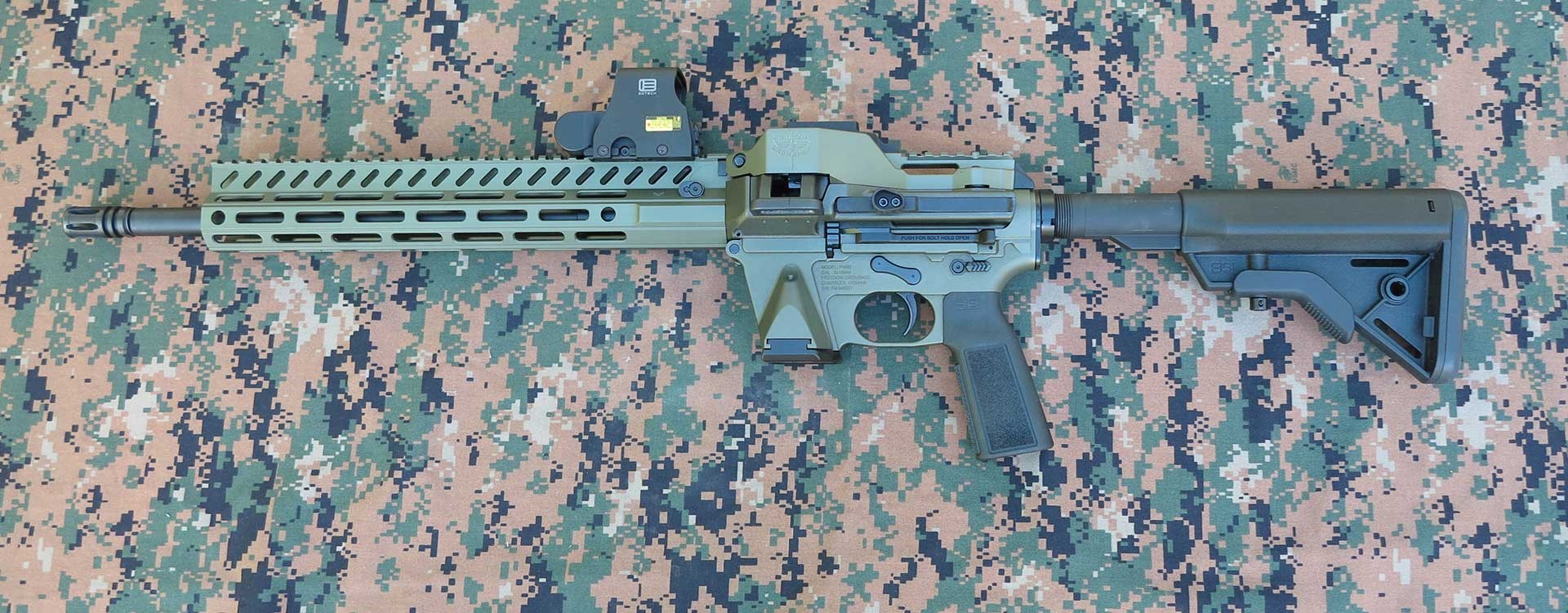
Also, if you buy the upper receiver alone, the bolt has a slot milled into the bottom that is necessary to clear the buffer retaining pin on your AR-15 receiver. However, the bolt included with a complete D Model isn’t slotted because the lower receiver has a new patent pending buffer retainer. So, you’ll need to change to a slotted bolt if you intend to use the upper receiver from a complete FM-9D on an AR-15 lower.
How It’s Made
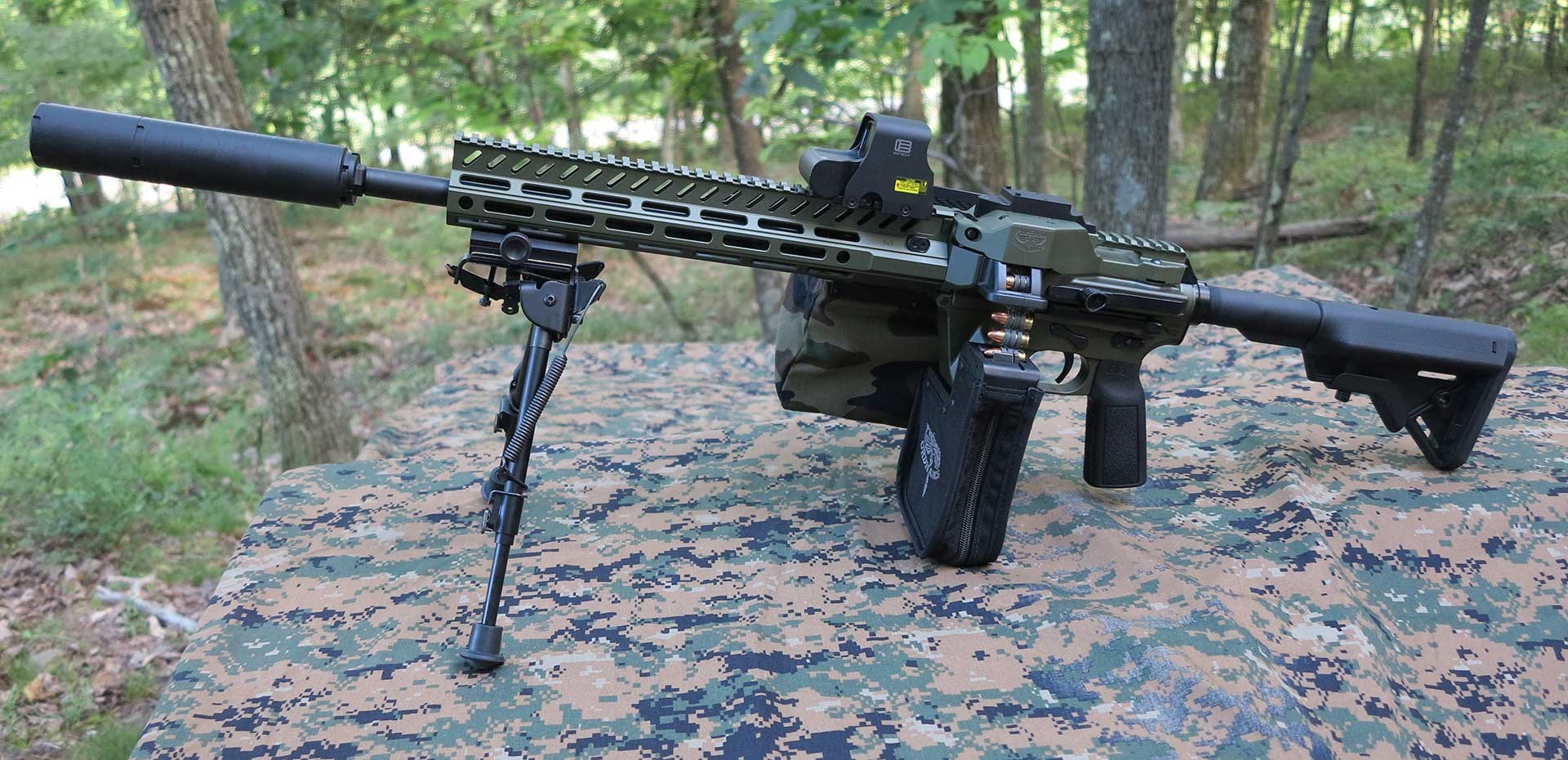
Configured as a rifle, the D Model has an overall length of 32.75 to 36 inches depending on stock setting, a 16.5-inch barrel and an unloaded weight of about 9 pounds. Fully loaded with 100 linked rounds in the link bag that attaches to a slot in the lower receiver’s magwell puts it at about 12 pounds, making the D Model a good candidate for bipod or tripod use; or if you’re channeling your inner Rambo, slung from the shoulder and fired from the hip.
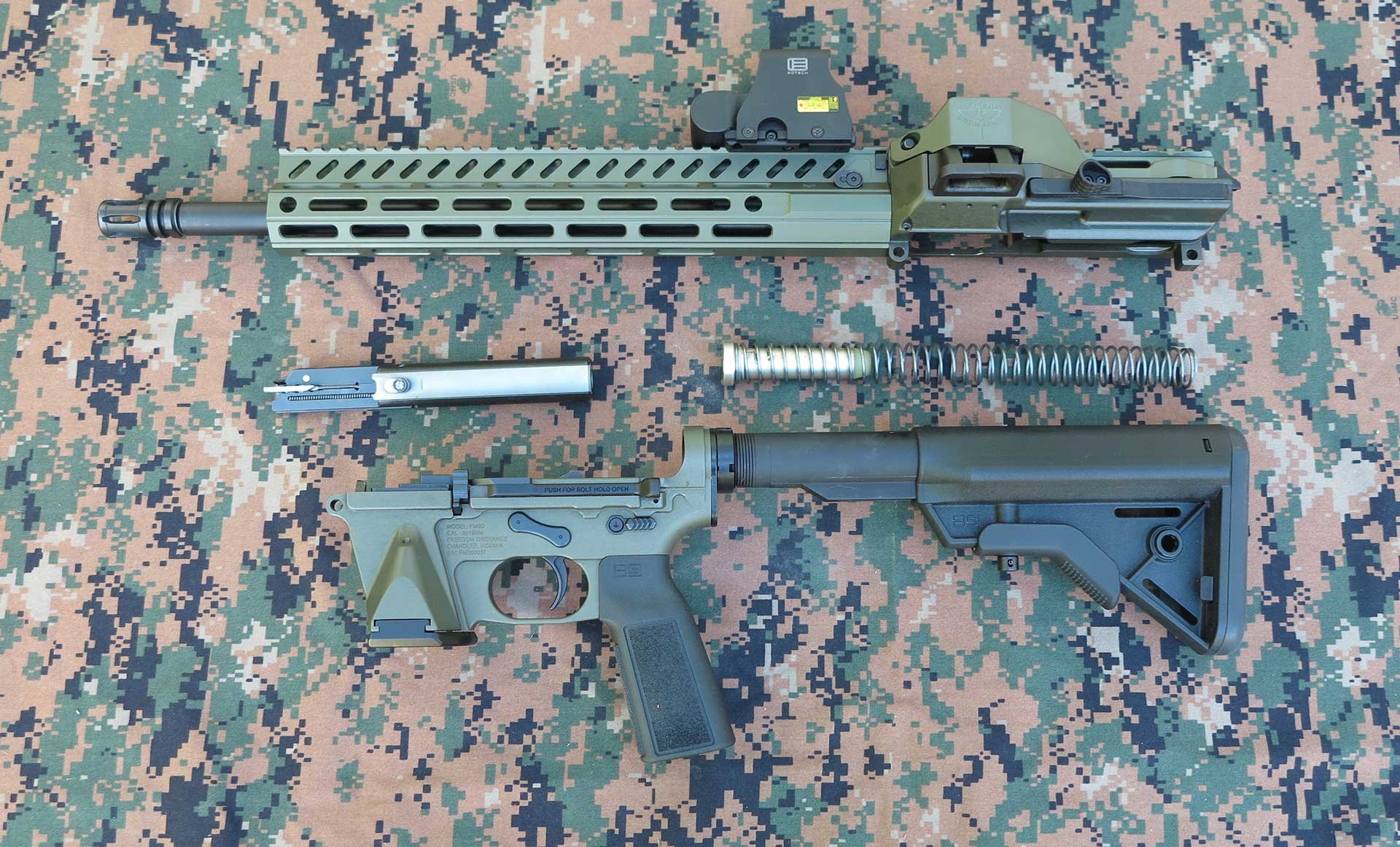
The barrel is made from 4150 chrome-moly steel with a QPQ nitride finish topped with a full birdcage flash suppressor. The upper and lower receivers and top cover are made from 6061 aluminum billets. The receivers, top cover and handguard have a hardcoat anodized finish, and three colors are offered.
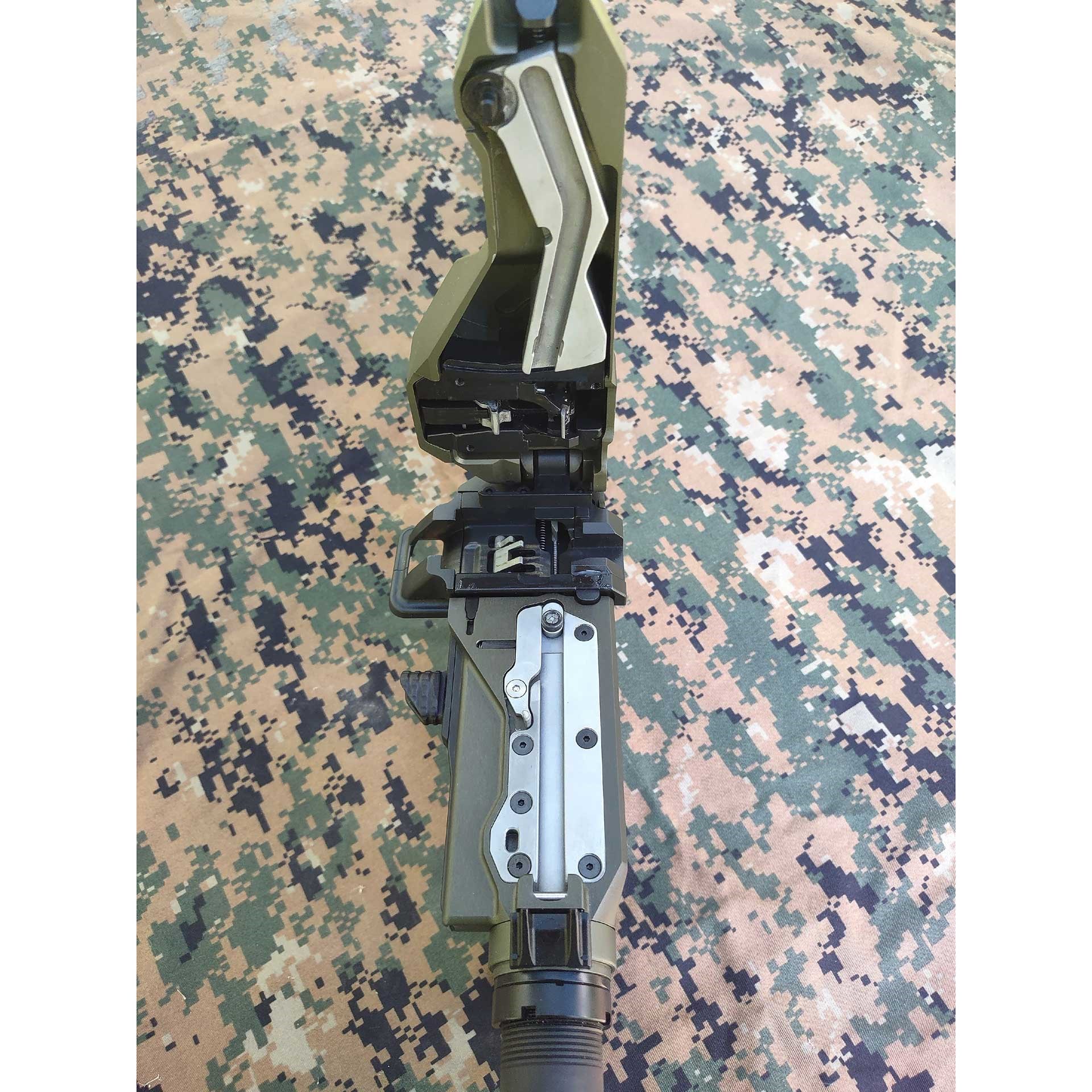
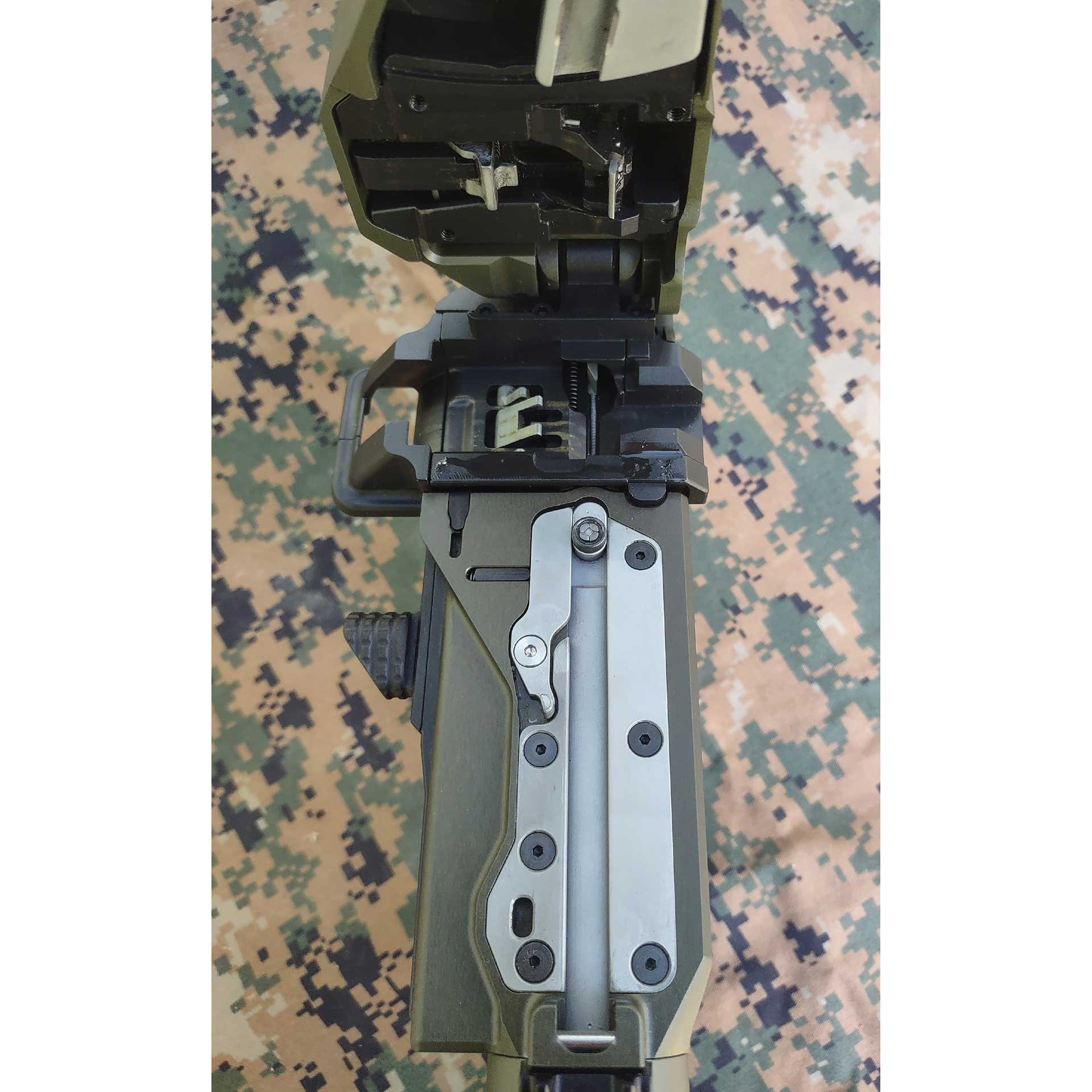
AR-15-compatible parts include the KAK Industry extended takedown and pivot pins which join the upper and lower receivers, buffer assembly, B5 Systems Bravo six-position buttstock and P Grip, safety selector, and most internal parts in the lower receiver. Otherwise, the FM-9D uses proprietary parts. The belt-fed mechanism is reminiscent of the venerable M1919 Browning machine gun combined with Freedom Ordnance’s ingenious spring-loaded split bolt designed to enhance feeding reliability with 9 mm ammo.
The 13.5-inch handguard is made from 6061 extruded aluminum and has a full-length Picatinny top rail and M-Lok slots on the other three sides and uses a BCM mounting system. QD sling mounting points are on the buttstock and at the front and near the rear of the handguard.
Sights aren’t supplied, but there’s rail slots on the handguard or the top cover to attach one. Freedom Ordnance also makes dedicated mounts that attach to the top cover for the Trijicon RMR and other optics.
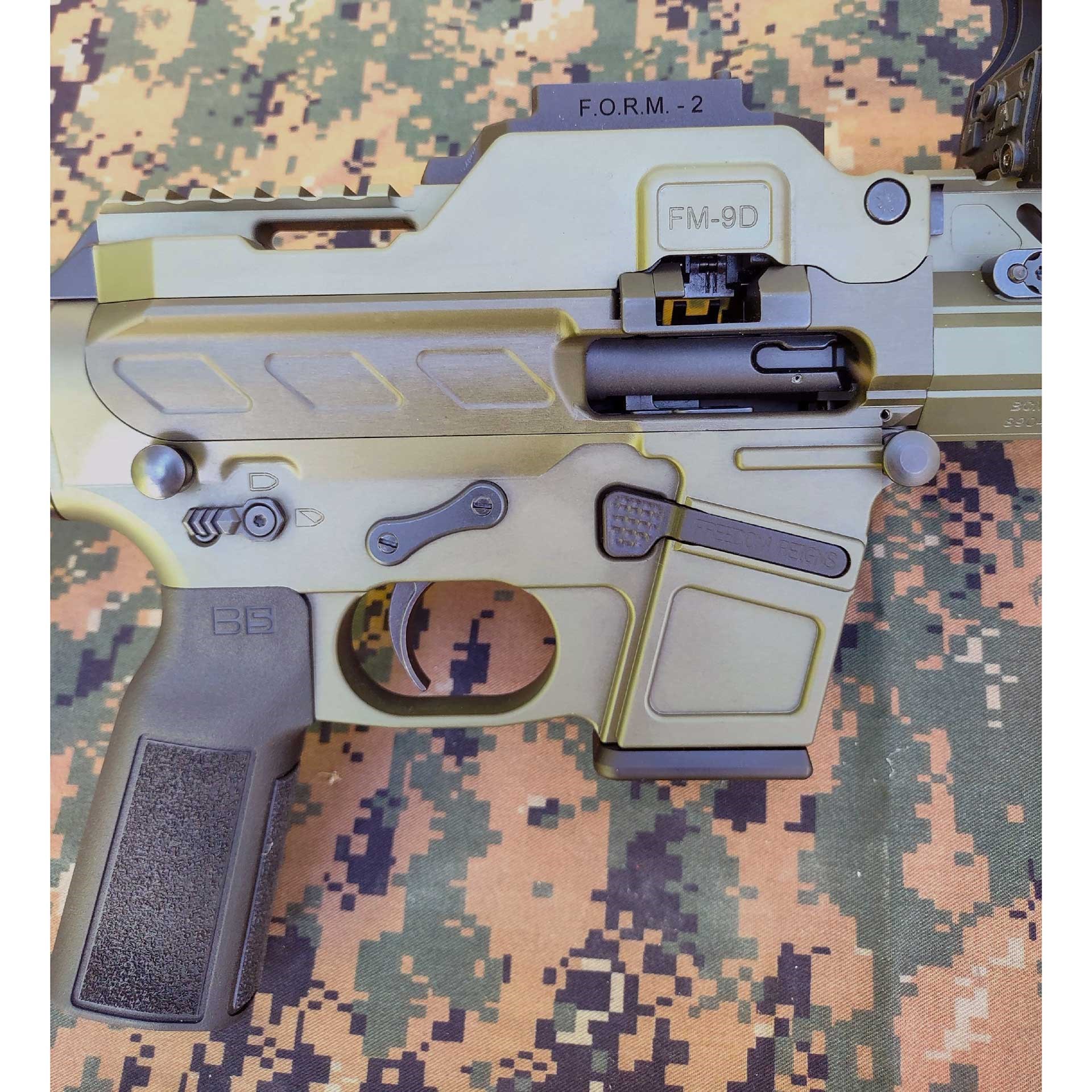
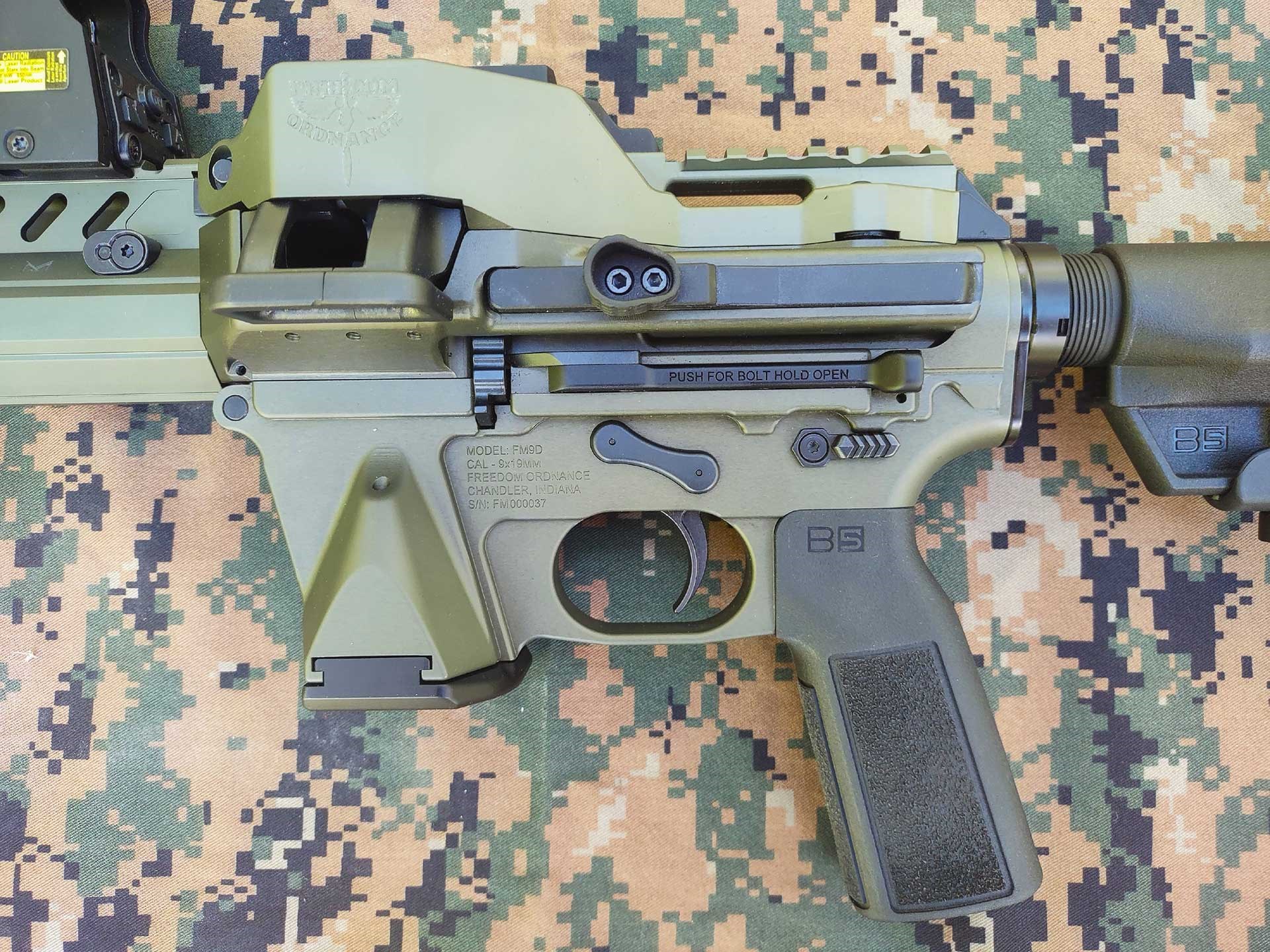
Controls are similar to the AR-15, and the bolt catch/release automatically locks the action open after the last round is fired when firing from a magazine but not when using belt-fed mode. However, the bolt can be locked rearward by retracting the charging handle fully then pressing the Reacher Slide forward. This operation can also be easily done one-handed.
Quality Indicators & Careful Engineering
High-quality workmanship and parts selection is evident on the D Model. The receivers fit tightly, and all visible parts are cleanly made with a precise fit. The bolt is made from S7 tool steel and nitride finished. Parts in high wear areas like the cam arm, roller channel, feed pawls and roller channels are heat-treated 4140 steel with a chrome finish. Each bolt and bolt slider is tested for Rockwell hardness after heat treat. All steel parts are hardened and either chrome-plated or nitride-finished.
Thoughtful engineering and improvements to the original FM-9 are evident in several areas. The spring-loaded split bolt and spring-loaded feed horn, for instance, improve feeding and reduce belt drag while last-link ejection allows instant transition from belt- to mag-feed operation without risking a link causing a stoppage. There’s also a safety block that prevents the top cover from closing if the cam arm is in the incorrect position, which would otherwise damage the mechanism.
Knowing that the D Model will encourage high-volume firing, Freedom Ordnance included bushing plates on both sides of the lower receiver made from heat-treated 4140 steel to prevent elongation of the hammer- and trigger-pin holes. They also made two small modifications to improve reliability with newly manufactured links and ammo using wide hollow-point bullets. That latter change underscores the company’s commitment to quality, since it would have been just as easy to advise customers not to use certain brands of hollow-point ammo, because nearly every buyer will be a “fun-and-gun” shooter who won’t shoot expensive hollow points.
Follow the Manual
Knowing the cycle of operation in belt-fed mode is important, so read the operator’s manual completely before proceeding. Mag-fed guns use a conventional operating system and manual of arms that experienced shooters understand, but belt-feds are an entirely different system that isn’t as straightforward.
For instance, with mag-fed operation, cartridges are fed upward from the magazine into the chamber. With belt-fed, they’re contained in a linked belt and pulled upward from a nylon bag onto a feed tray. A spring-loaded attachment to the bolt called the feed horn pushes a single round forward off its link and downward into the chamber. Clearing a bed-fed firearm is also different: open the top cover and remove the loaded belt, then flip the hinged feed tray upward, retract the charging handle to clear the chamber and visually check it for clear.
Also, don’t disassemble the upper receiver—especially the bolt—beyond what is recommended or you may regret it, because assembly uses custom jigs and specific procedures. You can clean the parts adequately without doing a detail strip.
Pro Tips for Reliable Belt-Fed Operation
There’s a few things to keep in mind when running belted ammo that will improve your experience starting with the links, which need to be inspected for bent legs before and after inserting ammo into them. Make sure the loaded belt flexes in the correct direction like a bicycle chain without stiff spots that will offer more resistance when the belt advances as the action cycles. Look for burrs on the case mouths of cartridges which may have formed when inserted them into the link and cull them from the belt.
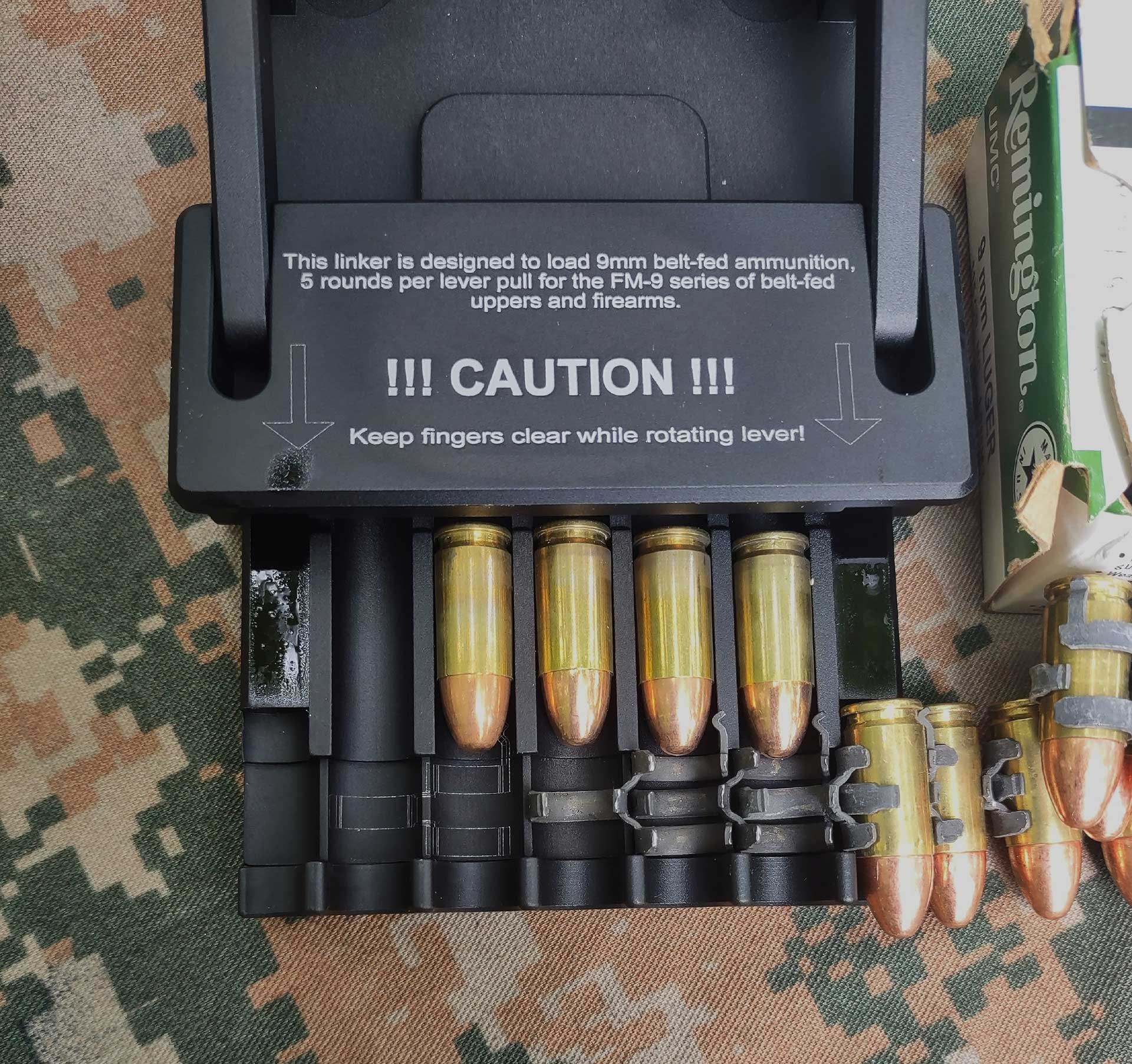
Some loads, like Winchester USA 115-grain FMJ slip easily into the links while the unchamfered case mouths on others like my supply of legacy Remington UMC do not and caused reliability issues. The problem was solved by lubricating the links with PB Blaster oil prior to loading and using a wood block during the linking process to prevent the links from popping upward. Before these fixes, this load didn’t feed reliably; afterwards, it did. Do not lubricate the ammo, however, just the links and allow them to dry before loading.
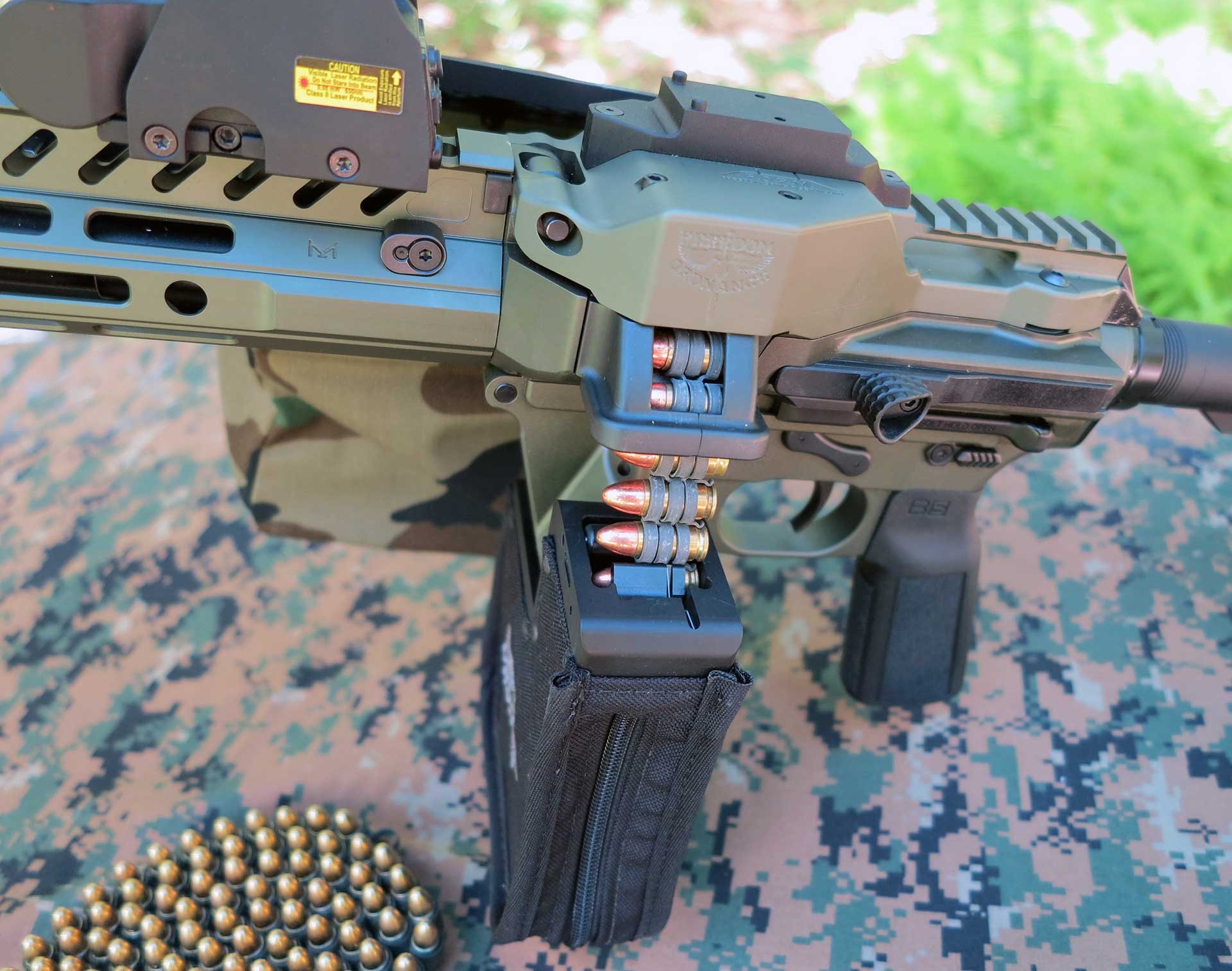
Be certain your make-ready procedure is perfect and you fully retract and release the charging handle to chamber the first round off the belt. If you don’t, expect a misfire. Finally, don’t make the rookie mistake of putting a coiled roll of linked ammo into the ammo bag because uncoiling it requires much more energy than necessary and can lead to a stoppage. Instead, “layer” the belt back and forth inside the ammo bag.
Range Time—Ergonomics
The D Model’s overall ergonomics are very good. The grip has sufficient texture and is particularly suitable to firing from prone off a bipod because its angle positions your wrist comfortably. The stock’s length can be adjusted 3.2 inches over six settings to fit your physique and shooting position and has minimal play with the buffer tube and a functional rubber butt pad. The narrow profile handguard is also comfortable, and the mag release is positioned exactly where a right-handed shooter wants it. Finally, the Reacher Slide makes locking the action open a simple, one-handed operation. Try doing that on your AR-15!
Areas to improve are the safety levers and possibly the trigger. Made wider and with a 45 degree throw instead of 90, the safety levers would be easily activated by the thumb or trigger finger without changing your firing grip. (They can be switched to an AR-style safety of your choosing.) The trigger on my sample was initially very gritty with an unpredictable break and a relatively heavy weight of pull of 6.6 pounds, but after several hundred rounds and added lubrication, it smoothed out and settled at about 5.4 pounds.
Range Time—Precision
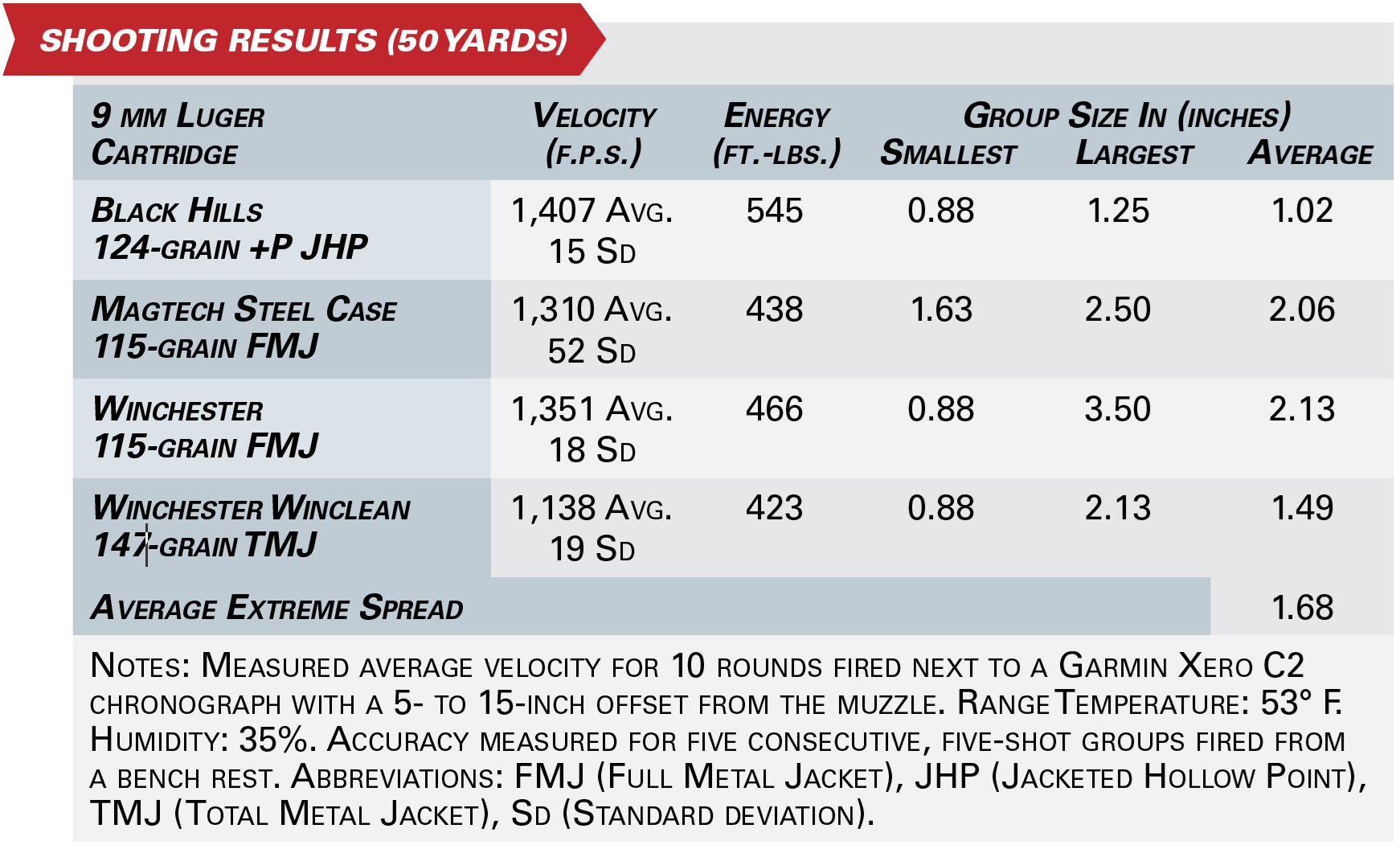
The D Model was tested for precision using four loads at 50 yards shooting from a Caldwell Precision Turret Rest using an EoTech HWS XPS2 optic. The mean five-shot group of all loads measured at the centers of the bullet holes ranged from 1.02 inches to 2.13 inches, with the Black Hills 124-grain +P JHP load scoring the best.
Range Time—Functional Reliability
I tested the D Model for magazine- and belt-feed reliability using the same Magtech and the two Winchester loads used for the precision test plus three additional 115-grain FMJ loads from CCI Blazer Brass, Federal American Eagle and Remington UMC. Mag-fed reliability was tested using 33- and 15-round Glock OEM mags, a 33-round KCI mag and a 27-round Magpul PMag. Reliability was perfect except with the PMag which didn’t stay seated, possibly because the forward-moving bolt pressed the magazine lips and walls—which aren’t steel-lined—inward and out of contact with the mag catch.
Belt-fed reliability was tested by firing at least 50 rounds of each load from a linked belt. Functioning was perfect on every load, except for Blazer Brass that failed to feed three times and the Remington load without lubricating the links and using the link-loading method described earlier that corrected the matter. The Winchester TMJ load, which has a flat-nose bullet, failed to feed about 15 percent of the time, but my test rifle predates the design change on guns with serial numbers above 200 which should rectify this issue.
Must-Have Accessories
Two must-have accessories are the belt-linking device from Freedom Ordnance and the brass catcher from Tactical Brass Recovery. The linker is sturdily made from aluminum and correctly loads five rounds at a time. It also fits into a pocket of the Savior gun case for easy transport to the range. Yes, you can load links by hand, but it’s annoyingly tedious and time-consuming especially, if you want to fill the 100-round link bag.
The TBR brass catcher is the best catcher I’ve used. It attaches via a throw arm to a small section of Picatinny rail mounted to the M-Lok slots on the handguard. The collection bag can hold dozens of links and shells and has a zipper to dump the empties without needing to dismount the catcher. It’s made from cloth, not nylon mesh, which can melt from hot brass. Ejecting brass and links don’t rebound into the action or escape to the ground.
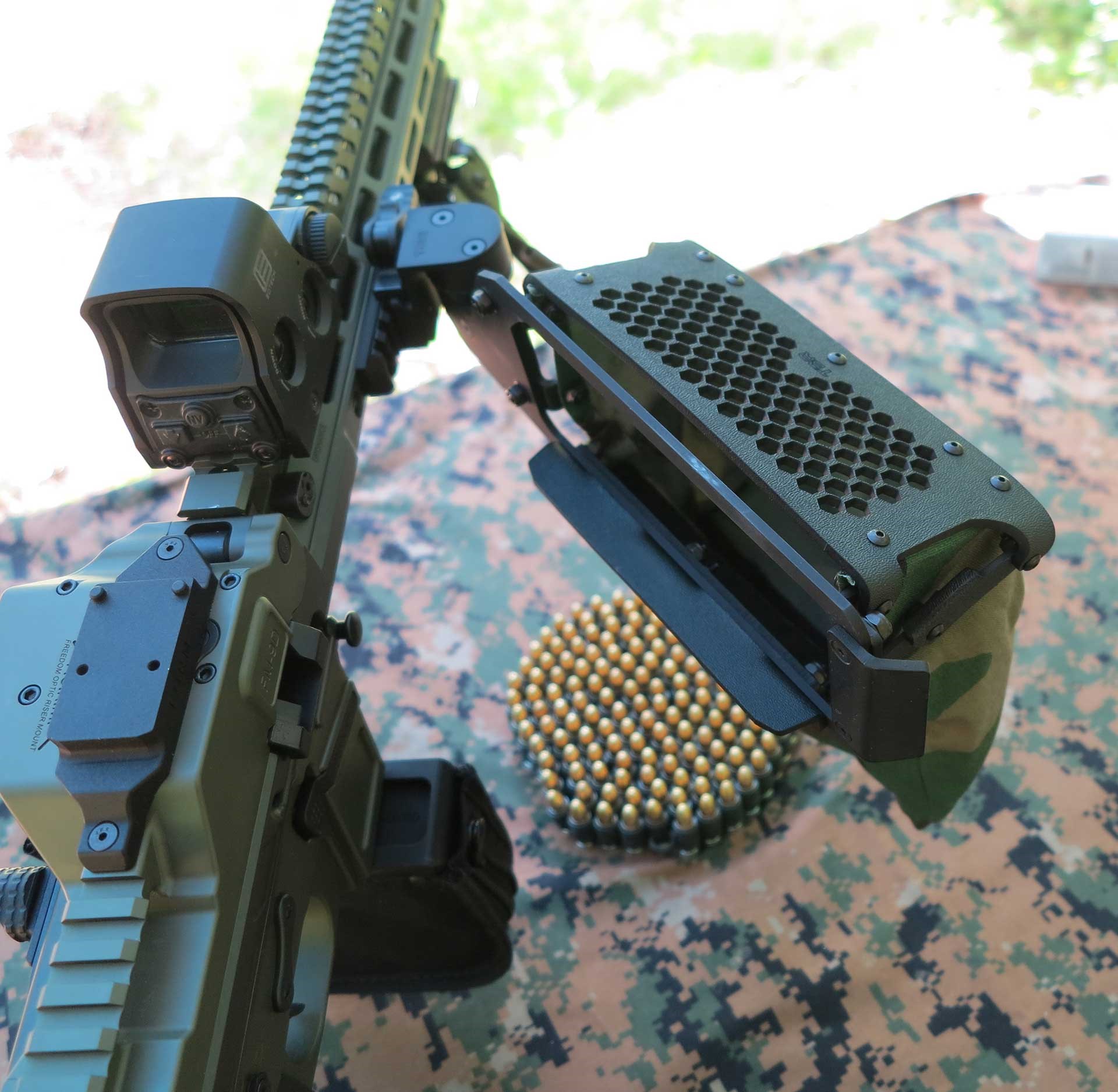
The catcher folds flat against the receiver, allowing the gun to be carried in a gun case with the catcher mounted. It is hinged and swings away from the ejection port to allow quick access to the chamber for clearing a stoppage or to verify the firearm is clear. That’s a far superior method than catchers that require you to remove the entire device.
Dead Air’s Wolfman: An Ideal Can for the Job
The Dead Air Wolfman suppressor is deservedly known as an ideal submachine gun suppressor and is one of the most durable 9 mm cans available, owing to its 17-4 stainless-steel construction and fully welded baffles that contain gas pressure from high cadence and full-auto firing. The Wolfman is configurable as a seven-baffle, 5-inch long unit, or if you want added sound reduction, an 11-baffle, 7.5-inch long can. Its 1.62-inch diameter also offers greater volume and hence more potential sound suppression than the typical 1.38-inch diameter used on most pistol caliber suppressors. For maximum sound and flash reduction, the end cap can hold a replaceable rubber wipe, one of which is included.
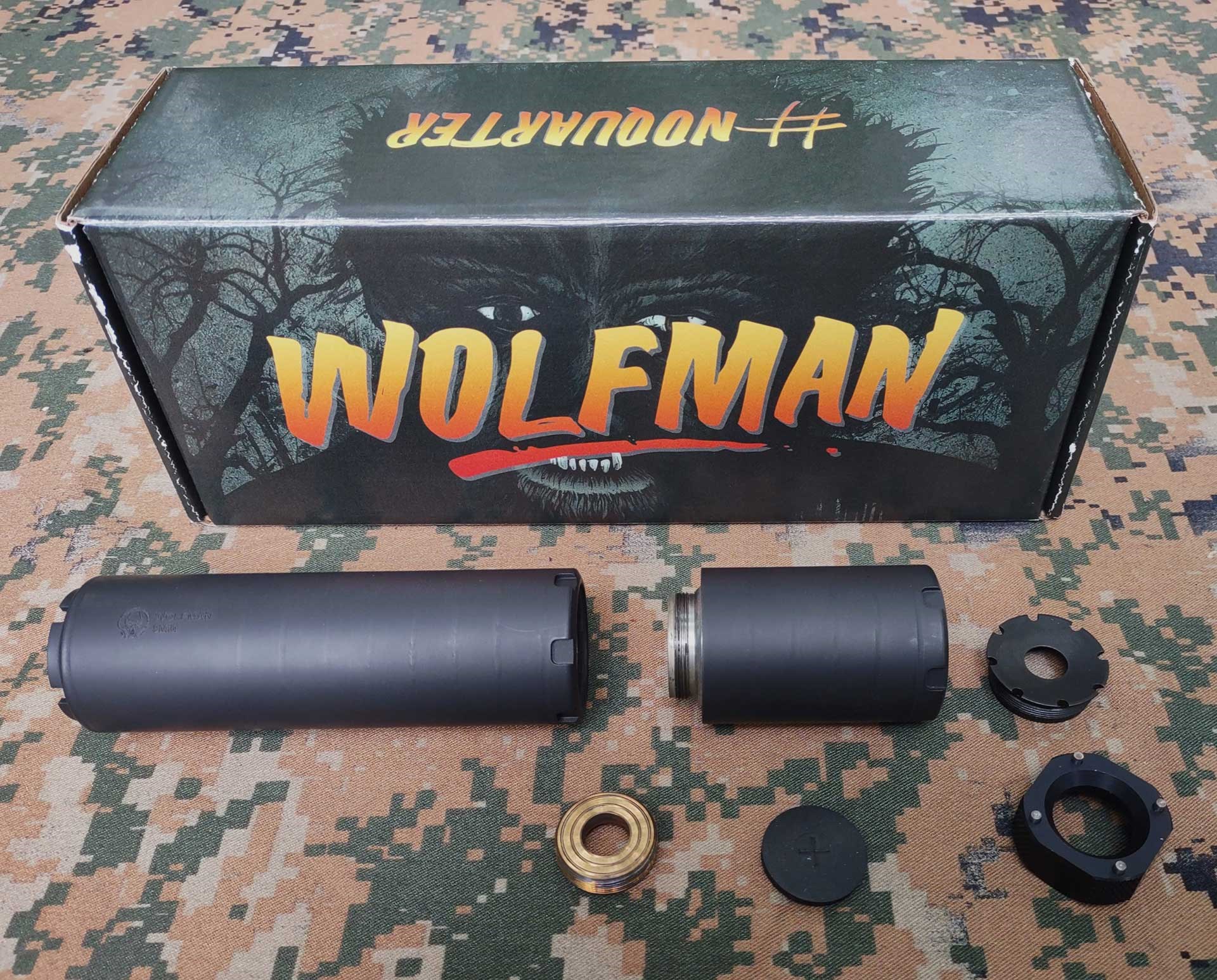
The Wolfman is also rated for subsonic .300 Blackout, 7.62x39 mm and 5.56 NATO rifle rounds. Though some users may prefer a 9 mm can that disassembles for cleaning, it’s only an issue if you use bullets with exposed lead bases where a portion of the vaporized lead will accumulate on the blast baffle. If that’s a concern, shoot loads using lead-free primers and bullets with metal-encapsulated bases like the 147-grain Winchester Winclean TMJ load I used in this test, which is accurate and reasonably priced. You can also use Dead Air’s KeyMicro muzzle brake/suppressor mount, which directs a large portion of the gas onto its porting fins and the walls of the blast chamber where lead deposits are accessible for cleaning.
Suppressors create back pressure that causes a small amount of gas to be vented rearward through the chamber. Shooting the D-Model with the Dead Air Wolfman sound suppressor, a small but noticeable amount of gas escaped towards my face through gaps in the top cover, so be sure to wear wrap-around safety glasses.
Summing Up
The FM-9D is a standout product and one of only a few truly innovative new firearms introduced within the last few years. It’s a costly indulgence, but unlike many new designs from companies that haven’t withstood the test of time, this intriguing piece comes from an experienced gunmaker that literally invented the 9 mm belt-fed AR a decade earlier. The D Model wasn’t rushed to market, and it shows with fairly reliable performance using several brands of economical practice-grade ammo despite its relatively complicated design.
Freedom Ordnance FM-9D Specifications
Manufacturer: Freedom Ordnance; 612 Grace Way, Chandler, IN 47610; 812-297-5141
freedomordnance.com
Action Type: semi-automatic, centerfire rifle
Chambering: 9 mm Luger
Frame: 6061-T6 1aluminum
Barrel: 4150 chrome moly steel; six-groove, 1:10-inch RH twist rifling; 1/2x28 TPI thread muzzle
Magazine: 33-round detachable box, 100-round disintegrating link detachable bag
Furniture: B5 Systems Stock and pistol grip
Sights: None
Trigger: single-action; 5-pound, 6-ounce pull
Unloaded Weight: 9 pounds, excluding ammo bag and magazine
Accessories: Savior American Classic Double Rifle soft case, 33-round factory Glock Mag, 100-round link bag, 150 steel links
MSRP: $4,500 as tested; $3,600 base
Overall Length: 32.75 to 36 inches
Barrel Length: 16.5 inches
Most Popular