Down in Texas, Staccato launched a new pistol to celebrate America's 250th anniversary: the P4X. One can hardly blame them considering that the company's entire product line is based on the 1911, arguably the most American of handguns.
The materials, styles and calibers used in modern 1911s and 2011s may be different from John Moses Browning’s original designs, but their function and spirit remains the same. It’s that extremely seductive single-action trigger pull coupled with the 1911’s inherent accuracy. That’s a dragon people have been chasing for more than a century.
On June 27, 2026, Staccato held a 250th anniversary celebration in its backyard at Staccato Ranch to showcase the new Staccato HD P4X. Afterward, the staff kindly made some accommodations so that I could have some private time with the P4X in order to produce this article.
Introducing The Staccato P4X
Staccato’s new HD P4X is a further product expansion of its HD series line, which consist of 2011-style pistols that feed from Glock-pattern magazines. The HD series also has a few nuanced tweaks in comparison to Staccato’s original double-stack models like the P, XC and XL.
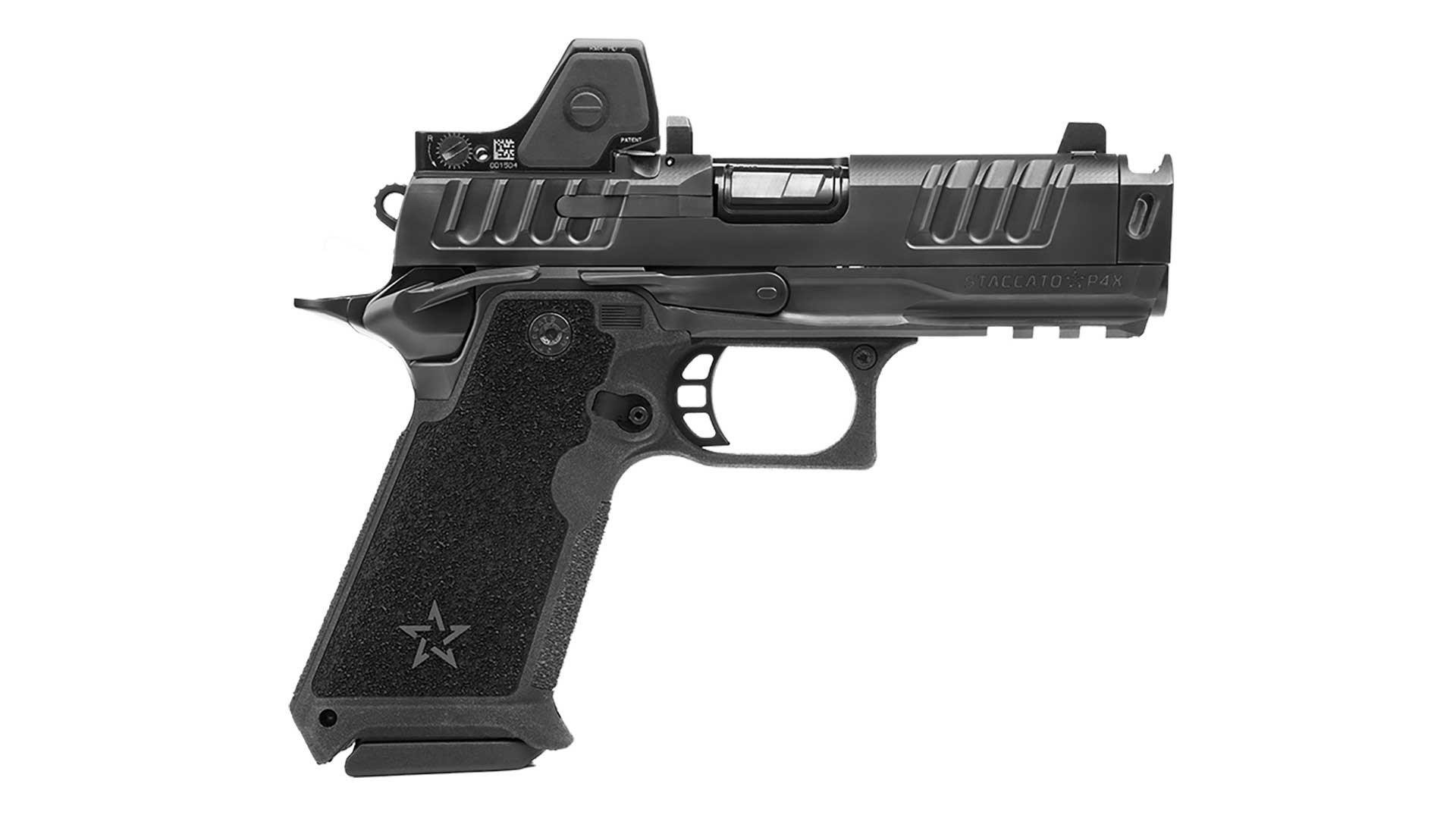
At its core, the new Staccato P4X pistol boils down to a variant of the Staccato HD P4 that wears the same style of combination compensator and front-sight block. Staccato builds P4Xs specifically on 4140 DLC steel frames. Like the HD P4, the P4X maintains the same full-size grip along with that same 4-inch barrel and slide.
Described in simplest terms, the HD P4X is Staccato’s designated “Commander-size double-stack with a compensator.”
Earlier this year, NRA’s Shooting Sports USA published my review of the Staccato HD P4.5. If you haven’t already, I’d encourage you to read (or read it again). A great deal of what I wrote about that gun equally applies to this HD series variant.
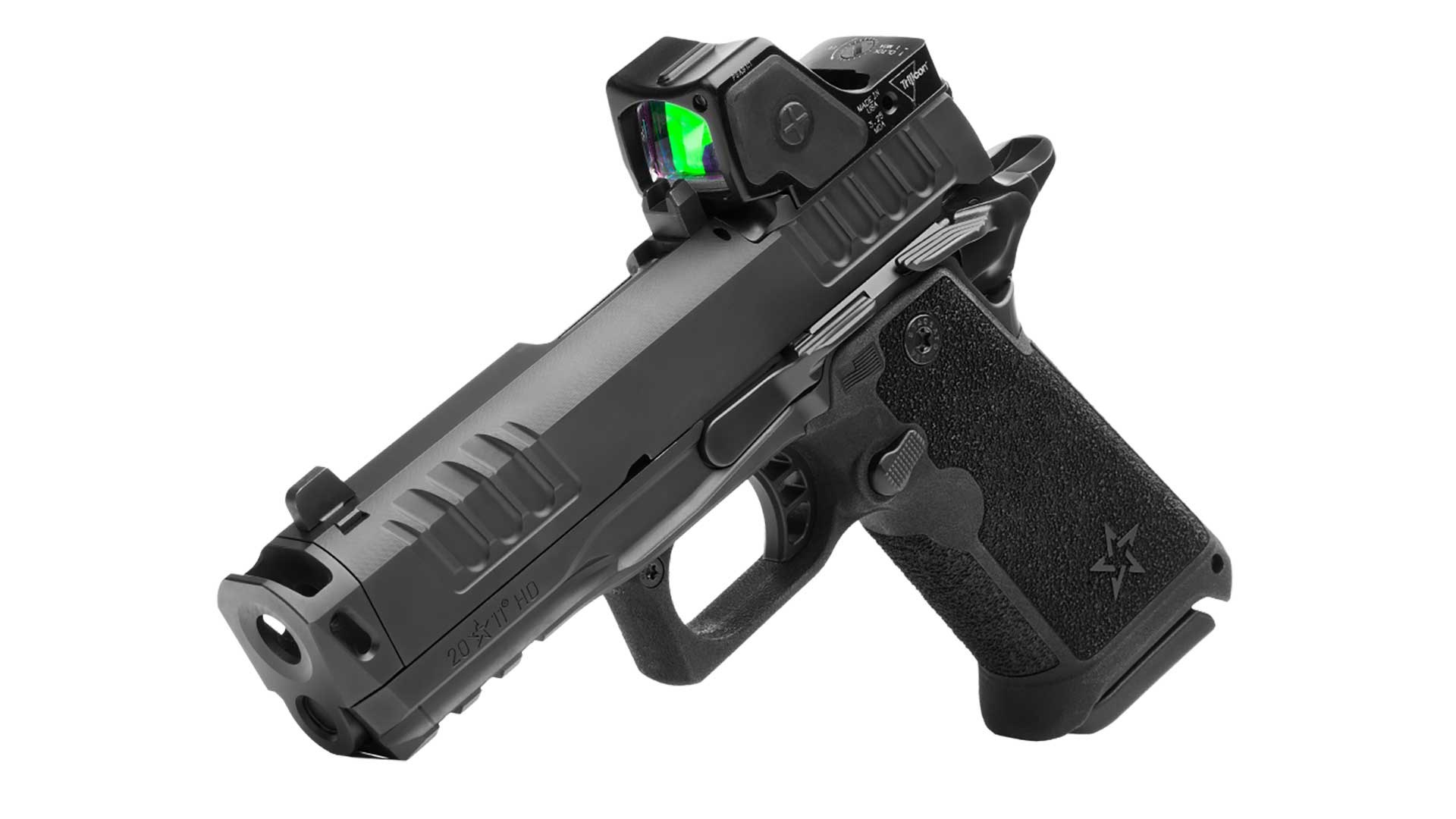
To briefly recap, the HD series provides solutions that address some of the original 2011’s biggest pain points like the traditional double-stack 2011 style magazine. Its ignition system is closer to a “Series 80” configuration for added drop safety benefits in the context of a service pistol. (And it still maintains a fantastic trigger pull).
HD pistols also use an ingenious ambidextrous slide-stop system and a red-dot optics mounting arrangement that Staccato calls the HD HOST system. It’s something I really appreciate on the HD P4.5 I reviewed because it provides plenty of room for the red-dot optic itself while tastefully incorporating the actual rear sight unit in front of the window. Again, if you haven’t already, please read my Staccato HD P4.5 review on Shooting Sports USA, because it really delves into the gist of what the HD series is about.
A Late-Morning Date With The Staccato HD P4X
Once again, I am grateful to Staccato for their hospitality and giving me some private range time with the new gun.
When I pulled up to the ranch that morning, Everest, one of the staff members, kindly took me to Range 2, a pistol bay with a full array of steel targets.
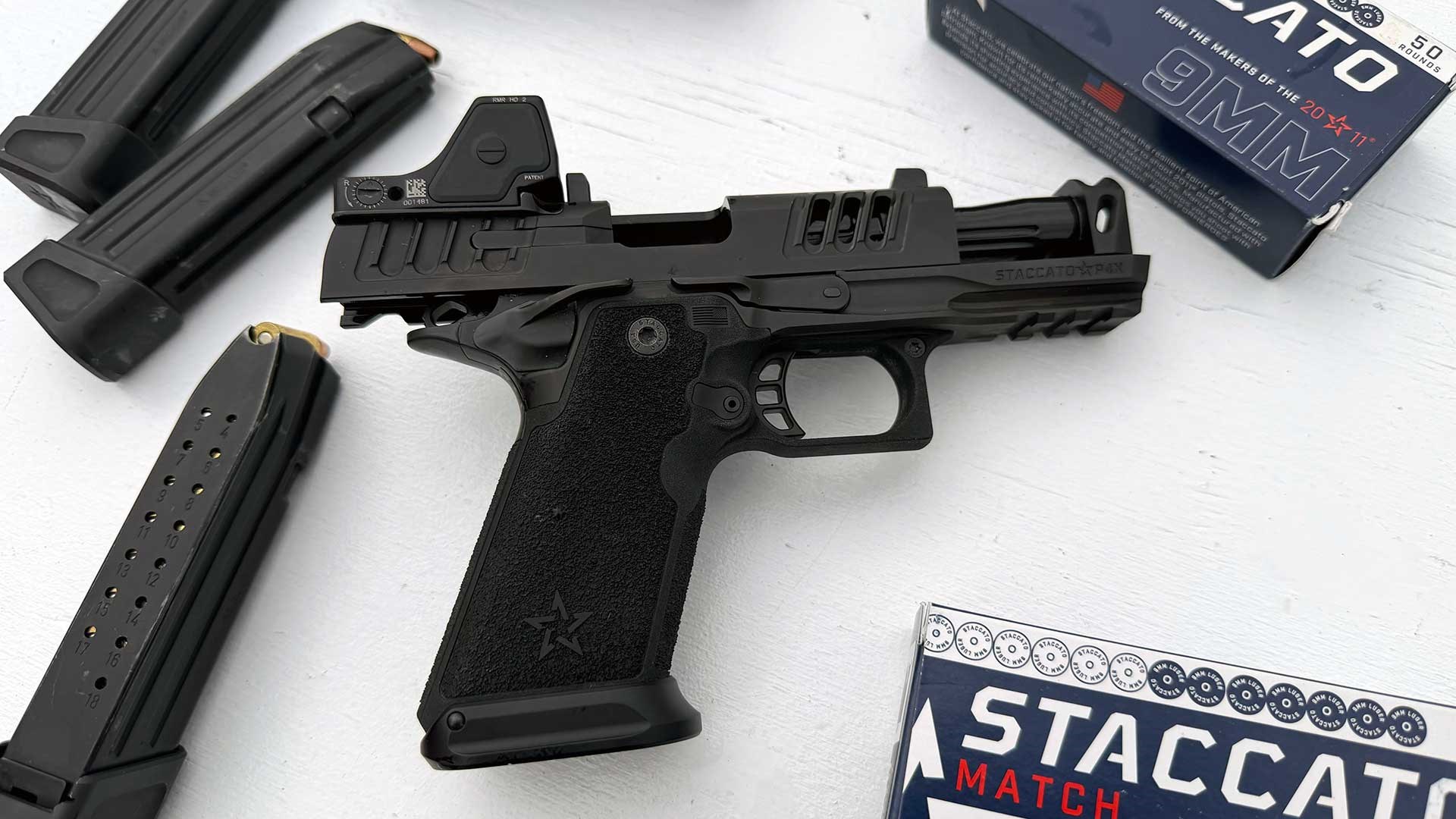
He produced a P4X from the soft Savior case that HD Series ship with, and I laid the gun out on the table to get some pictures.
It didn’t take long for the gun to find its way into my hand in order to get a better feel for it. Being left-handed, I really appreciate that HD series pistols are ambidextrous by default. The safeties on these guns feel very crisp when flicked from safe to off-safe. Everest pointed out that the current batch of HD pistols come with safety levers that are even more “blended” than early-production HD pistols in order to avoid disturbing shooters’ hands or fingers.
Another aspect I’ve come to admire about the HD series is the practical texturing on the polymer grip module. Specifically, I like how it interacts with the skin of the palm without being overly aggressive.
The test gun that Everest brought out for me to shoot had a Trijicon RMR HD mounted to its slide. If I hadn’t already mentioned it, the slides on HD series pistols were designed from the ground up with red-dot shooting in mind. It’s a trend I’m seeing more frequently in contemporary handgun design, where slides are shaped to deliberately accommodate the optic instead of treating the red-dot access like an afterthought.
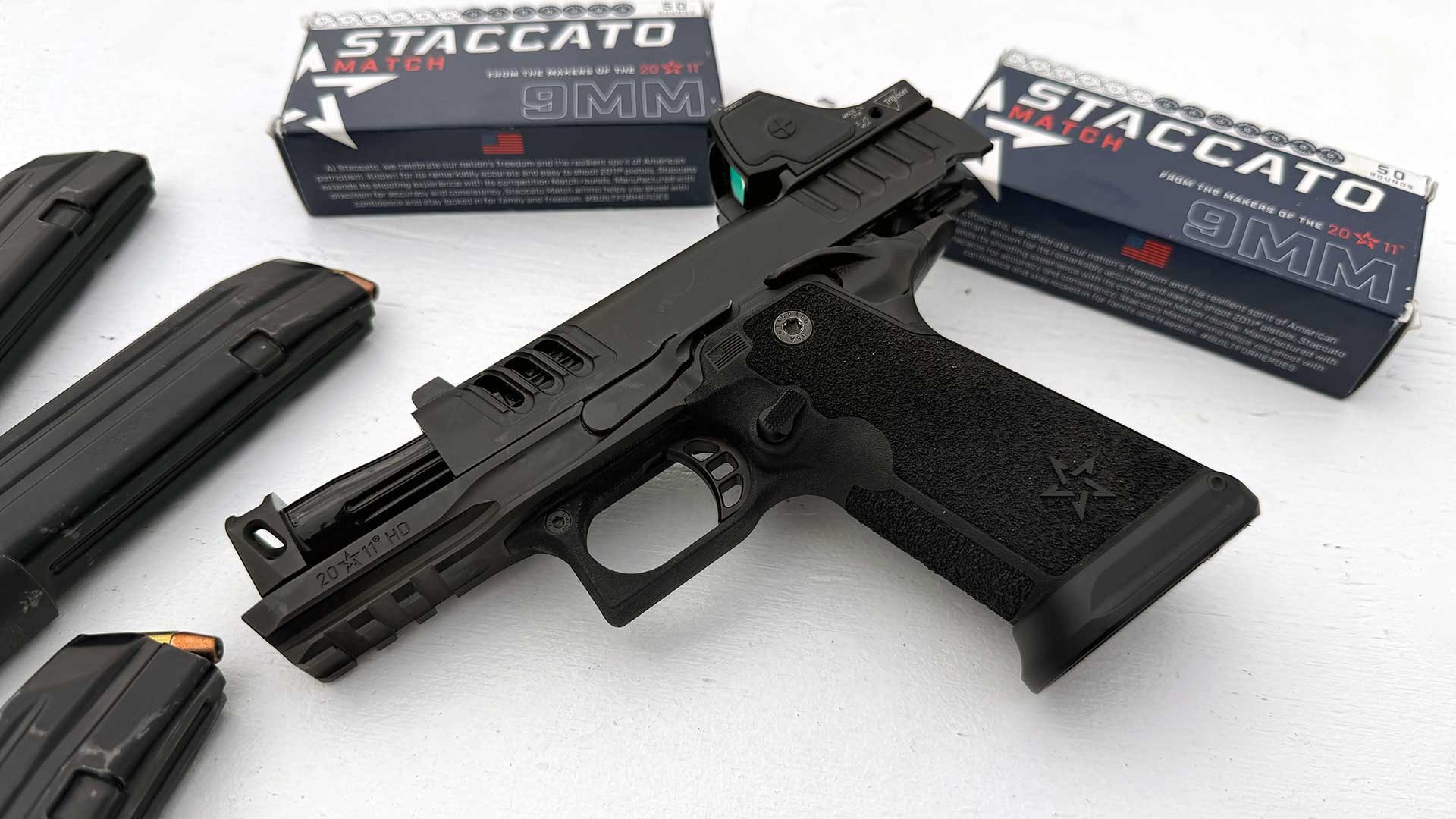
Everest also had 200 rounds of Staccato’s 136-gr JHP Match ammo for me. I’m familiar with these as I’ve grouped for accuracy both in my HD P4.5 review and CZ P10C Ported review.
Burning It Down
Since I wasn’t set up to bench the pistol for neat little groups on this occasion, I did what came naturally instead and just let the P4X rip.
As expected, this gun is built with a nice-shooting trigger. It’s a 1911-style firearm, after all. In fact, I must admit that these triggers can feel so nice that they can be easy to take for granted sometimes–just like air conditioning.
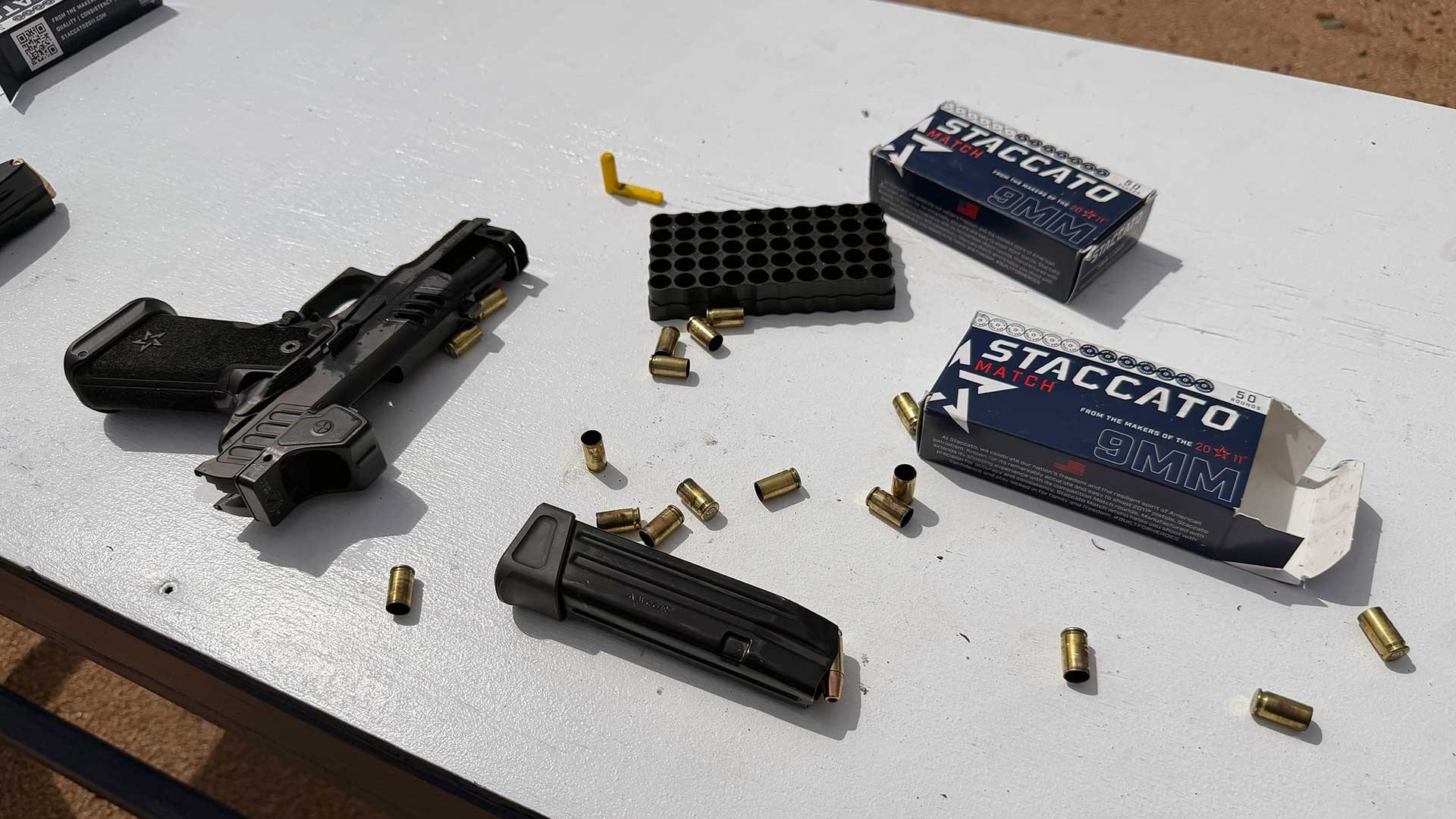
Those 200 rounds went by in a blur, and the gun got very hot. Locked and loaded, first I shot the plate rack, then I transitioned between the USPSA-sized steel array, shooting pairs in a spirited manner as one would in an action-pistol match.
Towards the end, I shook things out by shooting informal Bill Drills with the last box of ammo Everest had brought out for this shooting session.
Compensator aside, the shorter slide does reciprocate in a more aggressive manner. It’s just par for the course, and I can see why Staccato’s engineers used a steel frame on this build. The ballast of the frame helps stabilize the gun.
Watching The Dot Dance
Conveying the experience of shooting through text alone can be challenging, especially when the shooter is so locked-in and focused downrange.
On a high-performance gun like the Staccato P4X, the best way to get a feel for it is to observe the way the red dot moves under fire. In this case, the dot moved evenly in concert with the slide and compensator. The slide returns to zero easily. And like a race car, the harder you push the pistol, the more it will respond.
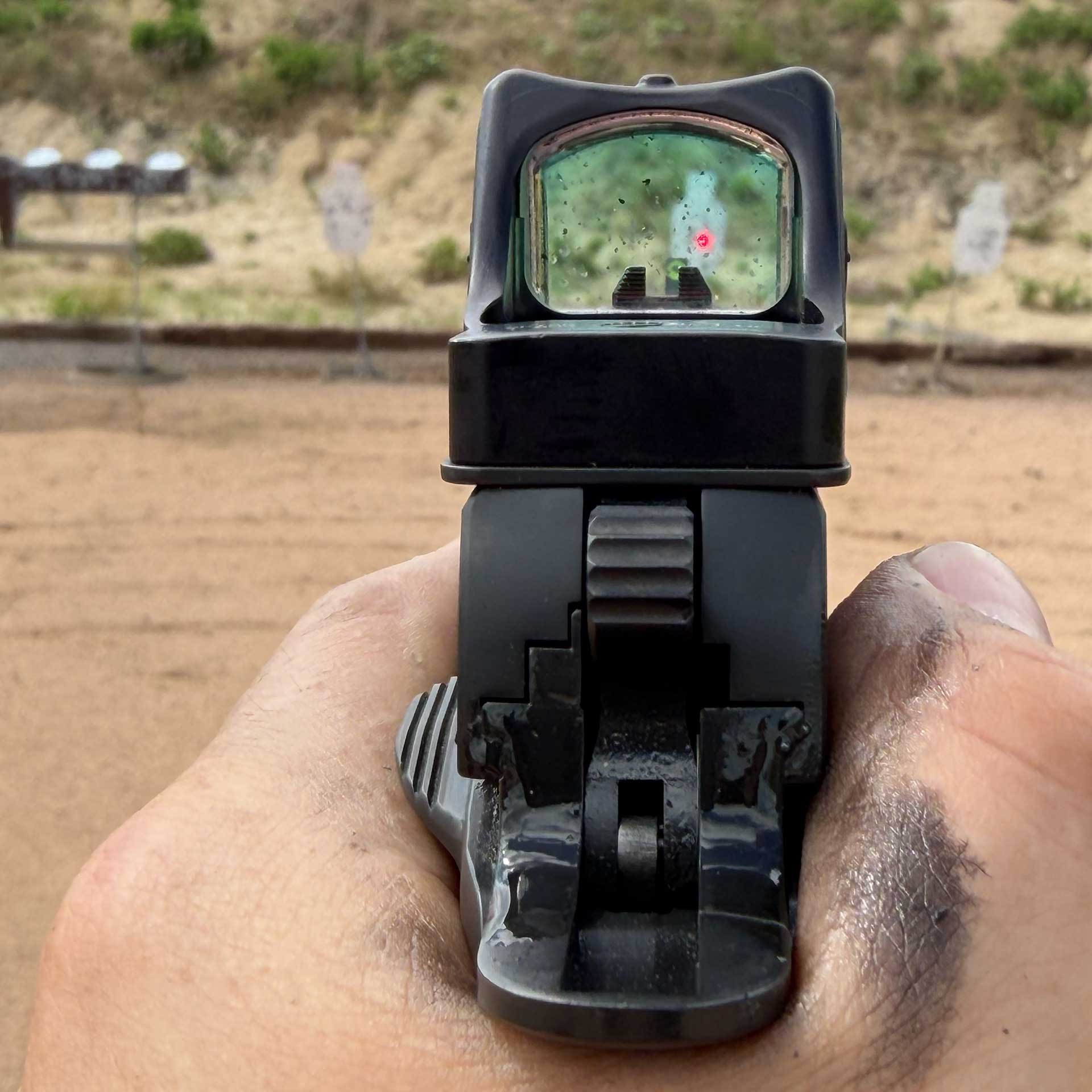
And maybe it’s cliché to use a race-car analogy to describe shooting a double-stack 1911, but this gun does have a sporty feel to it. Just as race cars or sports bikes are very responsive to the driver’s input, the Staccato P4X is also to the shooter’s inputs. But like a high-performance machine, this gun does its job and also stays out of the way. That’s why it’s easy to forget about the trigger; it’s not there being creepy. And that shorter slide moves quickly.
To further continue the race car analogy:
For best results, a handgun like the Staccato HD P4X also requires an assertive driver. When shooting pairs at some of the steel targets or trying to burn down some Bill Drills, there were a few times I missed. The culprit was not fully tensioning the grip with my support hand. This pistol does everything you ask of it, but taking it to the cutting edge requires your full presence of mind.
The Takeaway
Compensated pistols with mounted red-dot optics are a sign of the times. I’ve only been writing about firearms professionally for a short while, but the industry is at a point where all major gun companies are offering such pistols, regardless of ignition systems.
In the case of 2011s and double-stack 1911s, some may thumb their noses at them, dismiss them as “cheater guns,” et cetera. I’ll admit to having a somewhat contrarian streak against them, especially after they became trendy (thanks in part to Staccato’s revamping of the old STI brand no less). However, I cannot and will not deny that these guns offer an incredible level of performance.
Contrarian or not, the fact of the matter is that 2011-style pistols can be shot at a very high level in the correct hands.
The new Staccato HD P4X embodies these qualities. Even though this isn't an in-depth review, I can at least testify that the gun is able to handle intense, short bursts of shots without a hiccup. My first impression of the newest member of the Staccato 2011 HD family is quite strong. All in, I don’t think it took me more than 30 minutes to flatten all those bullets against the steel on Staccato Ranch’s Range 2.
Special thanks to Staccato 2011 and Staccato Ranch for having me as a guest.
Staccato HD P4X 2011 Specifications
- Manufacturer: Staccato 2011
- Action Type: single-action semi-automatic
- Caliber: 9 mm
- Capacity: 18 +1
- Frame: Steel
- Grip Module: Polymer
- Slide: Steel
- Barrel Length: 4 inches
- Compensator: Multi-Port Staccato HD Compensator
- Sights: Fixed rear sight, fixed Trijicon front sight with green tritium insert
- Trigger Pull Weight: Approximately 2 lbs, 4 oz
- Length: 7.6 inches
- Width: 1.2 inches
- Height: 5.6 inches
- Weight: 5 ounces
- Accessories: 2 magazines, large soft-sided zippered carrying case and documentation
- MSRP: $3,599
Most Popular