The world was introduced to the idea of a Scout Rifle by Jeff Cooper in 1984. The appeal of Cooper’s idea was a lightweight rifle suitable for answering most any practical question one might ask of such a tool. Thus began the enigma the Scout Rifle remains to this day, making it one of the most misunderstood firearm systems ever imagined. We have never actually seen a factory rifle meeting all of Cooper’s Scout Rifle specifications, but there have been a lot of designs called “Scout Rifles” that fulfilled the same general-purpose niche. Franchi’s new MULE falls into this category.
In 2018, Franchi introduced its Momentum rifle and followed that up the next year with the Elite version. Then, in 2023, Franchi added what I called the “MATE,”—Momentum All-Terrain Elite—to the Momentum rifle lineup. This is a Scout-like utility-style rifle that is very user-friendly. New for 2026 is the Momentum Utility Lite Elite (MULE) rifle, which is a slightly refined and more compact version of the MATE that utilizes the same Momentum action and features a shorter, 16-inch barrel.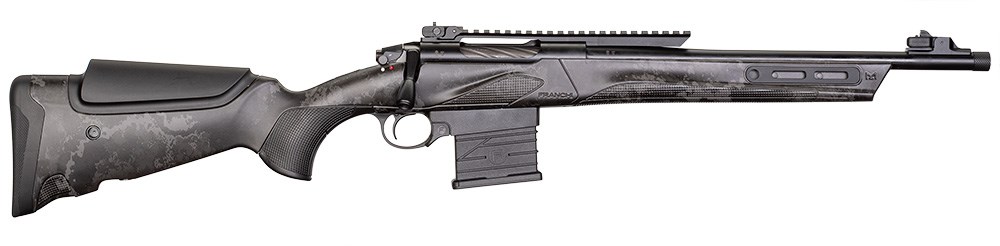
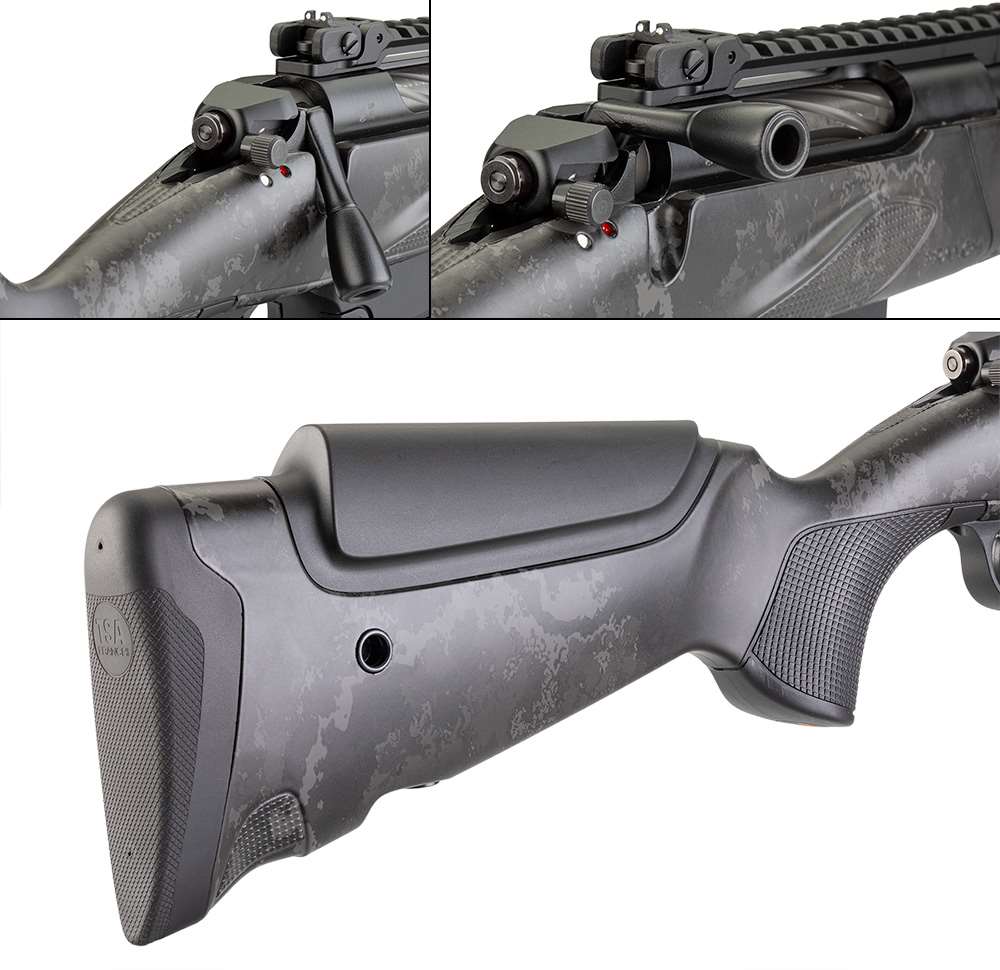
The MULE’s Momentum action is a cock-on-opening design with a fluted three-lug bolt, a plunger ejector, a 90-degree extractor and a short, 60-degree throw. The bolt handle is a bit oversize in length, as the bolt also is in diameter, and it does not require excessive force to lift/cock the action. The rifle’s user-adjustable trigger is a single-stage unit that has somewhat of a mushy feel, but it broke smoothly and consistently at 3.25 pounds. Just above the trigger on the right side of the action is a two-position safety, which does not lock the bolt when in the “safe” position. The bolt release is a toggle-type lever located on the opposing side of the action, and the rifle is offered only in a right-handed configuration.
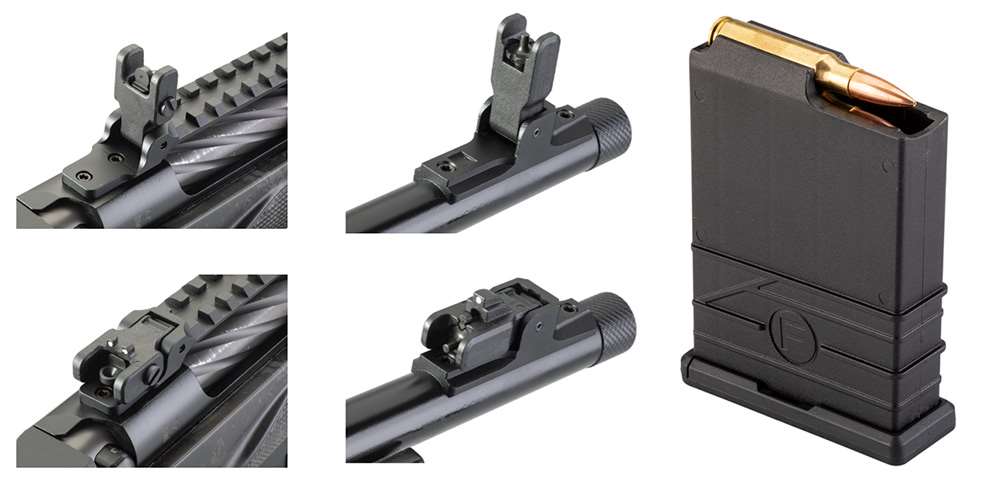
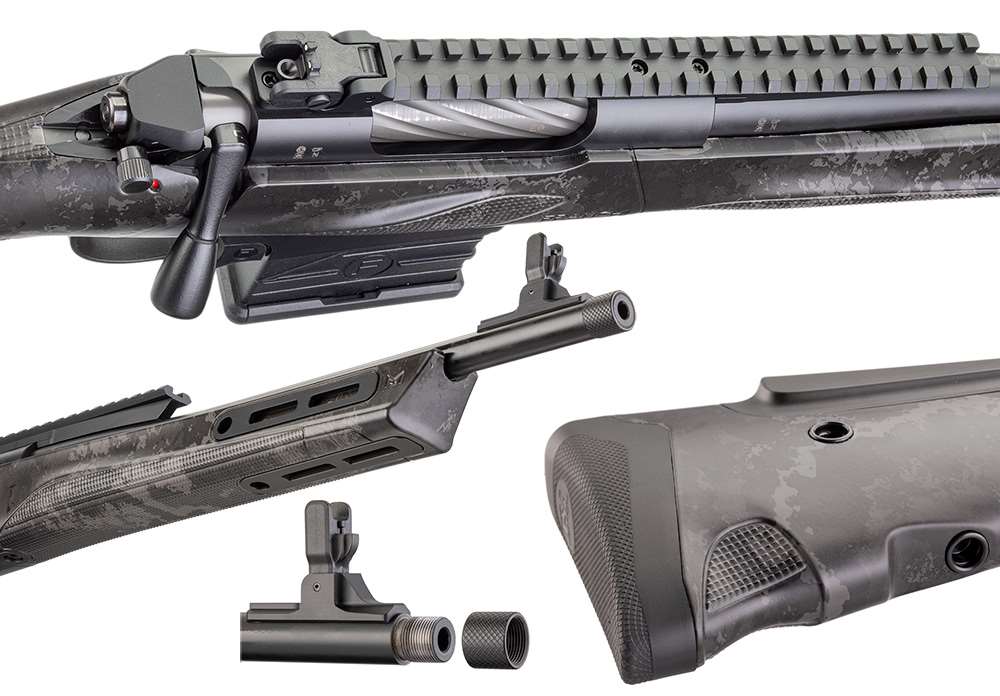
The most interesting aspect of the MULE is its sighting arrangement. The carbine comes with a 21-slot Picatinny rail already installed. This rail runs from the rear of the action out to 4 inches beyond the front of the action. However, this is a cantilever scope rail—it extends over the barrel but is not attached to the barrel—and is what many would describe as a “Scout” rail. It is held in place by four screws located in the conventional scope-mounting locations, and it facilitates the attachment of a traditional riflescope, a scout scope or a red-dot/reflex-style optical sight. What sets this rail apart from other Scout-like rails is its integral rear sight.
The rear sight can be folded up or down. When down, it has a non-adjustable notch sight with two white dots that pair with the front sight, which also folds up and down. When the front sight is down, there’s a corresponding post with a white dot to mate with the rear notch. When the rear and front sights are raised, you then have a windage-adjustable peep sight in the rear and an elevation-adjustable post in the front, resembling the battle/back-up sights commonly found on AR-15-style rifles. In totality, this is the most versatile sighting system offered on any modern rifle.
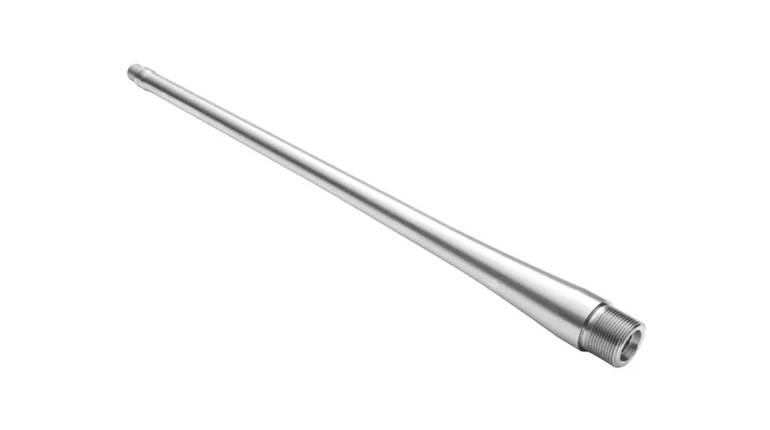
The MULE is fitted with a cold-hammer-forged, chrome-molybdenum, 16-inch barrel. The barrel comes with a muzzle that’s threaded 5/8x24 tpi, and a protective cap is included. At the muzzle, the barrel diameter is .70 inch, and the barrel is freefloated from the front of the action all the way to the end of the stock’s fore-end. The polymer stock is almost as unique as the sighting system on this carbine.
A Veil Tac-Black finish adds a neat look to the stock and, at the butt, it is capped off with a TSA recoil pad. Just forward of the toe, there is a small, molded-in checkered section to aid with grip and elevation adjustment with the support hand when shooting from a bench or when shooting prone from a bipod. On the butt of the stock are three QD sling-swivel-attachment points, and there is a raised comb with negative drop. On the fore-end, there are also three more QD attachments integral to three M-Lok rails on the sides and bottom. The fore-end is wide and has molded-in checkering.
The MULE uses a center-feed, detachable, AICS-pattern box magazine held in place by a polymer magazine well integral to the trigger guard/floor plate. Between the trigger and the magazine well, there is an oversize, ambidextrous lever/pad, and when it is pushed forward, it releases the lock on the magazine. Empty, the magazine will not drop free, but is easily removed.
Using a Leupold 1-6x24 mm Patrol 6HD riflescope mounted in Leupold QRW rings and a Banish Backcountry suppressor, from the benchrest at 100 yards, I found the MULE was a bit finicky when it came to which loads it liked. Based on the rifle testing I’ve conducted over more than a quarter-century, this is common for rifles in what I consider the standard price point, which is now between $1,000 and $2,000. Two of the five loads averaged less than an inch, and the rifle really shone when shooting from field positions.
Without a suppressor, the rifle balances almost perfectly right at the front action screw. This offers a good equilibrium of handiness and shootability. This balance held true with a conventional riflescope and a reflex sight. With a scout scope, the MULE was—as is common with scout scope-equipped rifles—a tad muzzle-heavy. Some of the field shooting was conducted with the open sights, but most was done with a Burris 2-7x32 mm Scout scope. I alternated the shooting from prone, sitting, kneeling and standing, with and without various Spartan Precision shooting supports using that company’s MagnaSwitch M-Lok adapter, which connected to the bottom M-Lok on the MULE’s fore-end.
Plainly put, if you cannot utilize the MULE and one or more of its various sight-system options—with or without shooting supports—to repeatedly score kill-zone hits out to around 300 yards, you need to go back to shooting school. During testing, no stoppages or failures were experienced.
Overall, there was more that I liked about the MULE than disliked, so let’s start with the negatives. Field-ready with an optical sight, sling and a fully loaded magazine, the MULE is on the heavy side, exceeding 8 pounds. To me, the rifle is moderately ugly, with a bit of a futuristic appearance, and though the trigger was good, I was not a fan of its mushiness. Additionally, because of the folding rear sight and the fact that the rearward-most rail slot was located a bit forward over the ejection port, the selection and mounting of a traditional riflescope requires some measuring and special attention.
On the plus side, the MULE’s versatility with regard to sighting options is unparalleled. You could have a traditional rifle scope, a scout scope and a reflex sight—all in QD mounts—offering you perfect optical-sight options based on application. And, in the event of optical sight failure, you have two options regarding open sights. (The notch and post sights are not adjustable and printed high and left at 50 yards, making them better as a close-quarters option. The AR-15-style sights, however, were easily zeroed and eminently usable at all sensible ranges.) As for the stock, you can utilize the sling-mounting options to customize user interface with a shooting sling, and you can use the M-Lok rails to facilitate the mounting of a light and/or a bipod/tripod. I also liked the non-drop-free magazine, which is a nice touch for a rifle designed with a general-purpose intent.
Cooper’s most recent (and final) Scout Rifle definition stated, “The most important thing about the Scout is that it is a general-purpose rifle. Its most outstanding characteristic is handiness. It’s light, compact and friendly. It will put ’em where you point ’em from arm’s length out to a range too great for any sensible attempt. The essential characteristics of a Scout Rifle are compactness and what may be called shootability.” Except for weight, all those things could be said about the MULE, which is a bolt-action rifle very smartly configured for combined use as a hunting, survival or self-defense longarm.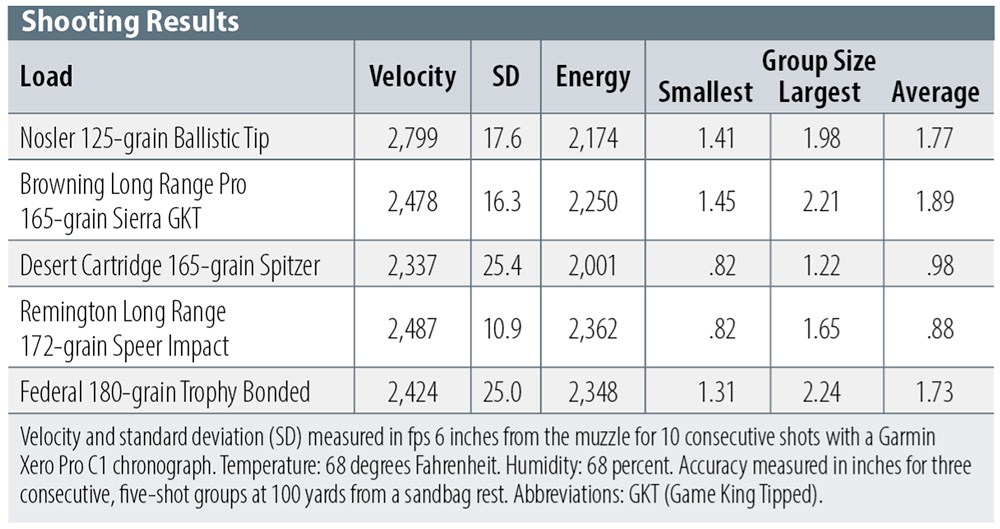
Additionally, a rifle’s name is important— a rifle named “Ralph” would likely not sell very well. As for the Franchi Momentum Utility Lite Elite (MULE), the need for an acronym is obvious, and given its practical general utility, MULE seems perfect. It may be the most aptly named rifle we’ve seen in a long time. I’d not be surprised if “mule rifle” takes on a life of its own to describe similarly configured carbines embodying the spirit of the Scout Rifle.
Ironically, Cooper felt the general-purpose Scout Rifle was the antitheses of the specialized rifle, but then saddled his concept with a highly specialized definition nearly impossible to meet, at least not without a lot of cash. Regardless, just like the equine for which it is named, if your rifle shooting needs are of a general-purpose/utility nature, they should be very well fulfilled with the Franchi MULE. In the world of modern, factory-made, bolt-action rifles, it belongs in a multi-purpose category inhabited by few others.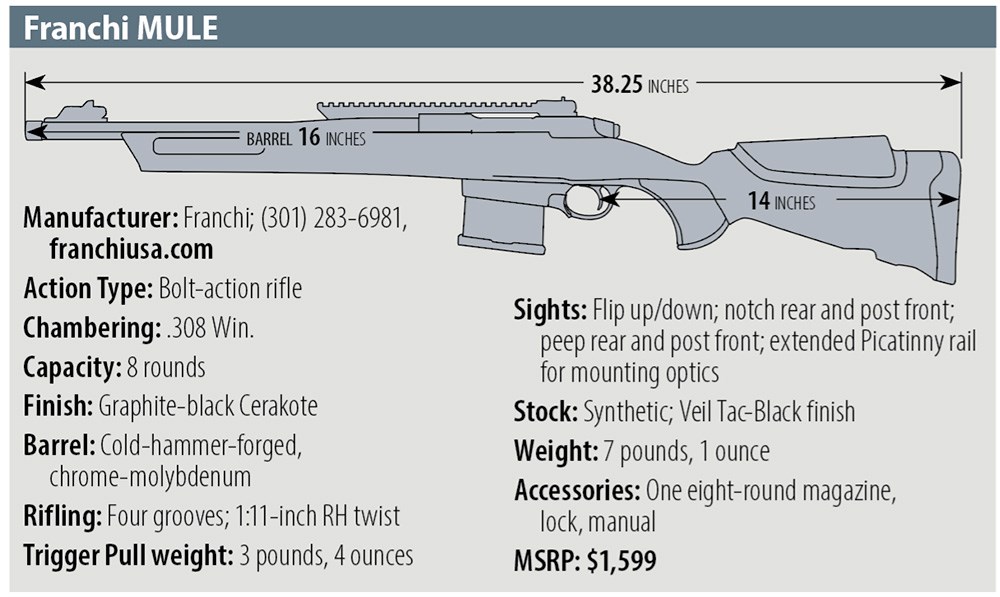
Most Popular